


Bangladesh at crossroads

Bangladesh is living through a familiar national story in a new global setting. The country has repeatedly turned constraint into momentum, from scaling garment exports to building mass-market digital finance. Now it faces a different kind of test: a world being reshaped not just by faster machines, but by systems that can generate text, images, code, predictions and decisions at near-zero marginal cost. Artificial Intelligence (AI), particularly the recent surge in generative AI, is becoming a general-purpose technology that seeps into every industry rather than sitting neatly inside one.
That matters because the timeline is compressing. Employers globally are not planning for AI “one day”. They are reorganising around it. The World Economic Forum’s Future of Jobs Report 2025 found 86% of surveyed employers expect advances in AI and information processing to transform their business by 2030, while employers estimate that 39% of workers’ existing skills will be transformed or become outdated between 2025 and 2030. This is the context in which Bangladeshi youth, startups and established industries must compete: a labour market that is changing by design, not by accident.
 For all latest news, follow The Daily Star's Google News channel.
 For Bangladesh, the stakes are high because its current strengths sit alongside deep vulnerabilities. It has a young population and a vast base of mobile-first users. It also has an economy where large numbers of people depend on sectors with tight margins and limited safety nets. If AI becomes a productivity multiplier in rich economies and supply chains, then competitiveness will increasingly depend on data, skills, trust and infrastructure. Countries that cannot provide these will still participate in the global economy, but often from the lowest-value rungs.
A connected economy that can still be switched off
Bangladesh’s digital economy looks robust in headline numbers. The Bangladesh Telecommunication Regulatory Commission (BTRC) reported 129.89 million internet subscriptions at the end of November 2025, including 115.27 million mobile internet subscriptions. Those figures help explain why digital services now underpin daily life, from education and shopping to banking and work.
Yet the last two years have shown how fragile connectivity can be, and how quickly a network issue becomes an economic issue. During the nationwide internet shutdown in July 2024, Reuters described businesses disrupted across sectors and highlighted the particular shock to freelancers and small exporters who depend on uninterrupted internet access. The same Reuters report, also carried by Context, noted Bangladesh’s large online workforce, describing 650,000 freelancers and an IT-related sector contributing about $1bn to the economy.

That episode is worth revisiting because it captures a central tension. Bangladesh wants to be a competitive digital economy, but competitiveness rests on continuity. It is hard to persuade global clients to place high-value work in a country where the fundamentals of connectivity are perceived as uncertain. It is also hard for local firms to build secure, always-on services if the rules and reliability of the underlying infrastructure are in question.
This is one reason satellite internet has become politically salient. In March 2025, Reuters reported Bangladesh’s interim leader, Muhammad Yunus, said the country expected to finalise a commercial agreement with SpaceX’s Starlink within months, framing it as a route to more reliable nationwide access that cannot be disrupted by political interference. Starlink began operations in Bangladesh on 20 May 2025, Reuters reported, with a monthly price of BDT 4,200 and a one-time setup cost of BDT 47,000, making it a premium option rather than a mass-market replacement for mobile broadband.
The point is not that satellite internet will solve everything. The point is that resilience is becoming an economic asset. In an AI-driven world, the countries that win investment are those that can promise stability for data, uptime for networks, and clarity for compliance.
The data economy is expanding, but trust is the limiting factor
Bangladesh’s mobile financial services have expanded rapidly and moved beyond basic transfers into a broader payments ecosystem. Bangladesh Bank data cited by the Financial Express put the number of mobile financial services accounts at 146.46 million as of August 2025, with large rural participation.
This scale creates opportunity. AI can improve fraud detection, automate customer service, strengthen risk controls and help small businesses access credit. But it also expands the surface area for harm, from identity theft and scams to biased automated decisions. When AI models learn from messy real-world data, they can reproduce inequalities that already exist. When data is shared or reused without clear consent, trust erodes quickly. A country that wants to attract global partnerships in fintech, health tech and logistics must be able to answer basic questions from investors and customers: who owns data, who can access it, how long it is retained, and what happens when something goes wrong.
Bangladesh has begun to build a legal framework for this, but it remains contested. In October 2025, The Daily Star reported that the interim government approved drafts of the Personal Data Protection Ordinance (PDPO) 2025 and the National Data Governance Ordinance 2025, including a principle that individuals are owners of their personal data. Government news agency BSS similarly reported the approval, framing the measures as aimed at privacy, security and ownership. The Bangladesh Government Press listed the PDPO in its extraordinary gazette archive in November 2025, indicating formal publication steps.
But the public debate has been sharp. Article 19 warned in May 2025 that, without strong safeguards aligned with international human rights standards, Bangladesh’s draft data protection approach risked enabling surveillance and repression. Human Rights Watch, in a joint statement on emerging digital laws, argued that broad exemptions for law enforcement and intelligence agencies could undermine core principles such as consent and purpose limitation. Transparency International Bangladesh criticised the pace and structure of the ordinances, warning about the absence of an independent data protection authority and raising concerns about governance concepts it said were inconsistent with global practice.
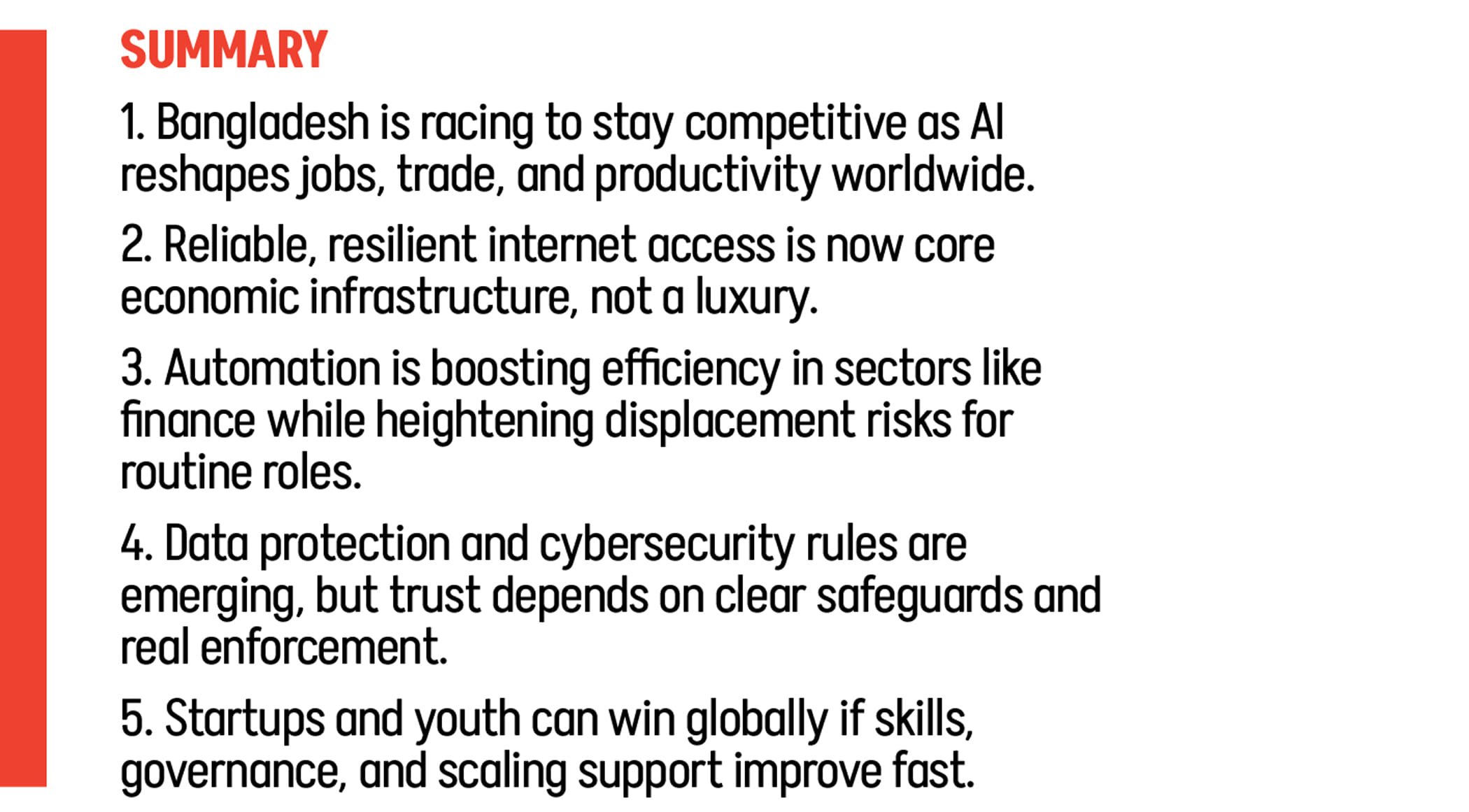
For a supplement focused on Bangladesh’s place in the future world, this is not a niche legal argument. It is about competitiveness. Global companies and partners increasingly treat privacy and security as part of market access. A startup trying to sell to overseas clients, or a bank integrating new AI tools, will face questions about compliance and safeguards. Clear, rights-respecting laws can be an advantage that signals maturity. Unclear, overly broad or weakly governed frameworks can become a barrier.
Cybersecurity law is evolving in parallel. In May 2025, Prothom Alo reported the interim government approved a Cyber Security Ordinance that included recognition of internet access as a civic right, with the gazette to follow. Bdnews24 also reported that the draft ordinance recognised internet access as a citizen’s right and repealed sections of the earlier law that had drawn criticism. Bangladesh’s laws portal lists the Cyber Security Ordinance 2025 as enacted on 21 May 2025. The long-run impact will depend on implementation, oversight and how the law is used in practice, but the direction signals that digital rights and digital security are now part of the same national conversation.
Startups can move faster than institutions, but scaling is still the hard part
Bangladesh’s startup ecosystem has matured enough to produce regional ambition, not only local services. The standout example in 2025 was the strategic merger between Bangladesh’s ShopUp and Saudi Arabia-based Sary, backed by a $110m funding round and forming SILQ Group, as reported by The Daily Star. LightCastle Partners, in its H1 2025 startup investment report, said Bangladesh’s startup funding reached $119.9m in the first half of the year, with the surge “almost entirely” driven by the ShopUp and Sary transaction.
This illustrates both promise and limitation. Bangladesh can produce companies capable of cross-border scale and complex deals. At the same time, the ecosystem remains sensitive to a few headline transactions, while many early-stage firms struggle with predictable problems: limited growth capital, a small domestic market for high-value software, and regulatory uncertainty.
AI changes the startup equation in a particularly sharp way. On one side, generative tools reduce the cost of building. Small teams can prototype, test and iterate faster than ever, sometimes producing in weeks what used to take months. On the other side, AI raises the bar for credibility. Customers now ask whether a product is secure, whether data is handled safely, whether models can be audited, and whether outcomes are fair. In sectors like finance, healthcare and education, a single failure can destroy trust.
The implication is that Bangladesh’s next wave of startups will need to compete on governance as well as innovation. That does not mean copying foreign regulation. It means building practical assurance: strong cybersecurity practices, transparent data handling, and clear accountability when automated systems make mistakes.
Beyond software: why frontier industries are back on the agenda
One reason AI is unsettling is that it changes where value sits. If routine coding and basic digital tasks become cheaper globally, the competitive advantage shifts to those who can combine AI with domain expertise, proprietary data, strong institutions and industrial capacity. For Bangladesh, that points to an uncomfortable but necessary conversation about diversification beyond garments and basic IT services.
The renewed global interest in semiconductors and electronics supply chains has reached Bangladesh’s policy circles. In July 2025, The Daily Star reported that a national semiconductor taskforce recommended creating a dedicated “semiconductor fund” under the ICT Division or Bangladesh Bank to support ventures in design and testing through financing. Bangladesh’s investment authorities have also published material on the taskforce and its priorities, including skills development and global linkages.
Semiconductors are not a quick win. They require long timelines, deep skills, and strong intellectual property protections. But they represent a broader strategic point. Bangladesh’s future role in the global economy will be stronger if it can move into industries where value is created through knowledge, standards and trust, not only through scale and low costs. AI can help accelerate learning and productivity in these fields, but only if the ecosystem supports it.
The crossroads is a choice about people, not only technology
Bangladesh has a familiar advantage: a large, ambitious youth cohort and a history of adapting under pressure. The risk is that the next phase of technological transformation amplifies inequality. If high-skilled workers and a small number of firms capture the gains while millions of workers face displacement, insecurity and lower bargaining power, the social and political consequences will be severe. If rules around data and cybersecurity become tools for control rather than trust, the country will struggle to attract the partnerships and investment needed for higher-value growth.
The practical path forward is not a single grand project. It is a set of aligned decisions. Resilient connectivity must be treated as economic infrastructure. Industrial upgrading must include credible retraining pathways for displaced workers. Data protection and cybersecurity must be strong enough to build trust, and restrained enough to protect rights and encourage innovation. Education and training must be designed for a labour market where skills decay faster than before, and where learning becomes a career-long expectation rather than a youth-only phase.
Bangladesh is already participating in the new world. The question is whether it will participate mainly as a source of low-cost labour in a more automated global economy, or whether it will build the institutions, safeguards and skills that allow it to climb into higher-value roles. At the tech crossroads, keeping pace is not about chasing every new tool. It is about building the foundations that make transformation work for the many, not only the few.
Md Nazmul Hossain is a seasoned public relations professional with a strong foundation in journalism.
Comments