


The talk shows that never happened
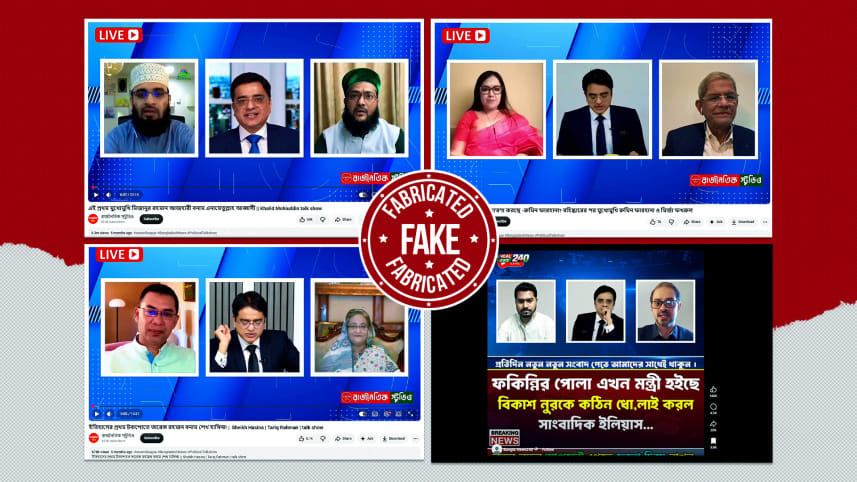
Imagine scrolling through your YouTube feed and encountering a split-screen video titled: “Sheikh Hasina vs Dr Shafiqur Rahman face-to-face in Khaled Muhiuddin’s talk show.”
The thumbnail carries the familiar visual style of Khaled Muhiuddin’s popular programme, placing two of the country’s politically polarising figures in what appears to be a live studio confrontation. Intrigued by the prospect of a rare and explosive exchange, you click.
 For all latest news, follow The Daily Star's Google News channel.
 You are not alone. More than 352,000 viewers watched this video, with thousands turning to the comment section to debate what seemed to be a direct verbal clash.
Similar content is widespread on social media, although none of the “talk shows” ever took place.
In nearly 200 such content analysed, separate archival clips have been selectively edited and stitched together to create the illusion of a live, face-to-face debate. The videos use the visual identity of trusted talk shows and journalists, presenting fabricated interactions as authentic television debate.
These examples point to a growing pattern across Bangladesh’s social media. The production and circulation of these fabricated videos rely on basic editing techniques, often called “cheapfake,” to mislead the audience.
These fake talk shows exploit sensitive contemporary political issues, combining archival footage, past speeches, and media appearances by religious scholars, political leaders, and journalists to simulate live debates that never occurred.
Through a targeted keyword search, The Daily Star identified several social media pages and YouTube channels propagating this type of content. Of them, we selected one YouTube channel and a Facebook page for in-depth analysis. Platforms that generated at least 50 fabricated talk-shows each were considered for this analysis.
Over the last few months, these two platforms produced at least 173 such videos.
YouTube channel *Rajnoitik Studio (রাজনৈতিক স্টুডিও)* is one of them. Launched in late 2025, the channel has accumulated nearly 70,000 subscribers. It presents itself as a conventional political talk show and news platform, using split-screen formats, studio-style backdrops, and broadcast graphics to mimic the appearance of real-time television programmes.
An analysis of the channel’s content shows that it has published at least 110 fabricated videos [1, 2, 3, 4, 5] so far, generating a combined 12.3 million views.
The channel also disseminates false or misleading claims. In one example, a video was uploaded with the caption, “Hasanul Haq Inu goes live immediately after being released from jail.”
The clip uses archival footage edited to suggest a real-time interaction in which Prime Minister Tarique Rahman appears to be listening to Inu’s remarks. In reality, Inu remains in custody since his arrest in 2024.
Similar misleading videos have been produced around the purported release of Awami League leaders from prison [1, 2, 3, 4]. In other instances, the edited content places ousted prime minister Sheikh Hasina in fabricated exchanges with political opponents [1, 2, 3, 4].
The channel’s content strategy is heavily driven by the prominence of its subjects.
Analysis indicates that Prime Minister Tarique Rahman is the most frequently featured individual, appearing in at least 38 videos [1, 2, 3]. Sheikh Hasina appears in 24 such videos [1, 2]. Other recurring figures include Jamaat-e-Islami Ameer Dr Shafiqur Rahman and former chief adviser Dr Muhammad Yunus, each appearing 11 times [1, 2, 3, 4].
Dhaka University Associate Professor Md Saiful Alam Chowdhury describes these operations as "cut-piece" channels driven by ideological alignment.
"They intentionally stitch together unrelated footage to cater to specific political and religious ideological perspectives, successfully drawing in audiences who view the content through the lens of their own biases," he said.
The Facebook page Bangla News240, with a follower base of more than 374,000, is another key distribution platform. The page has so far hosted at least 63 fabricated talk show videos, drawing 48 million views.
These videos follow a consistent format. Footage of journalist Khaled Muhiuddin is used to present the appearance of a host, while separate clips of political figures are edited into a split-screen layout, creating the illusion of a live studio discussion.
Tarique Rahman again emerges as the most frequently featured figure, appearing in at least eight videos [1, 2]. The page also prominently features digital activists and exiled commentators, including Elias Hossain and Pinaki Bhattacharya, each appearing seven times [1, 2, 3].
The Daily Star reached out to both the platforms for comment, but received no response.
A review of the comment sections suggests that many viewers interpret these videos as authentic broadcasts. Users frequently engage with the content as if the depicted exchanges had taken place, expressing strong and often polarised opinions in response to the fabricated discussions [1, 2, 3, 4].
Saiful Alam notes that a large portion of the audience simply cannot recognise these clips as manipulated. "We need to enhance people's media and information literacy from the school level to counter this deception," he said.
These contents violate Meta and YouTube policies by using sliced and recontextualised footage to mislead the audience. However, enforcing these guidelines remains a major challenge in the local context.
Saiful Alam points to a lack of state-level regulation and the financial motives of tech giants.
"The primary responsibility lies with the service providers, but our country lacks formal treaties or regulatory frameworks governing social media platforms. In fact, these vibrant digital hubs invest heavily in lobbying to ensure they can continue their businesses seamlessly without strict oversight," he said.


Comments