


The collapse of the Qurbani rawhide economy: Who is to blame?

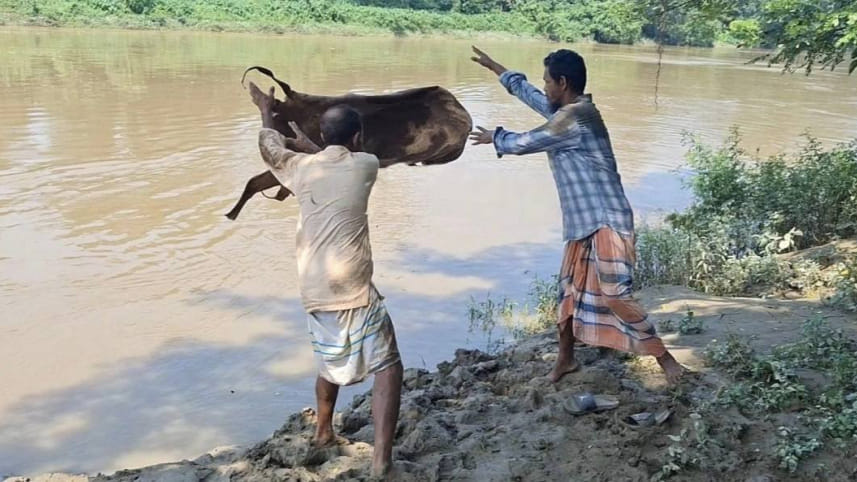
Since the afternoon of Eid-ul-Azha, media headlines have echoed a familiar crisis: raw hides of sacrificial animals are failing to sell at government-fixed rates. Left with no choice, seasonal traders across districts are dumping them by the roads, and into canals and rivers.
This year at my own village in Gaibandha district, a large cow’s hide barely fetched Tk 400 to Tk 500, while goat skins were entirely ignored and thrown away. Just 13 to 14 years ago, the scenario was completely different.
 For all latest news, follow The Daily Star's Google News channel.
 Eid-ul-Azha has evolved from a purely religious festival into a massive social anchor. It draws city dwellers back to their roots despite exhausting and risky journeys, allowing them to rekindle bonds, exchange greetings, and even host family events.
Crucially, this Eid acts as a vital economic and emotional lifeline for the rural underprivileged. For those who cannot afford meat all year, it offers sustenance and shared joy. Weeks prior, disadvantaged relatives, neighbours, elderly, widows, and distressed individuals would visit well-off households, asking them to reserve the proceeds from the upcoming hide sales. This money bought essential medicines, clothes, or basic necessities.
A decade and a half ago, this qurbani cattle hide economy drove an essential, grassroots wealth distribution system in rural Bangladesh. Today, the systematic collapse of rawhide prices has completely shattered this centuries-old social safety net, leaving our most vulnerable communities entirely empty-handed.
For a decade and a half, hide prices have plummeted so drastically that a single large cow’s hide can no longer support even five underprivileged families who traditionally seek aid before Eid. When an animal worth over Tk 1 lakh yields a hide selling for a meagre Tk 400-500, the mathematics of charity collapses.
Generally, in village areas, where multiple small families often share a single cow, each household’s share of the hide money amounts to just Tk 70 to Tk 100. Handing a mere Tk 50 or Tk 100 to an ailing relative needing medicine or a neighbour hoping for new clothes is deeply embarrassing. While some families previously subsidised this charity out of pocket, rural agrarian struggles have weakened that trend. This year, northern farmers, trapped by delayed Boro paddy harvests and low returns on potato cultivation, had to sacrifice with tight budgets or forgo qurbani entirely.
In 2004-2005, a medium-sized cow's hide fetched Tk 1,200 to Tk 1,500, and large ones reached Tk 3,000. Right after Eid prayers, seasonal traders would eagerly compete, even tucking advance cash into the host's pocket before the animal was skinned. Today, that enthusiasm has vanished. Those sacrificing cattle must actively call traders, handing over hides on credit only to receive nominal payments days later. Meanwhile, the distressed poor make repeated trips to these households, returning empty-handed.
Who bears responsibility for this failure? According to livestock ministry data, around 1 crore animals are sacrificed annually during Eid-ul-Azha in Bangladesh. Export Promotion Bureau (EPB) figures show that in the first 10 months of the current 2025-2026 fiscal year, leather and leather goods exports hit 990 million dollars -- a 6 percent increase over the previous year.
Clearly, the domestic leather market is not small, but mismanagement is killing the grassroots trade. The blame falls heavily on successive regulatory failures. The government and tannery owners have repeatedly failed to build an eco-friendly leather industry. Consequently, high-value European markets remain largely closed to Bangladeshi leather, leaving the sector dependent on low-paying Chinese buyers. Experts suggested that a compliant, eco-friendly tannery industry could boost annual exports from 1 billion dollars to 10 billion dollars. Despite initiatives dating back to 2003, full compliance remains a distant dream, leaving the poorest citizens to pay the ultimate price.
According to Islamic principles, those who sacrifice animals cannot consume the proceeds from selling qurbani hides -- that money belongs entirely to the poor, distressed, and helpless. For generations, this custom sustained rural charities, orphanages, and madrasas.
Orphanages and seasonal traders lack the resources or salt infrastructure to preserve raw hides for long. They are forced to sell hurriedly to local merchants, who routinely ignore government-fixed rates and delay purchases.
Because the wealthy do not pocket this money, the crash in rawhide prices does not affect them. The real victims are the underprivileged. This marginalised class possesses no political platform, union, or voice. Therefore, the responsibility to protect them lies squarely with the government.
The state must urgently resolve the structural crises plaguing the tannery industry. Upgrading to eco-friendly compliance would unlock high-value European markets, potentially boosting annual leather exports. Alternatively, the government should directly procure and preserve qurbani hides, much like it does with paddy and rice, before selling them to exporters.
If immediate regulatory intervention is not taken, Bangladesh's deep-rooted culture of mutual cooperation, the grassroots economy of Eid-ul-Azha, and the spiritual glory of the festival will soon be lost forever.
References:
- https://www.prothomalo.com/business/e82mkmv6pu
- https://bangla.thedailystar.net/economy/news-3928806
- https://www.ittefaq.com.bd/791288
- https://bangla.thedailystar.net/news/bangladesh/news-3928991
- https://www.tbsnews.net/bangla/bangladesh/news-details-496266
- https://www.ajkerpatrika.com/bangladesh/gaibandha/ajp7tpws5xzoq
The writer is a journalist and Bogura correspondent of The Daily Star.
Comments