


Women of Thakurbari shaped Bengal’s culture beyond Rabindranath Tagore
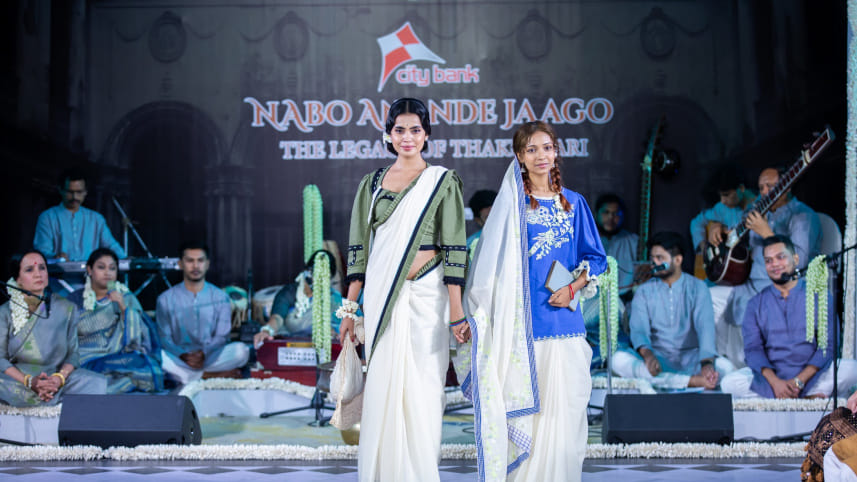
At “Nabo Anande Jaago: The Legacy of Thakurbari,” arranged by the Indira Gandhi Cultural Centre, High Commission of India, Dhaka, in collaboration with the Fashion Design Council of Bangladesh, Rabindranath Tagore’s 165th birth anniversary was marked through a wider lens. Instead of focusing only on the poet himself, the event used music, recitation, archival material, and fashion to also bring the women of the Tagore family into view.
That shift mattered.
 For all latest news, follow The Daily Star's Google News channel.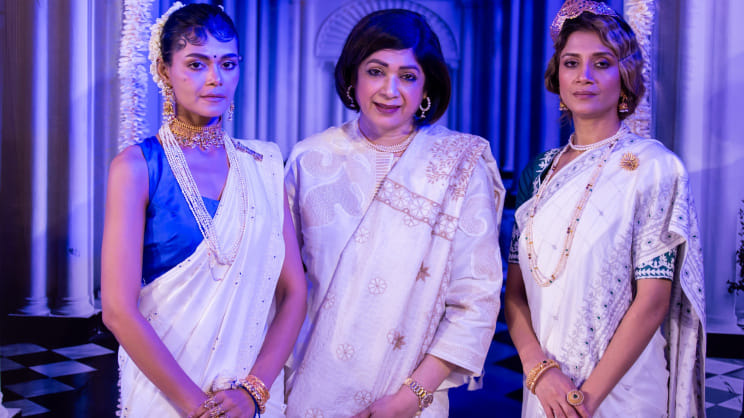
Rabindranath Tagore is so central to Bengali cultural memory that everyone around him risks becoming mere mentions in the annals of history. The women, especially, become portraits, names, or passing footnotes.
However, as Maheen Khan, founder and president of the Fashion Design Council of Bangladesh, made clear, this project was never meant to be only about homage. It was also about retrieval.
“For quite some time, for several years actually, we have been thinking about doing a project where we can bring the iconic women of Bengal to light,” she informed. For her, the women of Thakurbari represented something larger than literary prestige.
“They were the landed gentry; they were an intellectually profound family,” she noted, adding that their progressive way of life gave the women of the household a distinct cultural position.
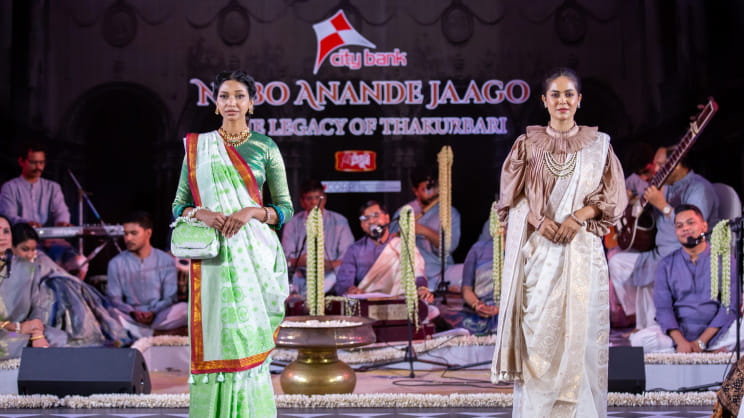
The event reflected that idea not only through speech, but through design.

Beyond literary pedigree
It is tempting to remember Swarnakumari Devi simply as Rabindranath’s sister. That would be the simplest possible reading of her. She belonged to one of Bengal’s most intellectually vibrant families, yes, but she also justified her place in it through her own labour.
Maheen Khan drew attention to one of the most practical aspects of Swarnakumari’s legacy. “Her lifestyle was a bit different,” she said, before pointing to Sakhi Samiti, the women’s association Swarnakumari founded.
The organisation worked to develop skills among widows and deprived women at a time when such work was far from fashionable philanthropy.
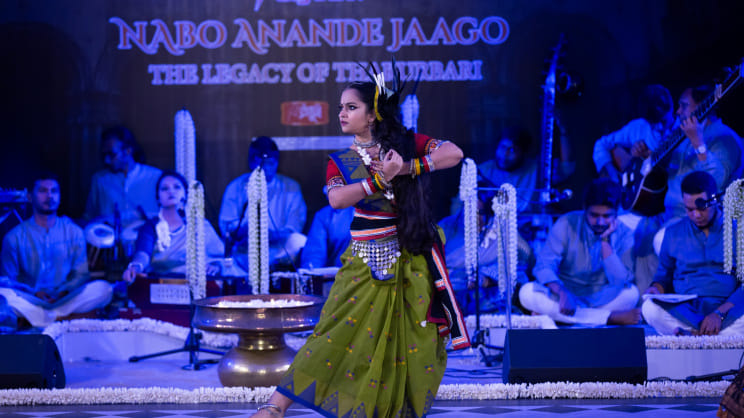
“This was back in the 1870s-1880s,” Khan noted. “This is something we are still struggling with today, providing people with skills to generate income.”
That observation does two things at once. It places Swarnakumari inside the reformist energy of her time, and it also makes her feel unexpectedly contemporary. In current conversations, women’s empowerment is often framed as a modern agenda. Yet, here was a woman in the Tagore family thinking institutionally about women’s economic capacity more than a century ago.
Swarnakumari’s significance lies not only in authorship or social status, but in usefulness. She did not simply inhabit a household where ideas circulated. She translated ideas into structure.
Education, elegance, and exposure
If Swarnakumari reveals one side of Thakurbari’s female legacy, Indira Devi Chaudhurani reveals another: education shaped by exposure.
Khan described Indira Devi as a standout figure, not only because of her family background but because of what she represented historically. She was, as Maheen Khan pointed out, one of the first female graduates of the Tagore family.
“They had much more exposure to the world than an ordinary person,” Khan said of the women in this branch of the family. That exposure matters when one thinks about the women of Thakurbari not as secluded cultural symbols, but as participants in a larger transnational modernity.
There is also something aesthetically important about figures like Indira Devi. They complicate any simplistic notion of Bengali femininity as rooted solely in domesticity and restraint. These were women who were shaped by Bengali culture, yes, but also by travel, languages, social reform, and global contact. They carried Bengal outward, and brought the world back with them.
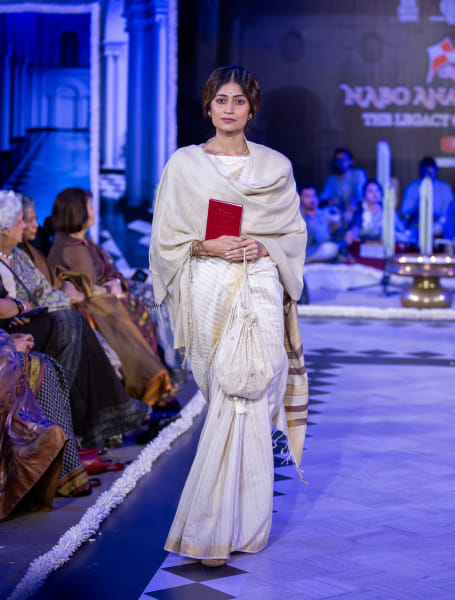
The architect of a visual language
Among the women Maheen Khan highlighted in her own line, Protima Devi received special attention. The choice was deliberate. Often remembered simply as Rabindranath Tagore’s daughter-in-law or as part of the Santiniketan circle, Protima is usually framed through relation. Khan’s reading was fuller.
“She was very close to Rabindranath,” she said. “Even though her husband eventually left her, she remained a pillar of the family.” For Khan, Protima’s significance lies in work rather than proximity. She was involved in the art department at Visva-Bharati, worked closely with Nandalal Bose, and contributed significantly to dance dramas.
She was not simply within Tagore’s orbit; she helped shape its visual and performative language.
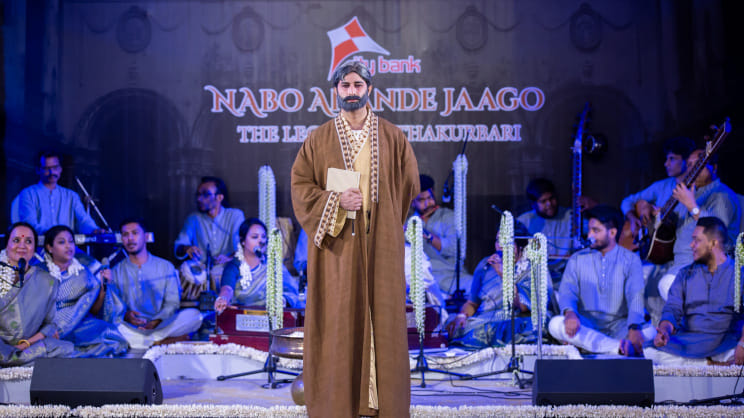
From Thakurbari to Bombay Talkies
If Protima Devi represents one kind of cultural labour, Devika Rani represents another.
Khan described her as Rabindranath’s grand-niece and one of the most progressive women of her time. Sent to England at a young age, Devika studied music, architecture, and textile design, travelled widely across Europe with Rabindranath, and later studied filmmaking in Germany with Himanshu Rai. Together, they would go on to found Bombay Talkies, one of early Indian cinema’s defining studios.
Khan’s decision to place Devika alongside Protima was telling. One remained rooted in Santiniketan and its artistic world; the other moved into film and modern industry. Yet both, in Khan’s view, represented “the incredible cultural synthesis of early 20th-century India,” bridging Indian aesthetics and global modernity.
Maheen Khan’s broader point was that the women of the Tagore family were not marginal to Bengal’s awakening. They embodied its tensions and possibilities. “We want their stories to reach the people,” she said. “People should know how they dressed and what their manners and lifestyles were like.”
And together, they make one thing clear: Thakurbari was never built by Rabindranath alone.
Photo: Silvia Mahjabeen/Courtesy
Comments