


What makes bystanders ignore someone in danger?
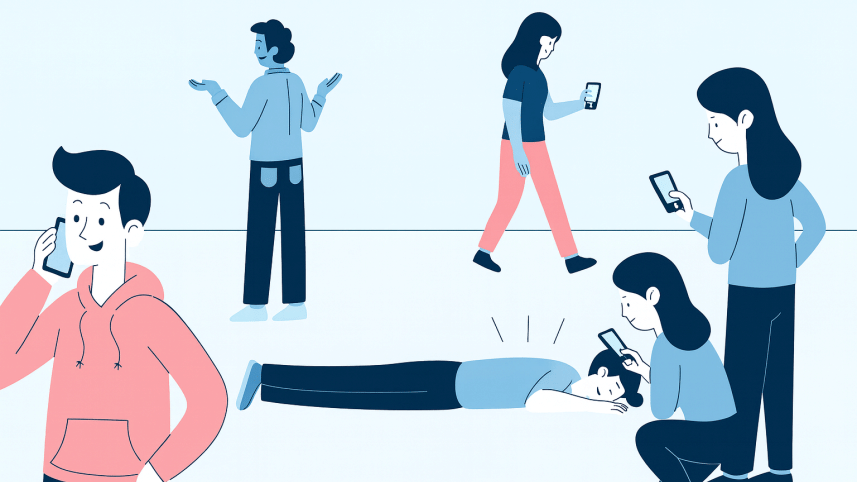
In cases of emergency, we like to believe we would step forward to help someone in danger. Yet, far too often, most people just stare or look away, while many even record the moment on their phones instead of helping, driven by a silent psychological chain reaction they may not even realise they are part of.
This behaviour is a common sight in an accident-prone, and often violent, Dhaka city. Whether it was the cocktail explosion near a university area or the arson attack on a running bus, videos surfaced online showing people filming the victims instead of rushing to pull them to safety. This shocking act of morbid curiosity captures a grim reality of human behaviour.
 For all latest news, follow The Daily Star's Google News channel.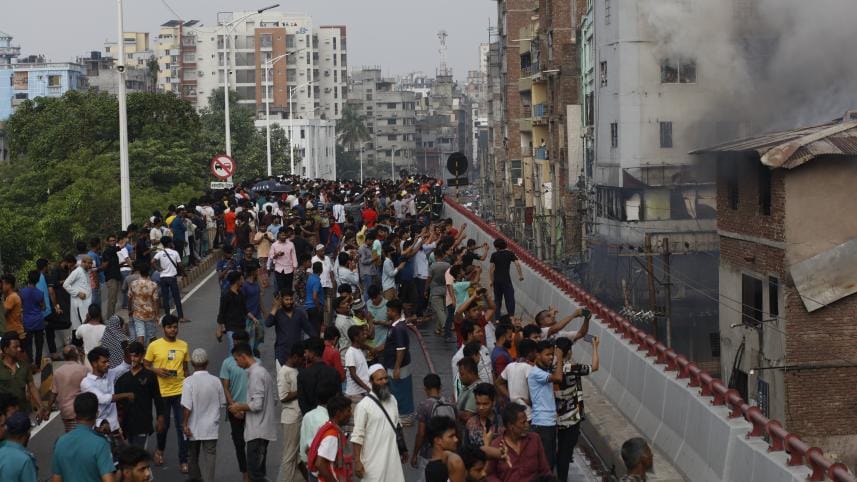
Dr Ashique Selim, a consultant psychiatrist based in the UK, shared in an interview with The Daily Star, "In most cases, people simply do not want to get involved mainly because they think their intervention will be uncalled for."
In the Bangladeshi context, the reluctance to help often stems from complicated concerns. Many onlookers say that they hesitate, fearing legal trouble and assuming law enforcement might badger them for being at the scene. Some avoid intervening because they do not want to be late for work or class. Many hesitate, fearing the misconduct might either be politically motivated or that they may not know the full context or background story.
Dr Selim highlighted a deeper issue and said that we need some kind of law and order in our country to prevent this kind of misdemeanour; if we want to stand against this, we need acute awareness and a clear sense of right and wrong.
Then there are victims, like people going through an epileptic seizure, a heart attack, an accident, or even a mob attack, lying unattended because everyone assumes someone else will step in. Psychologists have coined the term "bystander effect."

Referring to this social dynamic, Dr Selim pointed out, "Oftentimes, all it requires is just one person who initiates the help, and another person who follows."
If someone else needs urgent help, stay at a distance while making the emergency call to 999 or alerting nearby security, as your own safety is a valid concern. If you see someone else helping, join them.
The bystander effect works both ways. Just as apathy creates a chain reaction, so does taking action. Research suggests that once one person acts, others are far more likely to follow.
If you ever find yourself on the receiving end of this bystander treatment, you cannot always count on strangers. What you can do is keep your loved ones on speed dial and have a basic plan for emergencies. If possible, keep a note with your medical details and emergency contacts in your wallet. The rule of thumb is to single out one person from the crowd and mention a specific task. For example: "You in the black shirt, this is a medical emergency. Please call 999."
Small measures like these give bystanders clarity about their role, increasing the likelihood that someone will step forward.
Now, let's understand the perspective of a bystander. It is important to note that the hesitation is actually a part of the social dynamic. When others around them ignore the situation, it gives the bystander a silent signal that "everything must be fine." In social psychology, this is also known as pluralistic ignorance —when people spot a crime or medical emergency and do nothing.
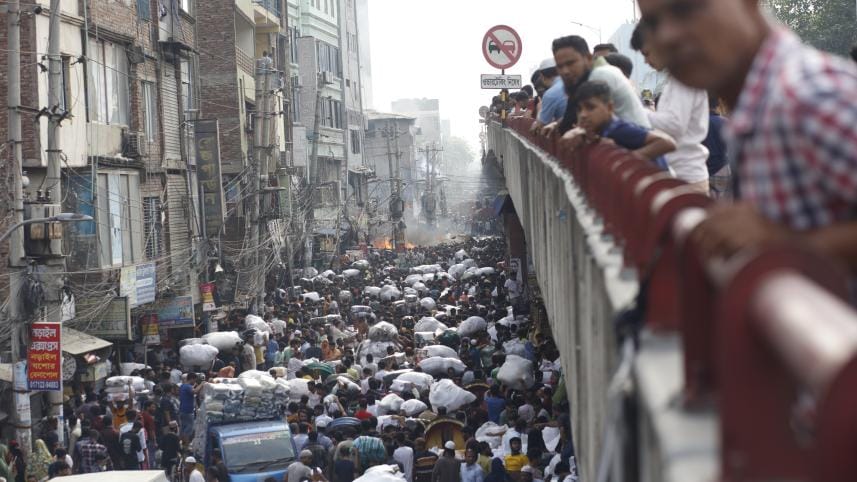
Research shows that most bystanders do not come forward to help precisely because of the crowd itself.
The "Smoke-Filled Room" experiment, conducted by American social psychologists Darley and Latané, revealed that when a person was alone at the scene of an emergency, they helped someone 85 per cent of the time. But when they were in a crowd of five other people, the helping rate dropped to just 31 per cent.
The more witnesses there are, the more each person feels the responsibility is shared — and not theirs alone — assuming that others will step in, a phenomenon otherwise known as diffusion of responsibility. This suggests an important social dynamic: people are less likely to help when other bystanders are present.
While psychology clearly explains our behaviour, that does not justify it. Now that you know better, you should act differently as a responsible individual.
Comments