


Bangladesh’s coldest season is also its most dramatic


January in Bangladesh has a funny way of inflating our egos. A few degrees drop in temperature, and suddenly everyone becomes an amateur weather historian, a self-proclaimed climate scientist, a folklore expert — or all three at once!
Come January, meteorology is no longer the job of the Bangladesh Meteorological Department; it belongs to uncles, tea-stall philosophers, rickshaw pullers, newsroom editors, and anyone holding a cup of steaming tea!
 For all latest news, follow The Daily Star's Google News channel.
 You will notice ordinary people, here and there, debating over facing "real winter" as if they had personally survived blizzards that logically never touched the ground of this region in recent centuries.
"This cold?" says a man wearing a thin sweater. "This is nothing."
And then begins the storytelling.
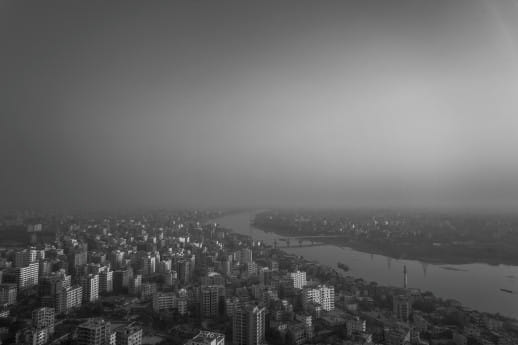
The competitive memory of cold
Every January conversation is a contest. Someone mentions the cold. Someone else raises them in a colder year.
"Back in 1997," announces Hamidur Rahman, a middle-aged man in a sleeveless vest, leaning as if this story has been marinating for a full year, "We had fog so thick you couldn't see your own hand." Before anyone can nod, an elderly man interrupts: "No, no. 1995. I remember because our pond water froze."
Water froze? In Bangladesh? Of course! Because January here is not merely the coldest month — it is a competitive sport of delusional exaggeration!
Another uncle shakes his head gravely, making sure we all feel the weight of his disappointment. "You people don't know real winter," he declares. "In our time, we didn't even have blankets or comforters. Just jute sacks or haystacks, and a fire if you were lucky."
Now, that made me pause. If people once survived on hay, jute, and sheer stubbornness, do I really need gloves, scarves, and a long jacket at a polite 13°C?
Well… perhaps yes — because, despite history's heroic tales, I do feel cold and my toes are certainly not willing to negotiate with this cold.
The lost snowfall of Sylhet (That actually never happened)
Eventually, every January discussion drifts north, or somewhere near a hill, a tea garden, or memory itself.
In Sylhet, elderly people will tell you — sometimes quietly, sometimes dramatically — that there used to be snowfall a hundred or two hundred years ago.
Or in the Barendra region, some elders speak of white mornings and frozen fields.
It sounds convincing. It sounds ancestral. But it is also, geographically speaking, almost certainly impossible.
Because Bangladesh sits in a humid subtropical zone. Even at its coldest, our winters struggle to reach the kind of sustained sub-zero temperatures required for snowfall. Yet, the stories persist, passed down with confidence and improved with each retelling.
Which brings us to the unavoidable question.
So, has it ever snowed in Bangladesh?
The honest answer is both yes and no.
Yes, if we are willing to go far enough back — far beyond borders, flags, and recorded memory. During the Ice Age, snow fell across vast parts of the planet. Given Bangladesh's geographical position, it is reasonable to assume that this land, if it existed, in some prehistoric form, also experienced snowfall. But that was a Bangladesh without names, nostalgia, or anyone alive to say, "I saw it with my own eyes!"

No, if we remain within the boundaries of modern, independent Bangladesh.
There has never been a recorded snowfall here. The lowest temperature ever recorded in independent Bangladesh was 2.6 degrees Celsius, measured in Tetulia on January 8, 2018. That morning was cold by every Bangladeshi standard. People suffered. Headlines were written. But it was still not cold enough for snow. Because for snow to fall, temperatures must drop below zero — something our winters, despite their reputation, have never managed to do.
Which means the snowfall of Sylhet exists not in climate records, but in collective imagination.
Uno Borshay Duno Sheet (Meteorology, Village Edition)
Now, no Bangladeshi winter discussion is complete without rainfall arithmetic. This is our most trusted climate model:
Uno borshay duno sheet — double winter after a lighter rainy season.
Ask a rickshaw puller in Mirpur. Ask a farmer in Bogura. Ask a project manager staring at the AC remote. They will all tell you almost the same thing:
"It rained less this year? Just wait for the winter's grip."
Science, however, is less poetic and does not fully support this. Winter intensity in Bangladesh is largely influenced by cold, dry air masses moving south from the Asian continent, not by how generous the monsoon was months earlier. Rainfall affects humidity and fog, yes — but it does not store cold like rice in a warehouse.
But sayings survive not because they are accurate, but because they are memorable. And this one sounds wise enough to repeat.
Then why do we do this every year?
Perhaps this annual rewriting of winter history has little to do with weather at all.
Someone says, "It's cold."
Another replies, "This is nothing."
Someone mentions their childhood.
Someone else upgrades it by a decade.
Every January, somehow, gives us permission to exaggerate without consequence.
It is not unlike our cricket nostalgia. Or food nostalgia. Or moral nostalgia. Everything was colder. Everything was better. Everything was tougher — and we survived.
Perhaps that is the point. January is not just about cold weather. It is about storytelling. About proving endurance. About claiming a past where we were braver, thinner, poorer, but somehow warmer inside!
Comments