


Notable Supreme Court decisions of 2025
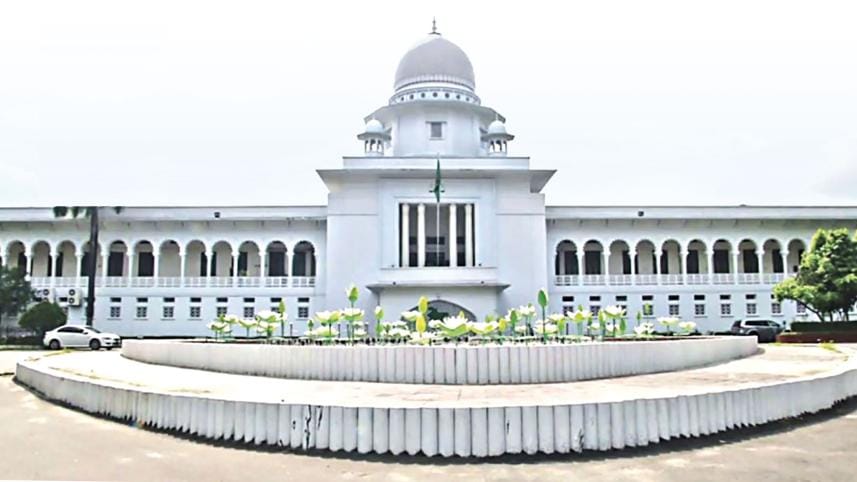
A number of landmark decisions were handed down by the Supreme Court of Bangladesh (SCOB) in 2025. This write-up compiles some of the landmark judgments that have significant constitutional and socio-political impacts.
Caretaker government reinstated, effective prospectively
 For all latest news, follow The Daily Star's Google News channel.
 In a landmark judgment, on 20 November 2025, a seven-member bench of the Appellate Division (AD), headed by the then Chief Justice Syed Refaat Ahmed, unanimously overturned its verdict handed down in 2011 and restored the caretaker government system. The Non-Party Caretaker Government system, which was introduced in 1996 by the 13th Constitutional Amendment, was held unconstitutional by the majority view of the seven-judge bench of the Appellate Division. The current decision came after allowing two separate appeals and four review petitions filed against the 2011 verdict. The Court in the review petition held that the impugned judgment is 'tainted by several cited errors apparent on the face of the record,' and thus set it aside. As a result, arguably, the provisions of Chapter IIA of Part IV of the Constitution relating to the Non-Party Caretaker Government have been revived. However, the revived provisions shall operate only prospectively, the Court held. The decision will, hopefully, open the door to a stable and consistent electoral practice and ensure free and fair elections in Bangladesh, thus strengthening democracy.
The year 2025 emerged as a vibrant and proactive year, delivering several landmark verdicts that enriched our constitutional jurisprudence while simultaneously extending justice to the downtrodden sections of society.
Article 96 restored in full, divergent views on code of conduct
On 5 June 2025, the SCOB released the full-text judgment of the 16th Amendment review case. Last year, the AD disposed of the review petition filed by the previous government that sought to overturn the 2017 verdict scrapping the 16th Constitutional Amendment. In this judgment, the Court labelled the 16th Amendment as an attempt to put the independence of judges at stake by putting the power to remove judges in the hands of the parliament. Apart from restoring Article 96 in its entirety, the apex Court, in the full judgment, take divergent views on 39-point judicial code of conduct. The then Chief Justice observed that 'the Code of Conduct is to be considered as permitting of growth and mutations by drawing on the inherent power of only the Supreme Judicial Council to revisit existing provisions as and when necessary.' However, the validity of the code as authored by the AD was questioned by other Justices, necessitating a fresh formulation. In essence, the verdict reinstated the independence of the judiciary and judicial accountability, leaving the question of code of conduct open.
Legitimacy of the interim government upheld
The Appellate Division, on 4 December 2025, upheld the verdict by the High Court Division (HCD) that summarily rejected the writ-petition questioning the legality of the interim government. The seven-member bench led by the then Chief Justice Syed Refaat Ahmed unanimously rejected the leave petition against the judgment by the HCD with observations. The writ petition questioned the process of formation and oath-taking of the interim government on the ground that it was not supported by any legal document. On 13 January this year, the HCD rejected the petition, saying it was malicious and unacceptable since the government was formed and sworn in under the advisory opinion of the Appellate Division of the Supreme Court. In effect, the present order has cleared the way for the interim government to hold elections and implement reforms.
Prices of life-saving drugs to be fixed by government
The HCD, in a judgment delivered on 25 August 2025, directed the prices of all life-saving medicines under the Drug and Cosmetics Act 2023, to be determined by the Government, and not the pharmaceutical companies. This decision came as an outcome of a Public Interest Litigation filed by Human Rights and Peace for Bangladesh in 2018, challenging a 1994 circular that fixed the prices of only 117 medicines, leaving the prices of other drugs to be settled by the manufacturing companies. The Court noted that medicines are not luxurious items and that fixing the price of the medicine is not a privilege of the manufacturers. The Court also directed the authorities to frame clear guidelines for preparing the list and fixing the prices. The judgment may be particularly helpful for the ailing patients suffering from diabetes, kidney or heart diseases. At the same time, it enables the poor and marginalised classes to have access to life-saving medicines.
Marriage and divorce information to be registered online
In a landmark decision, the HCD ruled that all marriage and divorce information must be mandatorily registered digitally. It also directed the secure storage of such information and enabled the citizens (especially women) to verify the records and obtain digital copies thereof. The bench consisting of Judge Fahmida Quader and Judge Md Ashif Hasan delivered this verdict on 11 December 2025, observing that the traditional system of marriage and divorce registration makes verification of marriage and divorce difficult, thereby undermining family stability and creating complications concerning the legitimacy of marriage. It also found that the lack of a digital database incentivises fraudulent practices and thus violates the fundamental rights protected under articles 31 and 32 of the Constitution. Finally, it can be opined that digitalisation of marriage and divorce will ensure transparency, prevent fraud, and reduce family-related disputes.
Political parties to contest national elections using their own symbols
The HCD on 11 December upheld the amended provision of the Representation of People Order, 1972 (RPO) that prevents the political parties from using the symbol of their partner party in an electoral coalition. Earlier, the Government brought a number of amendments to the RPO, including the impugned provision requiring political parties to contest national elections using their own symbols despite being in a coalition. On 1 December 2025, in response to a writ petition, the Court issued the rule asking the Government and the Election Commission why the provision should not be declared illegal and unconstitutional. It was argued that the amended provision restricts political freedoms and disrupts long-established electoral practices. The bench of Judge Fatema Najib and Judge Fatema Anwar discharged the rule after hearing the arguments. The petitioner has expressed its willingness to move an appeal before the AD. It can be argued that the earlier provision favoured small political parties, helping them overcome their limited organisational capability by making coalition with larger political parties.
To conclude, 2025 was a vibrant and proactive year producing some of the landmark verdicts that have contributed to our constitutional jurisprudence, and at the same time, reached the downtrodden populace of our society.
The writer works at Law & Our Rights, The Daily Star.
Comments