


Families struggle as dengue cases peak in November

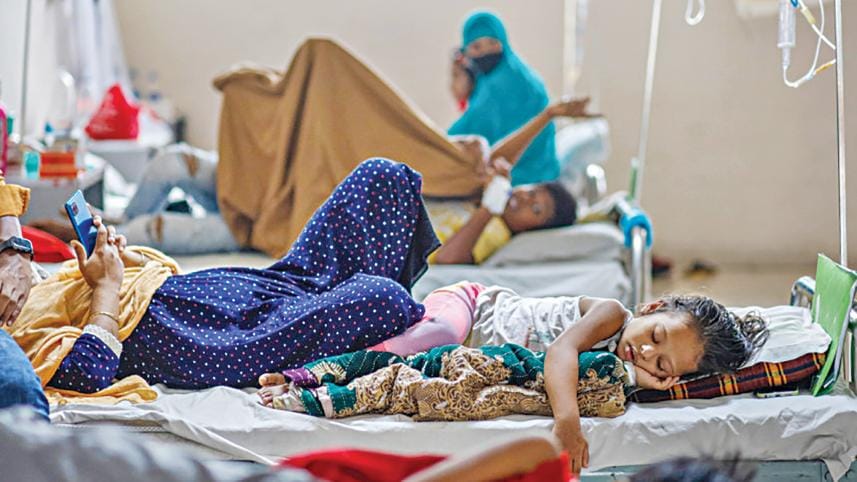
Twelve-year-old Nuhas and his two-and-a-half-year-old sister Najat are sharing a single bed at the children's ward of Mugda Medical College and Hospital, both diagnosed with dengue.
Their grandmother, Dina, said Nuhas developed a fever on Friday and was treated at a local clinic in Demra. As his condition worsened, he was referred to Mugda Medical College and Hospital and admitted on Tuesday.
 For all latest news, follow The Daily Star's Google News channel.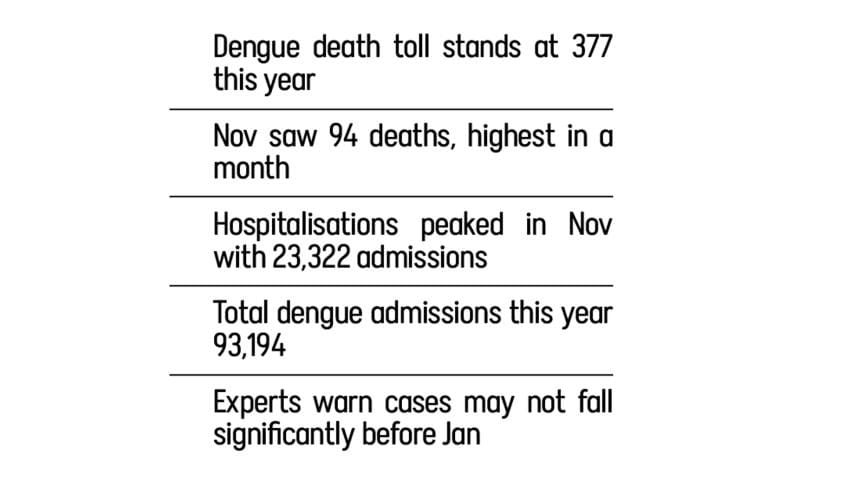
"After his admission, Najat also developed a fever and was diagnosed with dengue on Wednesday," Dina said.
According to their mother, Sonia, Nuhas' platelet count fell to 26,000 on Thursday, though his condition has since shown slight improvement. Doctors are still waiting for Najat's test results. The family said they are trying to avoid admitting her unless necessary, as they want to keep her off saline unless required.
A similar ordeal was unfolding for another family from Mugda. Four-year-old Mohammad Bagdad was admitted to the dengue ward on Tuesday. His mother, Samsunnahar, said he had been suffering from fever since Sunday and was diagnosed at Islamia Hospital before being referred to Mugda. "He still has fever and abdominal pain," she said.
Bagdad's two-year-old sister, Kaniz Fatima, has also been running a fever since Monday but has not been admitted. Doctors are treating her on an outpatient basis, Samsunnahar added.
These are not isolated cases. November recorded the highest number of deaths and hospitalisations from dengue this year, even though overall cases have recently begun to decline.
According to the Directorate General of Health Services (DGHS), 377 people have died from dengue and 93,194 have been hospitalised nationwide so far this year. Of these, 94 deaths occurred in November, the highest in a single month, surpassing October's 80 deaths.
Hospitalisations also peaked in November with 23,322 admissions, compared to 22,520 in October.
Entomologist Prof Kabirul Bashar of Jahangirnagar University said dengue will decrease only slightly in December, with a significant decline unlikely before late January.
"The immediate emergency is that in Dhaka's multistorey buildings, Aedes mosquitoes are breeding in basements. This is not linked to rainfall. These areas must be brought under control immediately," he said.
He pointed to under-construction buildings and abandoned structures in Old Dhaka as high-risk breeding zones.
"These three areas -- basements, abandoned buildings, and construction sites -- must be closely monitored. Immediate action is essential," Bashar added.
He warned that irregular water supply in parts of Old Dhaka forces residents to store water, increasing breeding risks. "People should clean water containers with detergent at least every three to seven days before refilling," he said.
Entomologist GM Saifur Rahman said while dengue cases may fall gradually, they will not disappear soon.
"Only the number of patients will slowly decrease," he said, cautioning that the Culex mosquito population is rising and could cause new public health problems by January or February.
"Containers that held water earlier may still contain eggs even if they are dry. These must be disposed of properly. Active breeding sites must be destroyed immediately," Rahman said. He added that authorities have a short window to act. "If preventive measures are implemented now, it may delay the dengue surge that usually comes after the first rains in March or April."
Comments