


Friday’s jolt lays bare Dhaka’s fragility




Building owners often chase short-term gains during construction, flouting rules as Rajuk looks the other way. Every time a disaster strikes, experts raise alarms and the agency vows action. Then some more days go, the dust settles, and everything returns to the old, perilous rhythm.
After Friday's 5.7-magnitude earthquake, which caused at least four deaths in Dhaka, experts warned that far greater losses await if the authorities fail to act now.
 For all latest news, follow The Daily Star's Google News channel.
 According to the Dhaka district administration, at least 14 buildings in the capital sustained damage from the quake, while the Rajdhani Unnayan Kartripakkha (Rajuk) put the number at over 50.
'Indo-Burma subduction zone accumulating strain capable of generating a significant seismic event, up to a magnitude of nine'
"We are still working. Many more buildings will be identified," Rajuk Chairman Md Riazul Islam told The Daily Star yesterday morning.
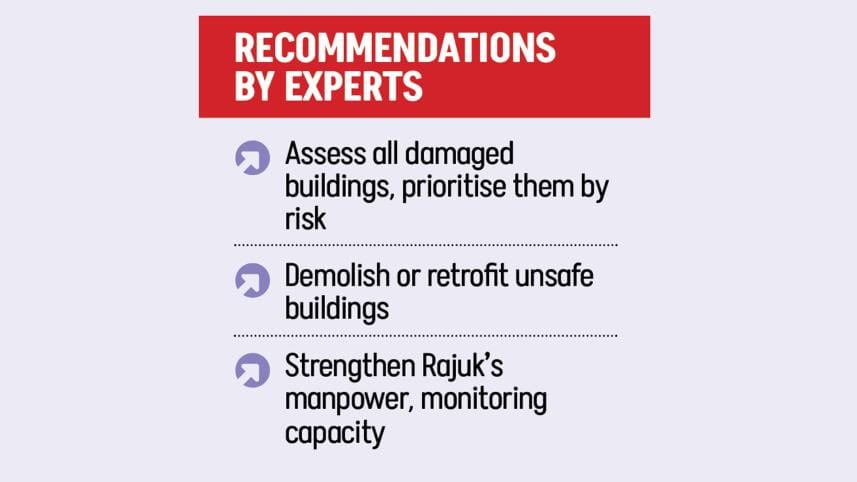
He said the next step was an immediate assessment of all buildings in Dhaka, at least those under the Detailed Area Plan (DAP), to determine which structures cannot withstand even minor shocks.
Rajuk is, by mandate, responsible for monitoring buildings from planning through construction and ensuring that rules are followed thereafter.
"I think these earthquakes are foreshocks of a bigger one. We must be prepared for that,"
Criticising the agency for chronic failures, Professor Munaz Ahmed Noor, vice president of the Bangladesh Earthquake Society, said Rajuk "always wakes up after a major incident," largely because it lacks the manpower for sustained oversight.
Prof Munaz said everyone should follow the building code very strictly when constructing any structure. In the past, the National Building Code was neither properly regulated nor enforced, which led many buildings to be identified as vulnerable in the Comprehensive Disaster Management (CDM) Survey, he said.
"The loads used in design must be applied correctly, and after the design is completed, the detailing must also be done properly. This is often where major negligence occurs. Sometimes the design is done correctly, but the reinforcement is not placed as detailed in the drawings," he added.
Prof Mehedi Ahmed Ansary of BUET's civil engineering department stressed that damaged buildings must be examined immediately and prioritised based on risk.
"Some buildings have column damage, others none. We need clear segmentation to decide what must be done first," he said.
He warned that a stronger earthquake could cause far more devastating collapses. "If we act now, we can prevent greater losses."
He suggested Rajuk issue notices or newspaper advertisements instructing homeowners to assess their buildings and submit reports. Experts could then guide the next steps.
Although the number of visibly damaged structures remains limited, he said many across Dhaka likely suffered some degree of structural impact.

DAMAGED BUILDINGS
Near Mitali Bidyapith in Swamibagh, a small crowd of curious onlookers gathered yesterday morning around a building that had tilted into the neighbouring one after Friday's quake.
One observer, teenager Jishan Alam, said he had come to see the slanting structure in person after hearing of its condition.
It was clearly visible that the eight-storey building at 52/1 Mitali School Road had leaned against its neighbour, its sixth and seventh floors pressing into the adjoining structure.
Saiful Islam, the building manager, told The Daily Star he was not present during the incident. The owner was abroad, he said, and tenants continued to live inside.
A similar situation unfolded in Khilgaon's Sipahibag area, where two five-storey buildings stand side by side at the Tempo Stand intersection.
There, Ruhul Manjil appeared to have tilted after the quake, leaving only a narrow gap between the structures. Locals reported cracks inside, and residents watched nervously from their windows.
At midday yesterday, the Shwapno outlet on Ruhul Manjil's ground floor remained closed.
Across the road, Sayem Enterprise, a mobile phone shop, also shuttered after cracks formed in its walls. Its AC unit fell during the tremor.
The shop's owner, Md Belayet Hossain, said the building had been designed for four storeys, but a fifth was added later without following approved plans.
The building's owner declined to comment.
While inspecting sites, Rajuk Chairman Riazul warned that the Armanitola building, where three people died when a rooftop brick railing collapsed, could be sealed if design and approval documents were not submitted within seven days.
In Mugda, he and his team inspected a building leaning onto its neighbour. Shops on the ground floors of both structures were ordered closed, and owners were instructed to submit design documents within a week. He also ordered the removal of illegal food stalls encroaching on the footpath.
At Badda Alatunnessa School and College, he inspected three buildings. Two had column cracks; he ordered design submissions and directed steps for removing the unsafe structures. Academic activities were temporarily suspended.
Riazul added that Old Dhaka remained particularly vulnerable, with many multi-storey buildings erected without approvals.
Rajuk Chief Engineer Md Nurul Islam told The Daily Star that in Old Dhaka, the damaged parts were mostly those that deviated from approved designs.
NO ACTION ON RISKY BUILDINGS
In 2022, the Rajuk identified 42 buildings in Dhaka, Gazipur, and Narayanganj as being at immediate risk and ordered them vacated and demolished within three months. It also listed 187 structures requiring retrofitting. Most have seen no progress.
The high-risk buildings belong to several government and autonomous bodies, including the Education Engineering Department, Department of Health Education, LGED, Jagannath University, Dhaka University, Bangladesh Madrasah Education Board, the Institute of Leather Technology, and the Bangladesh Medical University hospital. They were flagged during a survey of 3,252 structures under the Urban Resilience Project.
Asked about these buildings, the Rajuk chairman said most were government-owned, and that a citywide reassessment was essential.
He said risky buildings were now being listed, sealed, or cleared as needed.
"This earthquake is a major warning. Science suggests a bigger shock may be ahead," he said.
He added that the work must be collaborative, involving Rajuk, city corporations, disaster management authorities, the army, and the fire service.
"We are disconnecting the utility meters of those constructing illegally. Some keep constructing using stolen meters or generators," Riazul said.
He urged owners to consider demolishing unsafe or ageing structures on small plots and then rebuilding jointly. "Combining plots may mean short-term losses, but it brings long-term benefits."
Comments