


The Bangladeshi diaspora in Britain: A forgotten front of 1971

Millions of souls nineteen seventy-one
homeless on Jessore Road under grey sun
A million dead, the millions who can
walk toward Calcutta from East Pakistan
— Allen Ginsberg, September on Jessore Road
 For all latest news, follow The Daily Star's Google News channel.
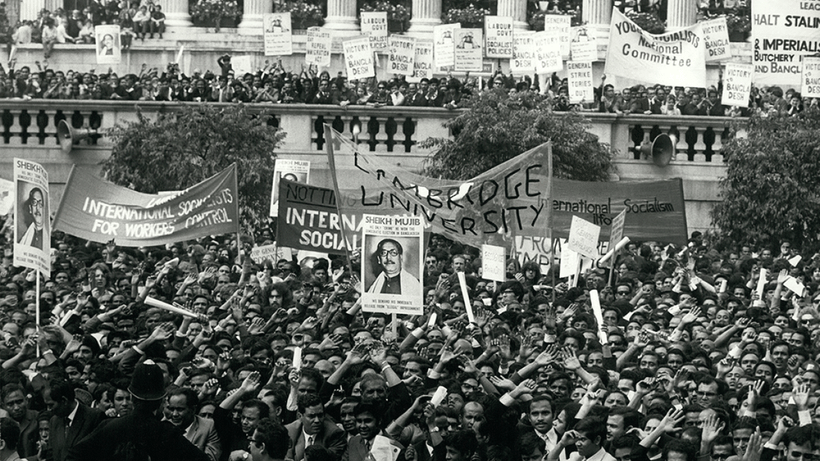
 The Bangladesh Liberation War of 1971 was not merely a South Asian conflict but a global moral crisis that drew in international actors. While Cold War superpowers manoeuvred for strategic advantage and neighbouring India bore the brunt of ten million refugees, a lesser-known front opened thousands of miles away—on Britain's streets, in its Parliament, and within its Bengali diaspora communities. This transnational dimension reveals how the struggle for Bangladesh's independence became a genuinely global movement, challenging Britain's postcolonial neutrality and transforming its immigrant communities into political actors.
A global coalition of conscience
The liberation struggle attracted an extraordinary constellation of international supporters. American Senator Edward Kennedy toured refugee camps and raised the alarm in Washington. George Harrison and Ravi Shankar organised the landmark Concert for Bangladesh at Madison Square Garden, introducing millions in the West to the crisis. French intellectual André Malraux lent his considerable prestige to the cause, while German novelist Günter Grass and American poet Allen Ginsberg bore witness through their art. Soviet Premier Nikolai Podgorny provided crucial diplomatic backing, whilst Indian Prime Minister Indira Gandhi orchestrated perhaps the most significant international campaign for recognition.
From Australia came W. A. Wanderland, a director at the Bata shoe company in Tongi, who transformed his factory into a guerrilla base, working alongside Bengali staff in liberation sectors one and two—efforts that would later earn him the Bir Protik, one of Bangladesh's highest gallantry awards. In Japan, academics Tsuyoshi Nara and Setsurei Tsurushima led solidarity organisations that mobilised public opinion, with Professor Nara issuing impassioned appeals condemning what he termed genocidal violence and calling upon the world's moral conscience to intervene.
Yet it was in Britain where perhaps the most sustained grassroots mobilisation outside South Asia took place—a campaign that has remained largely undocumented in historical memory.
The diaspora community: From settlement to activism
By 1971, Britain's Bengali community, though modest in size, had established footholds across the industrial heartland: London, Birmingham, Manchester, Bradford, Luton, Coventry, Sheffield, and Oldham. These were largely working-class settlements of seafarers, factory workers, and restaurateurs who had arrived during the post-war decades. Far from being politically dormant, this diaspora had already demonstrated remarkable organisational capacity.
Perhaps most striking was Mrs Badrun Nesa Pasha, a founding member of Birmingham's Action Committee. At a demonstration in Small Heath Park, Birmingham, where a symbolic Bangladesh flag was raised, Mrs Pasha delivered an impassioned speech before donating her entire wedding jewellery to the liberation fund. Her act exemplified the profound personal sacrifices made by ordinary people, with others donating their entire weekly wages to the cause.
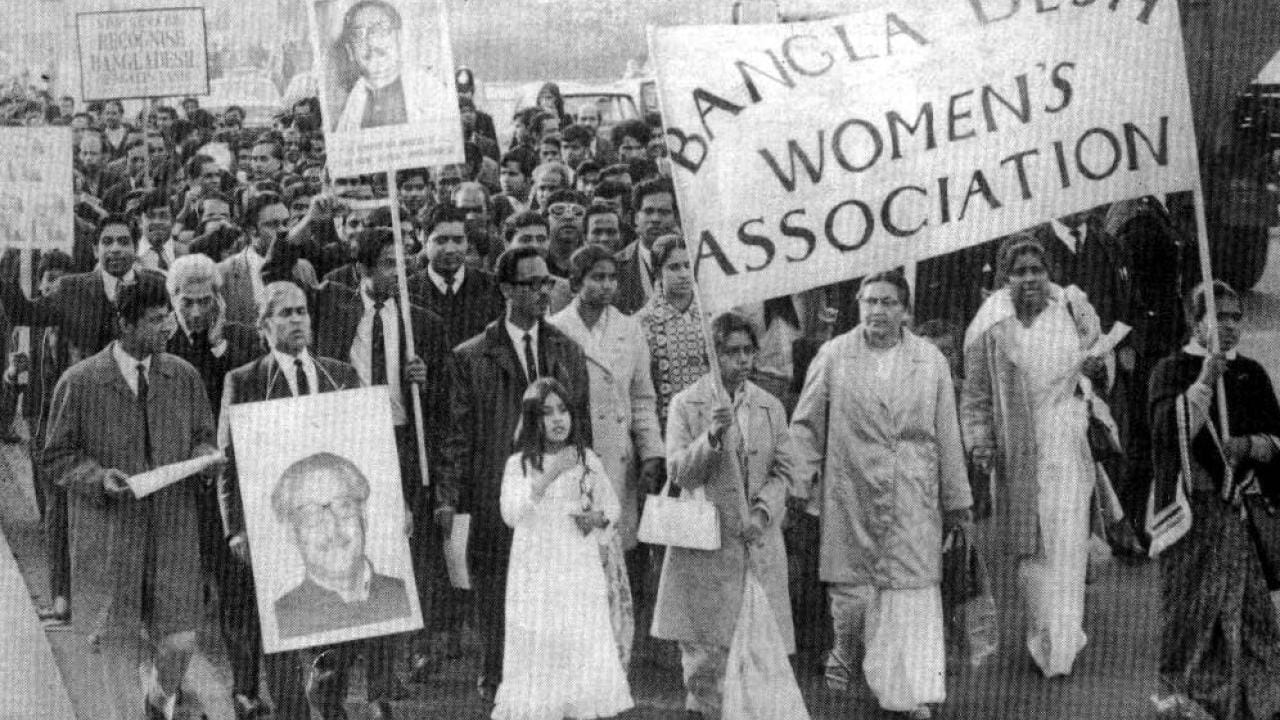
When Pakistani forces launched Operation Searchlight on March 25, 1971, Britain's Bengali community responded with striking speed and coordination. Within weeks, eighty-five Action Committees had formed across the country, alongside the Student Action Committee, the Bangladesh Women's Association, regional branches of the Awami League, and Action Bangladesh—the latter a solidarity organisation founded by British activists, including Paul and Ellen Connett.
Women at the forefront
The role of Bengali women in Britain's liberation movement deserves particular emphasis. Mrs Anowara Jahan of the Bangladesh Women's Association delivered letters directly to MPs at the House of Commons, cultivated relationships with parliamentarians—including Michael Barnes and John Stonehouse—and attended both Labour and Conservative Party conferences to lobby political leaders. She corresponded with world leaders on behalf of the organisation, inserting the Bangladesh crisis into the highest echelons of British political discourse.
Mrs Kulsum Ullah recalled the relentless pace of activism: Sunday rallies became the rhythm of life for nine months, as she set aside family responsibilities to organise demonstrations that drew participants from across England. Women formed the backbone of these gatherings, with Mrs Ullah herself bringing at least 150 women to the largest demonstration.
Perhaps most striking was Mrs Badrun Nesa Pasha, a founding member of Birmingham's Action Committee. At a demonstration in Small Heath Park, Birmingham, where a symbolic Bangladesh flag was raised, Mrs Pasha delivered an impassioned speech before donating her entire wedding jewellery to the liberation fund. Her act exemplified the profound personal sacrifices made by ordinary people, with others donating their entire weekly wages to the cause.
According to Mohammed Israel, accountant of the Bangladesh Steering Committee formed in April 1971, the British campaign raised £406,856, a substantial sum equivalent to several million pounds today. Justice Abu Sayeed Choudhury, the Mujibnagar Government's special envoy, personally transported these funds to Bangladesh.
Cross-cultural solidarity
The liberation movement revealed both the possibilities and the tensions within Britain's multicultural landscape. Mrs Pasha recalled recruitment drives for volunteer fighters, where queues formed of young men willing to travel to the battlefield. Most remarkably, a white English barman presented himself, declaring his readiness to fight for Bangladesh's liberation—an act that astonished organisers and demonstrated how the cause had transcended ethnic boundaries.
British MPs, diplomats, and journalists provided crucial establishment support. Michael Barnes, Labour MP for Brentford and Chiswick, visited Bangladesh during the crackdown and subsequently tabled a parliamentary motion opposing the Pakistan cricket team's tour of England, using sport as a lever for moral pressure. His speeches in the Commons exposed the scale of atrocities to British lawmakers.

Among diplomats, civil servants such as Mr Miles, Deputy High Commissioner in Kolkata (1970–74) and later High Commissioner to Bangladesh (1978–79), provided what he termed "unofficial support". Miles witnessed the historic gathering of half a million people who greeted Sheikh Mujib in Kolkata in January 1972 as he returned from London to liberated Bangladesh. His visits to refugee camps housing ten million displaced Bengalis provided British officialdom with first-hand testimony of the humanitarian catastrophe.
British journalists Simon Dring, Anthony Mascarenhas, and Mark Tully broke through the Pakistani military's information blockade, with Mascarenhas's eyewitness account of systematic atrocities proving particularly influential in swaying international opinion.
Yet the diaspora also experienced the war's intimate conflicts. Pakistani and Bengali communities, previously coexisting peacefully, fractured along national lines. Bengali activists reported verbal abuse and physical attacks on British streets. One school student, Tunu Miah, recalled Pakistani acquaintances treating Bengalis with contempt, questioning their religious authenticity and likening them to slaves. Street clashes erupted, with Bengali groups banding together for protection, transforming Britain's urban spaces into extensions of the distant battlefield.

The forgotten chapter
Despite its significance, this British dimension of Bangladesh's liberation remains largely unrecorded in official histories on either side. Comprehensive historical scholarship remains elusive. The story of how Britain's Bengali diaspora mobilised action committees, raised hundreds of thousands of pounds, lobbied Parliament, and transformed themselves from immigrants into transnational political actors deserves its place in both British and Bangladeshi historical narratives.
A global history
The Bangladesh Liberation War was a watershed in postcolonial history, demonstrating how decolonisation's unfinished business could erupt into catastrophic violence. But it was also a moment when global solidarity networks emerged, prefiguring later humanitarian movements. The Concert for Bangladesh pioneered celebrity activism for distant causes. Diaspora communities discovered their political agency, learning to navigate host-country institutions whilst maintaining ties to their homelands. International media, despite censorship, transmitted images that mobilised conscience across continents.
Britain's role, both official and grassroots, reflects the complex legacy of empire. Former colonial subjects turned to British courts, Parliament, and public opinion for justice, whilst British citizens responded with solidarity that transcended racial and national boundaries. This was not simply a South Asian conflict observed from afar, but a global struggle in which Britain itself became a significant theatre of action.
Ansar Ahmed Ullah is a contributor to The Daily Star.
Send your articles for Slow Reads to slowreads@thedailystar.net. Check out our submission guidelines for details.
Comments