


People who stay back in Dhaka on Eid
Every festival in Dhaka feels vibrant and full of life. The city embraces every celebration with warmth and enthusiasm. But Eid is different. It is a festival that calls people to be with their families, friends, and loved ones.
Most people who are not originally from Dhaka usually leave the city during Eid to return to their hometowns or wherever their families live.
 For all latest news, follow The Daily Star's Google News channel.
 But there are also people who spend their first meal alone in a room on Eid, or maybe wish the families Eid Mubarak on video calls. Sometimes, reality makes it hard to celebrate Eid with loved ones.
When millions leave the capital, thousands remain behind.
“There’s no one left in my village except that half-broken house. So, for the last few years, I haven’t gone back home for Eid. I stay here, help around the neighbourhoods and earn some extra income,” expressed Mobarok Hossain, a security guard from Farmgate.
There are actually so many people like Mobarok who have no one to celebrate the Eid with. So, they choose to stay back in the city. But is loneliness the only reason? For many, job security becomes more important than spending Eid with family.
“This is too much. But I have nothing to do. I cannot just quit my job and go home for Eid,” stated Md Jamil Ahmed, a working professional, with sorrow. “People should get at least two days of leave during Eid. It’s hard to spend Eid away from family.”
Sometimes earning a living becomes the reason not to return home, sometimes it’s the opposite — insufficient income forces people to spend Eid alone in this city.
Nasima Akter, a house help from Mirpur, said, “It’s so expensive to travel home and come back. Where would I get that much money?” She thinks that it’s better to save the travel expenses and send that to the family for Eid instead.
Across the city, thousands share similar experiences every Eid.
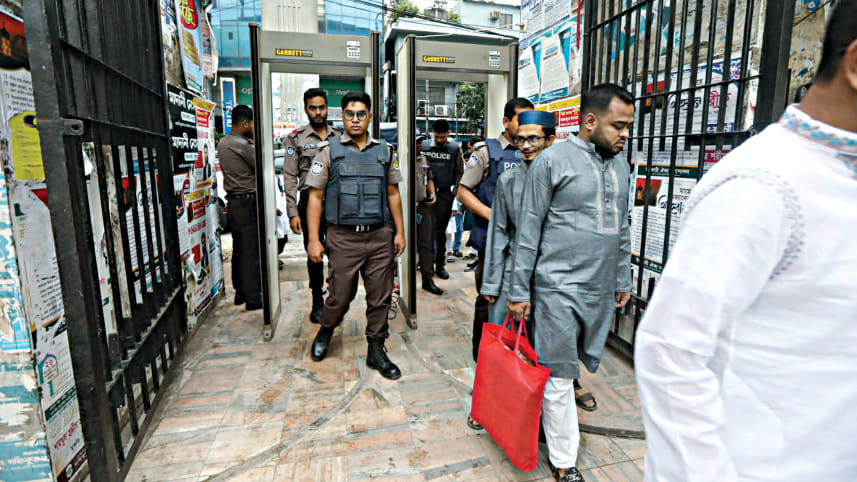
Some people have to be in the city no matter what. Security forces, traffic police, doctors, bus drivers, rickshaw pullers — they cannot just go home even though it’s Eid.
Md Shahjahan Ali, a traffic police officer near Panthapath, remarked, “Last Eid, my daughter called me and asked when I would come.” He paused and added, “It’s probably the hardest part of staying back.”
A rickshaw puller was sharing almost the same story. Md Miraj has two daughters and a wife in his hometown. He couldn’t buy an Eid dress for his little girls, so he’s not going back to his family on Eid out of shame.
Some students also spend Eid in their dormitories. Rejaul Haque, a university student, shared, “Exams are scheduled right after the Eid holidays, so I can’t go home this time. I do feel a little low, but some of my friends and seniors will also be staying here. They always manage to make Eid feel warm and wholesome together.”
He said that this’d be his second Eid away from home.
Stories like these reveal a side of Eid that rarely appears in glossy family photographs or social media posts. Behind the crowded journeys home are people quietly spending Eid in nearly empty flats, dorms rooms, and workplaces across Dhaka.
Their celebrations may be smaller, but they carry a different kind of meaning.
As evening falls on Eid day, the city slowly grows silent again. The streets are clear. The rush fades away. And in that unusual quiet, those who stay behind continue building their own version of Eid -- one shaped not by grand gatherings, but by resilience, duty and small acts of kindness.
Comments