


A ritual of red

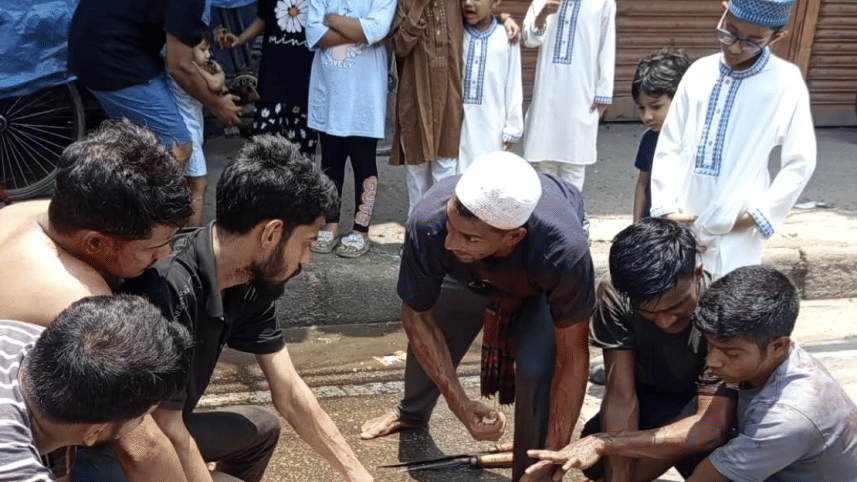
It is a reign of red during Eid-ul-Azha as the ritual of sacrifice is, after all, inseparable from visceral visages.
Even for believers who understand the theology not merely as slaughter, but as surrender, humility and charity -- there remains an undeniable corporeality to it all.
 For all latest news, follow The Daily Star's Google News channel.
 The flesh and blood is a common scene on the by-lanes and alleys. And for a child, especially one inclined towards timidity, the entire affair can resemble a scary theatre.
Much of my childhood was spent crossing oceans with my parents. But my father, with admirable obstinacy, almost always brought us home for the two Eids. Eid-ul-Azha arrived as a religious occasion and accompanying changes. Men became butchers. Courtyards transformed into abattoirs. Drainage canals ran red. Entire neighbourhoods smelt of wet hay, blood, smoke and raw meat baking under the indifferent sun of the subcontinent.
And then there were the boys.
Right after the Eid prayers, they would appear beside the sacrificial animals, almost ceremonial in their sameness. Young pupils from local madrasahs, many of which functioned as orphanages for the rural and urban poor. They wore near-identical uniforms -- lungis or pyjamas, skullcaps or the occasional pagri, all sharing the same muted palette. In their hands were knives too large for childhood. The curved blades, almost serpent-like, glinted under the morning light with an medieval menace.
They were called “picchi hujur” with that uniquely Bengali habit of turning to affectionate terminology. Cub clerics. Little maulanas. The phrase sounded almost comedic until one watched what they had to do on the day.
They would arrive in groups under the supervision of an ustad, imam, khatib or muezzin from the local mosque. The older cleric usually handled the more lucrative or difficult cattle slaughter for households lacking either skill or nerve. The boys served as assistants, errand-runners, holders of ropes and, increasingly, novice executioners. Goats were often reserved for them, partly because they lacked the physical strength for larger cattle, and partly because the goat became a sort of pedagogical instrument -- training wheels for ritual slaughter.
The spectacle was difficult to process. Boys scarcely taller than the cattle they were assigned to slaughter would struggle to force an animal down, wrestling desperately with bodies more muscular and more frightened than their own. Frequently, they failed in the first attempt. The knife would hesitate. The cut would falter. The animal would convulse in panic and pain. Embarrassment would spread across the child’s face while impatient adults barked instructions from the sidelines, transforming ritual into performance pressure. In those moments, sacrifice ceased to resemble spirituality and instead looked alarmingly like initiation -- a grim apprenticeship.
Blood would gush onto their pale clothes, blooming crimson. Just poor boys coerced early into adulthood by the economics of survival.
And they would look at me.
That perhaps remains the most haunting part of the memory. We were the same age. Equally small in stature. But unequally children -- we inhabited entirely different civilisations despite standing only feet apart. While I hid indoors, recoiling from the sight of blood and seeking refuge in my grandmother’s house, they stood ankle-deep in it. While I had the luxury of sensitivity, they had obligations. While I could afford fear, they could not.
Class often reveals itself not through wealth alone, but through one’s permission to remain innocent.
Those boys did not participate in slaughter because they were inherently cruel or unusually pious. They did it because poverty has a remarkable ability to accelerate maturity while simultaneously robbing dignity.
By afternoon, they would leave carrying parcels of meat and crumpled notes of cash back to families who depended on such earnings to punctuate lives otherwise governed by scarcity.
In many ways, Eid-ul-Azha exposes the uneasy intersections between faith, class and labour in South Asia. The affluent experience sacrifice symbolically; the poor experience it physically.
The theology may be shared equally, but the weight rarely is.
As a child, I interpreted my horror as weakness. I thought cowardice explained why I hid from the slaughter while others my age carried it out. Age, however, complicates memory. I suspect many of them were terrified too. But hunger is a brutal tutor. It teaches composure where childhood ordinarily permits trembling.
And perhaps that is what unsettles me most about Eid-ul-Azha even today.
Comments