


Is Subodh Bangladesh’s first cross-border graffiti icon?

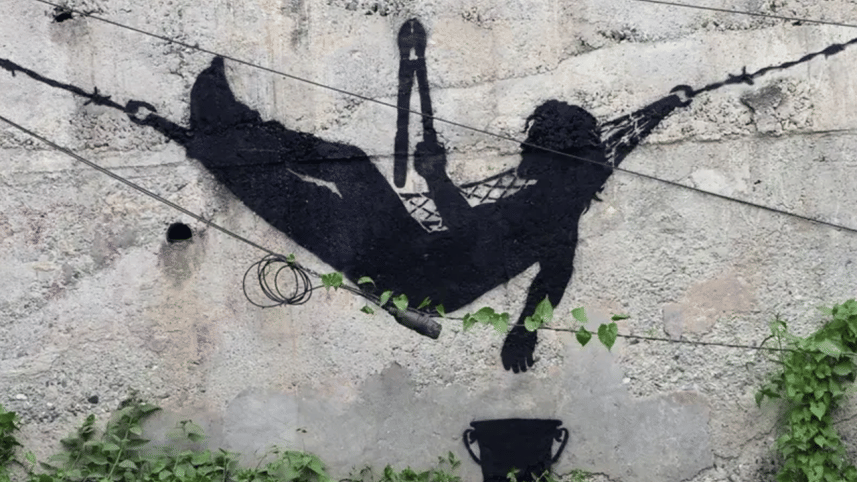
Subodh lies stretched across a concrete wall on the Majitar Nala Bridge near Rangpo, the gateway to India’s Himalayan state of Sikkim. Bare-chested, hair dishevelled, he reclines on a hammock tied to barbed wire, a wire cutter in hand. In one corner appears the familiar signature: “HOBEKI?” (which roughly translates to ‘will it happen?’ or maybe even ‘shall we?’).
A character born on the walls of Bangladesh has now surfaced in India’s mountain state. Is this simply another piece of graffiti, or does it indicate the latest geographical expansion of Bangladesh’s contemporary street art?

Once, Subodh raced across Dhaka’s walls carrying a caged sun against his chest, forever trying to escape. At times he stood behind prison bars; at others, he held a child in his arms. Now, he has turned up on the other side of the border.
This new graffiti is another marker in the evolution of Bangladesh’s street art that has for long been a reflection of our politics. As elsewhere in the world, graffiti has long served as a language of dissent, giving expression to questions and grievances that often cannot be voiced in formal public spaces. Whenever avenues for expression have narrowed, artists have turned to city’s concrete surfaces into canvases. Images painted under the cover of darkness have confronted passers-by the following morning, never with answers, but with uncomfortable nagging questions.
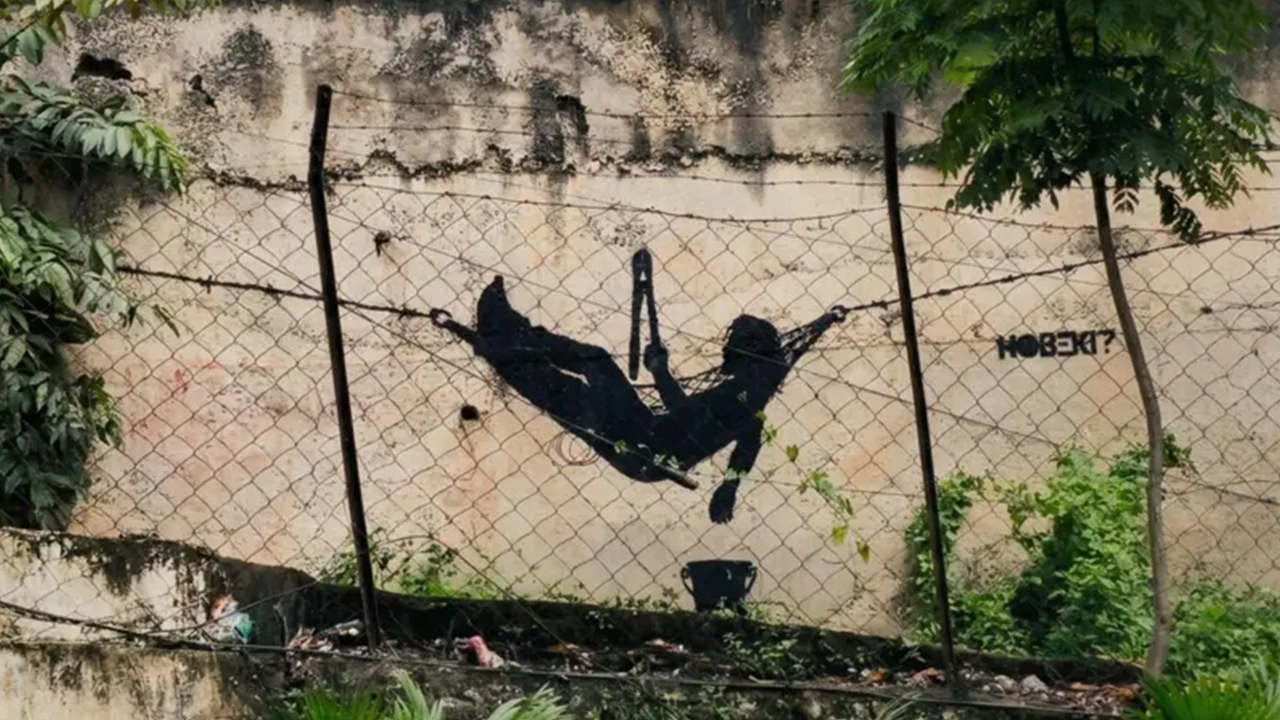
No figure embodies Bangladesh’s contemporary street art more powerfully than Subodh.
The mysterious character first appeared on Dhaka’s walls around 2017. He was no hero -- just an ordinary man on the run. Each mural came with cryptic lines: “Subodh, run away; time is not on your side,” “Subodh, when will dawn arrive?” and “Subodh is now in jail.”
The artist has remained anonymous, never stepping into the spotlight. Nor has the precise meaning of the character or its recurring visual language ever been explained. Yet that ambiguity may be Subodh’s greatest strength. Viewers have read him as a political metaphor, a symbol of personal freedom, or the face of an individual defeated by his times.
Over the years, that artistic language evolved across Dhaka’s walls. New characters such as Sohomot Bhai and Helmet Bhai entered the visual landscape, while university campuses, roadside walls and flyover pillars gradually became spaces for civic expression.
Then came the July Uprising which seemed to lend a new voice to our walls. Old political posters disappeared, replaced by murals, graffiti, slogans and artwork.
It is difficult to recall another moment in Bangladesh’s history when street art spread so extensively.
The history of graffiti around the world tells the same story. From Berlin and Paris to Gaza, Santiago and London, walls have repeatedly become the language of ordinary people in defiance of power. Over the past decade, Bangladesh has gradually developed a visual language of its own.
But why Sikkim?
Rangpo is more than just a town. It is an entry point and a checkpoint. It is here that Subodh decides to lie idly on a hammock swinging from the barbed wire. He decides to relax right on the fence like it is his vacation idyll. And the new graffiti takes on a new meaning.
Whether the artist has indeed travelled to Sikkim is beside the point. An artistic language has crossed a border.
Perhaps that is the greatest strength of powerful graffiti. Though painted on walls, it is never confined to them. It travels from one city to another, from one era to the next, gathering new meanings with each new context.
Yet, the artist’s silence remains its most powerful statement. Perhaps that is why, even after crossing a border, Subodh feels at once familiar and entirely new.
 For all latest news, follow The Daily Star's Google News channel.


Comments