


Export growth hindered by regulatory gaps, weak infrastructure
 For all latest news, follow The Daily Star's Google News channel.
 - Regulatory inefficiencies and poor logistics hinder exports
- Certification gaps expose weak testing facilities
- Export diversification stressed as mathematical necessity
- Direct shipping routes urged to boost competitiveness
Regulatory inefficiencies, weak certification systems, inadequate testing facilities, complex export procedures, and poor logistics remain major obstacles to export growth in Bangladesh, according to business leaders.
"Bangladesh must strengthen its certification, compliance, and logistics systems to boost export competitiveness," said Rupali Chowdhury, president of the Foreign Investors' Chamber of Commerce and Industry (FICCI).
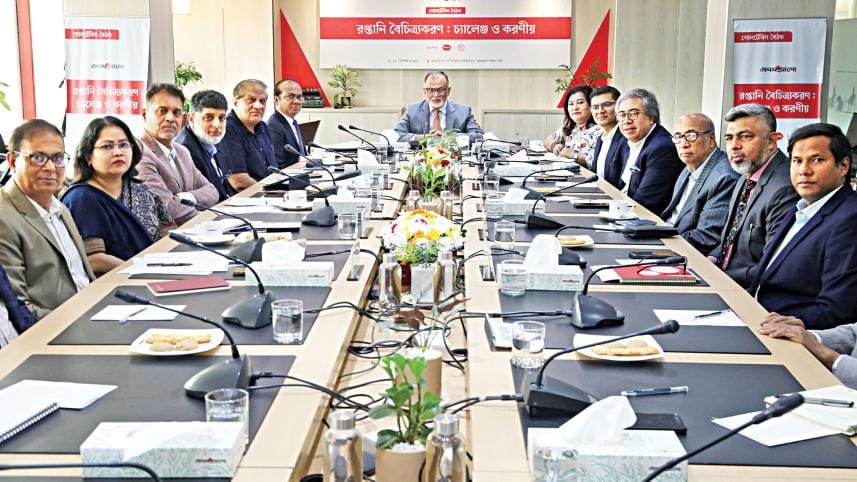
She spoke at a roundtable titled "Export Diversification: Challenges and Way Forward," jointly organised by Prothom Alo and Pran-RFL Group at the Prothom Alo office in Karwan Bazar yesterday.
Citing Berger's move to locally produce food-grade cans, Chowdhury said that these products still require certification abroad, mainly in India or Singapore, highlighting gaps in Bangladesh's testing capacity.
She called for major investment to modernise the Bangladesh Standards and Testing Institution (BSTI) and build essential pharmaceutical testing labs—projects that would cost several billion dollars.
Customs delays, limited automation, and weak compliance frameworks continue to hurt exporters, Chowdhury said. However, she added that trade restrictions in countries like China and Vietnam could create new opportunities for Bangladesh.
DIVERSIFICATION NOT OPTIONAL
Md Mahbub ur Rahman, CEO of HSBC Bangladesh, stressed the importance of identifying non-apparel sectors and supporting them with focused policies. "Twenty years ago, our exports were $9 billion. Now they're close to $50 billion—but 80 percent still comes from apparel," he said.
Rahman highlighted the potential of SMEs, saying, "But the process is too complex. We need to simplify it and build a strong support mechanism."
He also pointed to untapped markets in the Middle East and Asean countries.
Nahian Rahman Rochi, executive member of Bangladesh Investment Development Authority (Bida), warned that relying solely on RMG, which now brings in around $48 billion, will not meet the country's long-term goals. "Export diversification is not optional but a mathematical reality for Bangladesh," he said.
Citing Vietnam and Korea's success, he stressed sector-specific strategies, skill transfer, partnerships, and better use of Bida support mechanisms. "We're here to facilitate, not just regulate," he said, promising to raise key issues in the next national budget.
Ahsan Khan Chowdhury, chairman and CEO of PRAN-RFL Group, said boosting exports must be a national priority. "There is no alternative. We must decide whether we want to remain import-dependent or become an export-driven economy," he said.
He criticised rising demurrage charges, high air shipment costs, and urged direct shipping routes to major markets like the US. "If we can send goods directly from Chattogram to New York, we could alone export $1 billion worth of products," he said.
Sk Bashir Uddin, adviser to the Ministry of Commerce, called for unified, practical reforms rather than blame-driven discussions. He pointed to weak institutions and regulatory problems as core challenges, warning that over Tk 1,00,000 crore in non-performing loans—over 30 percent of GDP—reflects poor financial governance.
He cautioned against blindly relying on Free Trade Agreements and criticised the sidelining of small entrepreneurs, calling it a form of "chronic capitalism." On LDC graduation, he said solutions must be context-specific, noting Vietnam as a reference.
SECTOR-SPECIFIC INSIGHTS
Syed S Kaiser Kabir, managing director of Renata PLC, stressed the strategic importance of pharmaceuticals for exports, talent retention, and global credibility. He criticised the current policy environment as unfriendly to pharma entrepreneurs and called for supportive policies and relaxed foreign exchange rules to aid global expansion.
Mohammad Hasan Arif, vice chairman of the Export Promotion Bureau (EPB), stressed diversifying products and destinations, noting that 44 percent of exports go to the EU and 18 percent to the US.
Nasir Khan, chairman of Jennys Group, pointed to bureaucratic red tape and bonded warehouse inefficiencies as major obstacles. "Over 30 licences and 190 documents are needed to operate—this alone drives away foreign investors," he said.
Sayema Haque Bidisha, pro-vice chancellor of the University of Dhaka, said that many SMEs in food processing and agro-based sectors lack institutional support. She also stressed the need to enforce environmental compliance in the leather sector and improve branding for jute and pharmaceuticals.
Shamim Ahmed, president of the Bangladesh Plastic Goods Manufacturers and Exporters Association, said the real export value of plastics exceeds $1.8 billion, far above the $300 million officially reported.
Md Shahjahan Chowdhury, president of the Bangladesh Frozen Foods Exporters Association, said the sector could reach $3 billion within five years with proper support.
The discussion was moderated by Shawkat Hossain, head of online at Prothom Alo.
Comments