


Dhaka eateries hit by LPG price hike, supply crunch

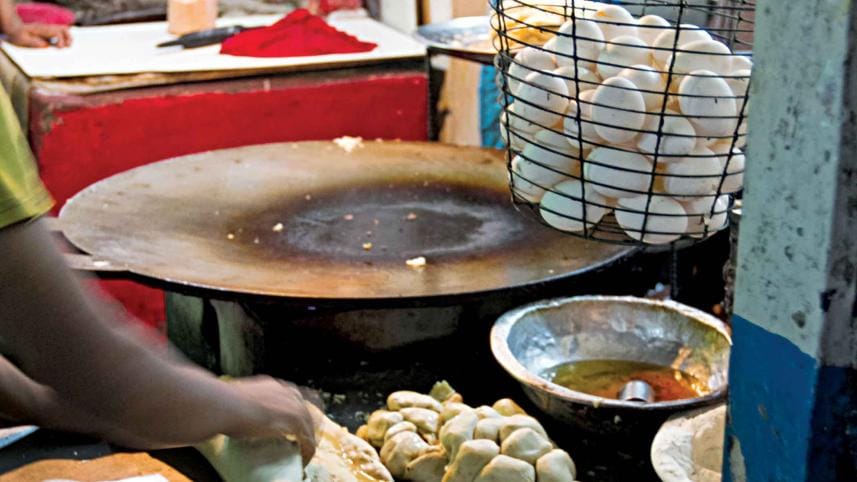
Restaurant owners in Dhaka are grappling with a deepening liquefied petroleum gas (LPG) crisis, marked by soaring prices and constrained supply despite official data showing steady imports and adequate stock levels.
Importers and government officials allege that some wholesalers are trying to create an artificial shortage by disrupting supply.
 For all latest news, follow The Daily Star's Google News channel.
 Restaurants across the capital say they are facing limited deliveries and steep price hikes, driving up food production costs and threatening daily operations.
At wholesale and retail levels, suppliers are selling 12kg LPG cylinders at Tk 350 to Tk 900 above the government-fixed rate, even as data from the National Board of Revenue (NBR) indicates no major disruption in imports.
The Bangladesh Energy Regulatory Commission (BERC) set the January retail price of a 12 kg LPG cylinder at Tk 1,306. However, in markets across Dhaka and Chattogram, cylinders are selling between Tk 1,650 and Tk 2,200.
Restaurant owners say the situation on the ground is worsening by the day. Many report receiving only 30 to 40 percent of their daily LPG requirements, forcing them to pay inflated prices just to keep kitchens running.
At Sky Lounge in Mirpur-1, operators say they typically require around 10 cylinders a day but are often supplied only two or three.
"We need 10 LPG cylinders per day, but we are getting only two or three, that too not at the government-fixed price," said Saad Bin Siraj, assistant manager of the restaurant.
Siraj said they are paying roughly Tk 400 more per cylinder than the official rate. "The situation is so severe that we are willing to pay the higher price just to keep our operations running."
Despite rising costs, food prices have not yet been raised. "Prices cannot be changed suddenly because menus are already printed. For now, we are continuing operations in the hope that the gas crisis will be resolved."
Only four cylinders remained at the restaurant yesterday, Siraj added. "These may last until today or tomorrow. If no further supply is received, the restaurant will be forced to shut down."
Similar accounts are emerging from other parts of the city. At Old Terrace in Dhanmondi, restricted LPG deliveries are disrupting daily operations.
"If we need three or four cylinders per day, we are barely getting one," said Rakib Mia, supervisor of the restaurant.
He said inflated prices have compounded the problem, while printed menus prevent immediate price revisions. The restaurant's gas line is also operating at minimal capacity, making it difficult to provide normal service. "If the supply does not improve soon, the restaurant may be forced to shut down."
The restaurant sector includes an estimated 25,000 eateries in Dhaka and about 4.81 lakh nationwide, employing roughly 30 lakh people, according to the Bangladesh Restaurant Owners' Association (BROA). The association estimates that around two crore people are directly or indirectly linked to the industry.
"Restaurant owners are facing a severe crisis as LPG prices have increased by nearly 50 percent to 60 percent," said Imran Hassan, secretary general of BROA.
The sharp rise in fuel costs has placed an unbearable burden on small and medium-sized businesses, he said. "Restaurants are receiving 30 percent to 40 percent less gas than their actual demand, causing eateries to incur around 15 percent to 20 percent losses per day."
"We cannot change food prices multiple times a day to match fluctuating fuel costs. As a result, we have become systematically hostage to the current energy crisis," Hassan said, warning that many restaurants may soon reduce production or shut down entirely.
"ARTIFICIAL SHORTAGE"
In 2025, Bangladesh imported 14.65 lakh tonnes of LPG, higher than the previous year. Of that volume, 54.2 percent arrived in the last six months, according to NBR figures. The total import bill stood at around Tk 11,780 crore, down nearly 2.7 percent year-on-year.
Bangladesh requires around 14 to 15 lakh tonnes of LPG annually, making the latest import volume broadly in line with demand.
At a recent meeting with energy ministry officials, LPG importers said overall stock levels remain satisfactory but flagged problems such as delays in opening letters of credit, rising shipment costs due to a shortage of vessels, and delays in approvals for expanding import capacity.
They warned that without government intervention, these issues could lead to a supply crunch in the future. Some importers also alleged that certain wholesalers have already created an artificial crisis, pushing prices higher.
Government officials, meanwhile, insist there is no genuine shortage. They argue current disruptions stem largely from market manipulation and collusion among wholesalers and retailers.
"We will contact the Bangladesh Bank to provide priority in opening LCs for LPG as a necessary product," Monir Hossain Chowdhury, joint secretary of the energy and mineral resources division, said after the meeting with importers.
He said shipment costs have risen after the United States last month imposed sanctions on at least 29 vessels used by importers. "Now they are looking for alternatives, but costs have increased due to the ship crisis," he added.
Power and Energy Adviser Fouzul Kabir Khan has also said recent abnormal price hikes were the result of deliberate manoeuvring rather than import or production failures.
He said district administrations and consumer protection authorities have been instructed to conduct enforcement drives, including mobile courts, to curb artificial scarcity.
The ministry has also proposed tax relief measures. In a letter to the NBR yesterday, it recommended restoring a VAT exemption by lowering VAT on LPG imports to below 10 percent and removing VAT on local production and trader-level sales to ease cost pressures during the winter demand surge.
Mohammed Amirul Haque, president of the LPG Operators Association of Bangladesh, said the government had taken appropriate steps amid a difficult period.
"We are trying our best to make the situation normal as soon as possible. The problems regarding booking ships in the Middle East are not in our hands," he said. "Though shipment costs are increasing, we hope the shipments will be okayed soon."
Comments