


BB unveils roadmap to cut bad loans
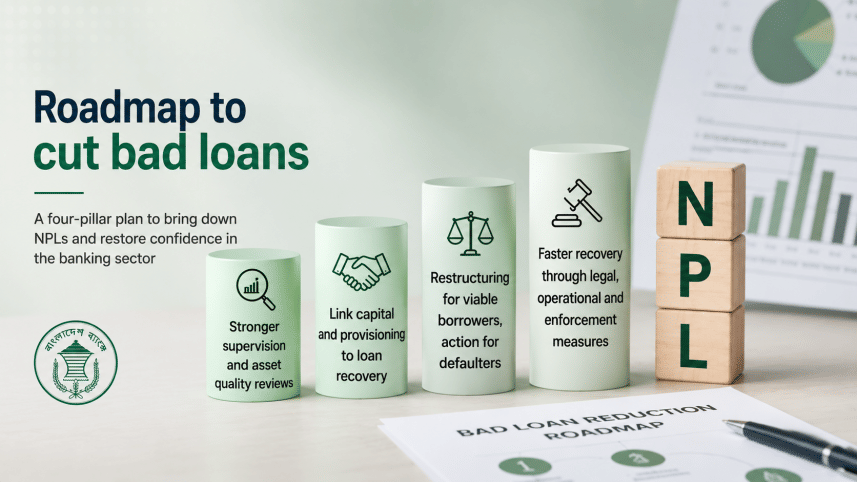
The Bangladesh Bank has laid out a comprehensive medium-term roadmap to tackle the country's mounting non-performing loans (NPLs), combining stricter supervision, faster loan recovery, legal reforms, and a shift to international credit loss standards as it seeks to restore confidence in the banking sector.
Persistently high level of defaulted loans remains one of the biggest challenges facing the financial sector, weighing on banks' profitability, capital strength, liquidity management and the effectiveness of monetary policy transmission, the central bank said in its latest Monetary Policy Statement (MPS) for July-December 2026 published today.
 For all latest news, follow The Daily Star's Google News channel.
 According to the latest assessment, the gross NPL ratio climbed sharply from 20.20 percent in December 2024 to 35.73 percent in September 2025 before easing to 32.26 percent by March 2026.
The net NPL ratio followed a similar arc, rising from 10.57 percent to 26.40 percent over the same stretch before falling to 15.01 percent by March 2026.
In monetary value, total classified loans rose by Tk 31,487 crore to Tk 588,704 crore at the end of March from Tk 557,217 crore in December, according to BB data.
BB attributed the swings to changes in borrowers' debt-servicing capacity, the adjustment period for short-term working capital facilities, and interest accrual patterns on stressed loan accounts.
To improve asset quality, the central bank introduced several regulatory and supervisory reforms during FY26. It allowed banks to write off bad debts with limited recovery prospects, to present a clearer picture of their balance sheets.
The regulator also revised its framework for stressed borrowers, allowing classified loans of viable businesses to be restructured for up to 10 years with a grace period of as much as two years. Special support measures under the framework remain available through June 2026.
In December 2025, BB updated its loan classification and provisioning guidelines to strengthen credit discipline across the banking industry. To keep financing flowing to productive sectors, banks have been permitted to maintain lower provisioning requirements for standard and Special Mention Accounts (SMA) in agriculture and cottage, micro, small and medium enterprises (CMSMEs) until December 2026.
A central element of BB's medium-term strategy is the transition from a rules-based provisioning methodology to an Expected Credit Loss (ECL) framework under IFRS 9, with full implementation targeted for calendar year 2027.
Under IFRS 9 -- an international accounting standard used in many jurisdictions -- banks are required to estimate and recognise potential credit losses before loans actually default, replacing the traditional approach of provisioning only after signs of impairment emerge. The approach is intended to provide a timelier and more transparent picture of banks' financial health by requiring lenders to set aside provisions earlier against potential losses.
Going forward, BB's roadmap focuses on structural reforms designed to achieve long-term reductions in bad loans, rather than relying on temporary regulatory forbearance.
It rests on four pillars. First, the regulator will strengthen Risk-Based Supervision (RBS) and conduct institution-specific Asset Quality Reviews (AQRs), particularly at banks with governance weaknesses or concentrated credit risks.
Second, banks' capital restoration and provisioning plans will be directly linked to measurable improvements in loan recovery, with supervisory actions — including restrictions on dividend distributions -- imposed where recovery targets are not met.
Third, loan restructuring facilities will be reserved only for financially viable businesses. Borrowers that fail to comply with repayment commitments will face legal and regulatory action.
Fourth, BB will accelerate recovery of large, defaulted loans through specialised internal recovery units within banks, stronger legal departments, faster disposal of cases in the Artha Rin Adalat, and more effective collateral enforcement mechanisms.
Separately, BB is putting in place a structured Emergency Liquidity Assistance (ELA) framework to ensure liquidity support for solvent banks remains clearly separated from the capital restructuring of financially weak institutions.
The roadmap is also backed by two newly enacted laws — the Bank Resolution Act 2026 and the Deposit Protection Act 2026 — intended to give authorities stronger tools to resolve troubled banks, safeguard retail depositors, and reduce moral hazard in the financial system.
Finally, the central bank plans to strengthen data infrastructure and enhance banks' credit risk modelling capabilities, to support the ECL rollout and enable earlier detection of deterioration in borrowers' credit quality.


Comments