


Rain, storms leave salt farmers counting losses


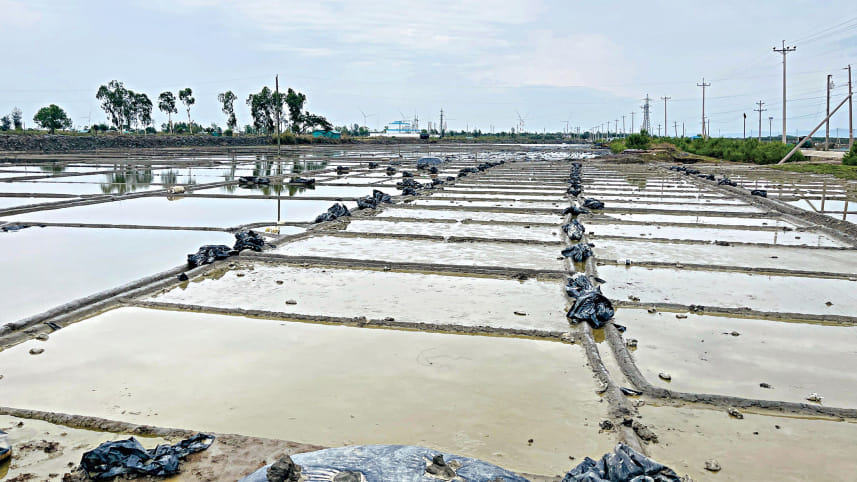
- Rain halts salt farming during peak production season
- Output drops to 17.68 lakh tonnes amid storms
- Farmers face losses despite higher market salt prices
Days of incessant rainfall during the peak production season have caused salt farming to come to a standstill, raising concerns over reduced salt output and posing risks to the country’s overall supply and market stability.
Farmers are receiving higher prices than last year for their produce. However, unfavourable weather has flooded salt fields, dashing their hopes for higher profits.
 For all latest news, follow The Daily Star's Google News channel.
 The salt production season in the country usually runs from November to May, with production peaking from April to May due to the intense summer heat, but rain has brought production to an untimely halt, said an industry official.
While the situation remains bleak at present, farmers are hoping that a return of favourable weather and the consequent resumption of production could help ease this crisis.
As of April 27, total salt output reached 17.68 lakh tonnes, down from 18.61 lakh tonnes during the same period last season, according to Bangladesh Small and Cottage Industries Corporation (BSCIC) data.
Bouts of adverse weather were responsible for the downturn in output, said Md Zafar Iqbal Bhuiyan, deputy general manager of the Cox’s Bazar Salt Industry Development Office under BSCIC.
“Nonstop rain at the end of last week damaged a significant volume of newly produced salt, causing heavy losses for farmers,” he said.
Prolonged adverse weather forced salt farmers to halt production before the season’s scheduled end. In such a situation, he expressed concern over whether the national salt production target could be achieved.
The country’s annual salt demand currently stands at 27.15 lakh tonnes, as per BSCIC data.
Production has remained suspended from April 28 to May 2 due to repeated storms and rainfall.
Around 12 days of rainfall in the season so far have caused lower-than-expected production, he said.
“However, the situation may improve if conditions become favourable for the rest of the season,” Bhuiyan said.
“This season, repeated rainfall has caused major losses. After this rainfall, we will hardly be able to produce any more salt. It seems the season is already over,” said Borhan Uddin from Abzalia Para in Moheshkhali, a salt farmer.
At the farmer level, the average price of salt is now Tk 255 per maund, compared to Tk 230 at the same time last year, BSCIC data shows.
Despite the higher price, farmers are far from optimistic.
“When our salt production is supposed to be at its highest, storms and rain have brought it down drastically,” said Abul Hossain, a salt farmer from the Nonachhari area of Moheshkhali upazila.
During the intense heat of April and May, an entire batch of salt can be produced within three days as water evaporates quickly, ensuring both higher output and better quality.
From one kani (40 decimal) of land, farmers usually produce 300 to 350 maunds of salt annually, of which around 200 to 250 maunds are harvested in these two months alone.
However, rainy weather has cut production to nearly half the target this year, he said.
“I lost around 250 maunds. If the rain had come a day later, I could have collected the salt. But the salt had not matured yet,” Abul Hossain said.
Speaking about prices, he said farmers initially sold salt at Tk 180 per maund at the start of the season, which later increased to Tk 220. Despite this, he expects a loss of Tk 25,000 to Tk 30,000 per kani this season.
HM Shahid Ullah, vice president of the Bangladesh Salt Farmers Association, said that this season has not been favourable for salt farmers due to poor weather conditions and low returns.
However, he expressed hope that if weather conditions improve, farmers will attempt to resume production in the remaining period.
Comments