


Revisiting Satyajit Ray in the age of noise
A narrow village path stretches into the distance, the wind moves through tall Kans grass, whispering secrets that only the field seems to understand. Durga, with a piece of sugarcane in her mouth, tries to understand where the clickety-clack sound is coming from. Apu follows his sister, wondering with quiet hesitation where they have come. With the increasing sound, they run, breathless, curious – chasing not just a train but a fleeting glimpse of a world beyond their own. In Pather Panchali (1955), this unadorned moment unfolds without fanfare, a simple frame capturing the poetry of childhood's fleeting joys. Yet, it lingers, etching itself into the soul like the earth's quiet breath.
As Satyajit Ray's birth anniversary on May 2 draws near, marking 105 years since his birth in 1921, revisiting his oeuvre feels less like nostalgic reverence and more like an urgent reclamation. The master filmmaker, composer, writer and illustrator from Kolkata didn’t chronicle Bengalis' struggle, he humanised them with unflinching honesty, blending neorealism with profound humanism. His camera watches, listens and waits—allowing life to unfold in its most unguarded form. What makes his films endure is not just their craft, but their deep understanding of the human experience. Across his body of work, whether in the rural landscape of Pather Panchali or the interior worlds of urban loneliness of Charulata, Ray returns again and again to the fragile complexities of everyday life. His characters are not extraordinary; they are recognisably human, caught between hope and limitation, tradition and change, intimacy and isolation. It is perhaps this quiet honesty that allows his films to travel across time, speaking to audiences far removed from the contexts in which they were made.
Frames that whisper
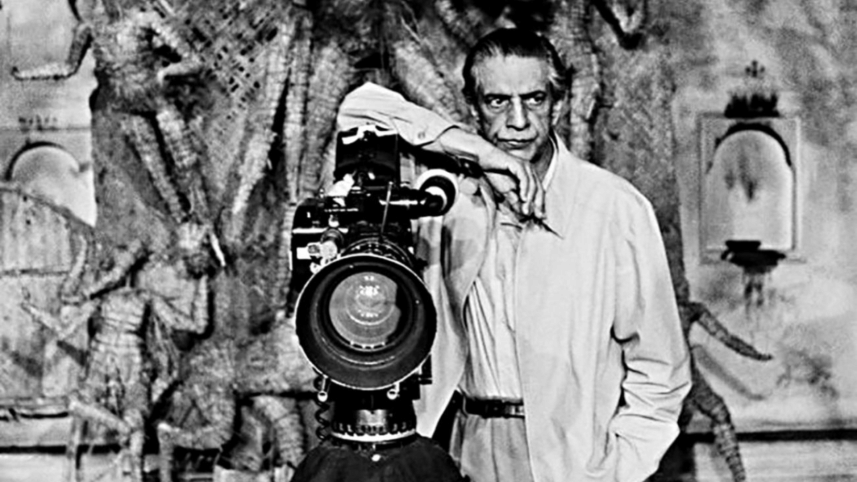
To return to Ray today is to rediscover the value of attention. His camera does not impose meaning; it allows meaning to emerge, gently over time. In the quiet frames he crafted, we are not merely spectators, we become participants in a shared human experience, one that continues to resonate long after the screen has gone dark. The genius of Satyajit Ray lies, above all, in his visual storytelling—where the camera becomes a silent observer, weaving narratives through composition, light and shadow rather than words. In Ray's cinema, images carry the weight of emotion. Minimal dialogue amplifies this restraint—characters speak sparingly, letting faces, gestures and landscapes convey inner turmoil and quiet epiphanies. What remains unsaid often resonates more deeply than spoken lines, creating a space where the viewer must feel rather than simply follow.
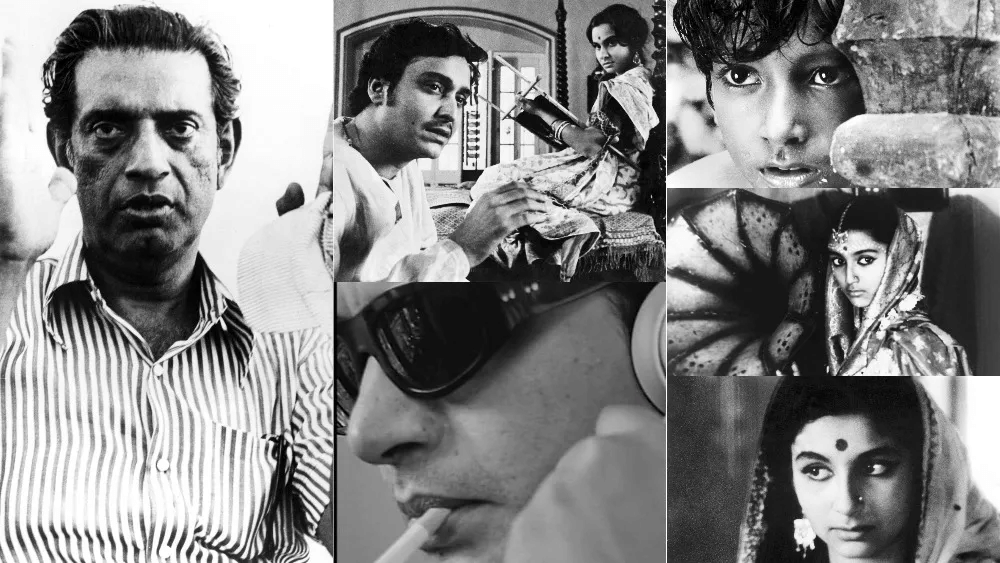
Charulata (1964), adapted from Tagore’s “Nostonir”, Ray's camera glides like an unseen voyeur: a slow pan across a sun-dappled garden reveals Charu (Madhabi Mukherjee) stitching her unspoken longing through embroidery, her solitude pierced by the distant clatter of Kolkata's horse-drawn carriages. Dialogue is sparse—her exchanges with husband Bhupati are clipped, formal; yet her gaze through opera glasses toward her brother-in-law Amal betrays a forbidden yearning. The now-iconic swing sequence, where Charu moves gently between confinement and freedom, captures an entire emotional landscape without the need for words.
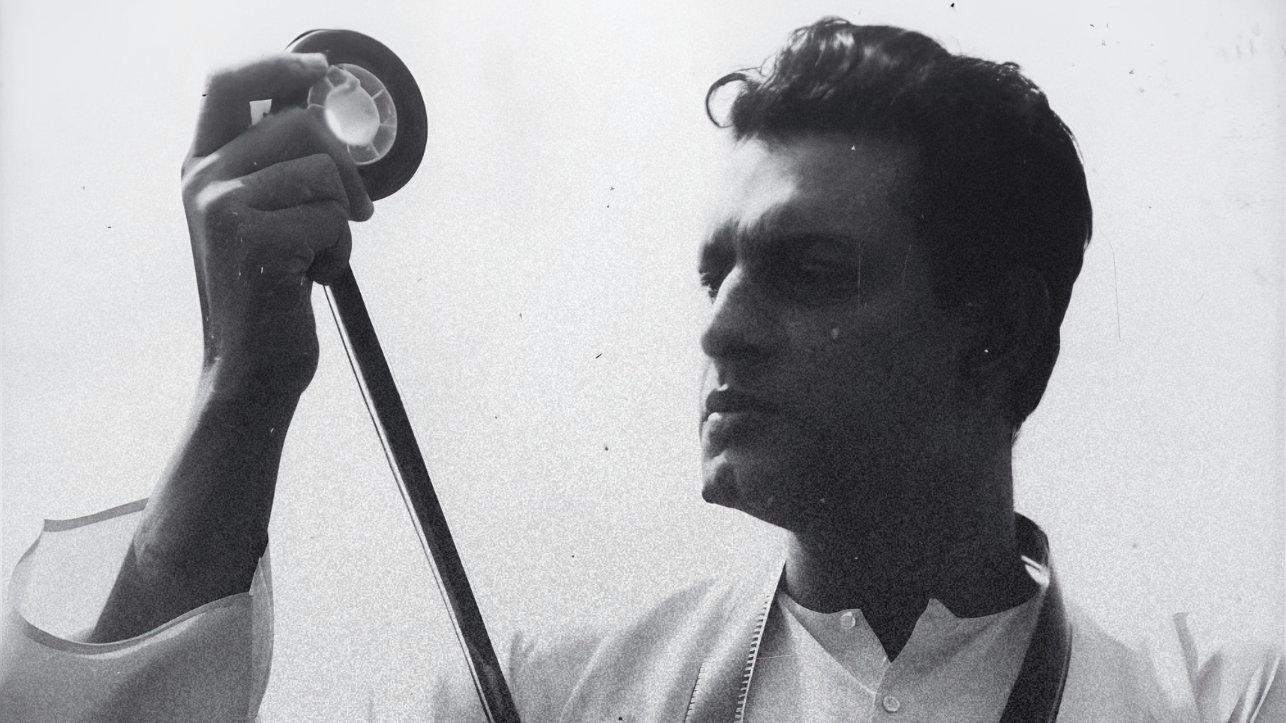
Ray's score, with its delicate violin motifs he penned himself, swells subtly during her feverish writing scenes, mirroring the rhythm of her repressed desires. This philosophy extends seamlessly into his use of music, an aspect of his craft that further reflects his artistic completeness. Ray composed his own scores too, blending Ravi Shankar-inspired sitar with Western orchestration to underscore emotional undercurrents without overpowering the frame. This economy of means earned Charulata praise from Scorsese as “one of the most elegantly made films I have ever seen”, proving Ray's craft could evoke Victorian restraint and modern alienation in equal measure.
Such techniques ripple through his oeuvre; the handheld tracking shots in Pather Panchali that hug Apu's curiosity or The Music Room's (1958) chiaroscuro lighting, where sitar strings vibrate under Ray's own composition amid a decaying zamindar's hubris. In Ray's hands, cinema wasn’t spectacle—it was revelation. He trusted the power of stillness, the eloquence of silence, and the expressive depth of a single frame. By stripping storytelling down to its essential elements, he created a cinematic language that feels both restrained and profoundly rich. It is this ability to say so much with so little that continues to define his craft, inviting viewers not just to watch, but to observe, reflect, and ultimately, to see. Ray himself articulated this restraint: “My cameraman and I devised a method... where we used bounced light instead of direct light. We agreed... four or five shadows following the actors is dreadful.” In an era demanding spectacle, his words endure as a manifesto.
Ray beyond cinema
To view Satyajit Ray only through the lens of cinema is to overlook the remarkable breadth of his creative legacy. His multifaceted contributions extended far beyond film, shaping Bengali literacy and visual culture through detective fiction, illustration and publishing. Ray was not confined to a single medium; instead, he moved fluidly between them, carrying with him a consistent artistic vision rooted in clarity, curiosity and humanism.
In literature, his most enduring creation remains the Feluda series, which debuted in Sandesh Magazine with “Feludar Goendagiri” (1967). At its centre is the sharp, bespectacled detective Prodosh Mitter—better known as Feluda—accompanied by his observant nephew Topshe and the flamboyant thriller writer Lalmohan Ganguly, or Jotayu. Spanning 35 stories, including beloved adaptations such as Sonar Kella (1974) and Joi Baba Felunath (1979), these narratives brought together Kolkata's chaotic streets, historical mysteries and razor-sharp logic. What made them distinctive was not just their suspense, but Ray's ability to make them accessible to readers of all ages while retaining intellectual depth.
Ray's artistic sensibility extended seamlessly into visual design, where he emerged as a virtuoso illustrator. He created over 300 book covers and vignettes, his clean lines and minimalist compositions defining the aesthetics of mid-century Bengali publishing. From the instantly recognisable Feluda paperbacks to editions of Rabindra Rachanabali, his designs demonstrated a rare balance between simplicity and expressiveness. His work in typography was equally significant; he experimented with and developed custom Bengali fonts, particularly for Sandesh, bringing a new level of precision and modernity to children's literature.
His association with Sandesh—a magazine originally founded by his grandfather—further highlights his role as a cultural curator. In 1961, Ray revived and co-founded the magazine with his wife Bijoya Ray, transforming it into one of Bengal's most influential children’s publications. Over the decades, Sandesh grew into a vibrant creative space, publishing more than 300 issues until 2010. Ray contributed extensively, writing under pseudonyms, translating works by writers such as Lewis Carroll, illustrating stories and even developing early narrative ideas that would later evolve into his iconic characters. In doing so, he not only preserved a family legacy that included the whimsical genius of Sukumar Ray, but also introduced generations of young readers to both local and global literary traditions.
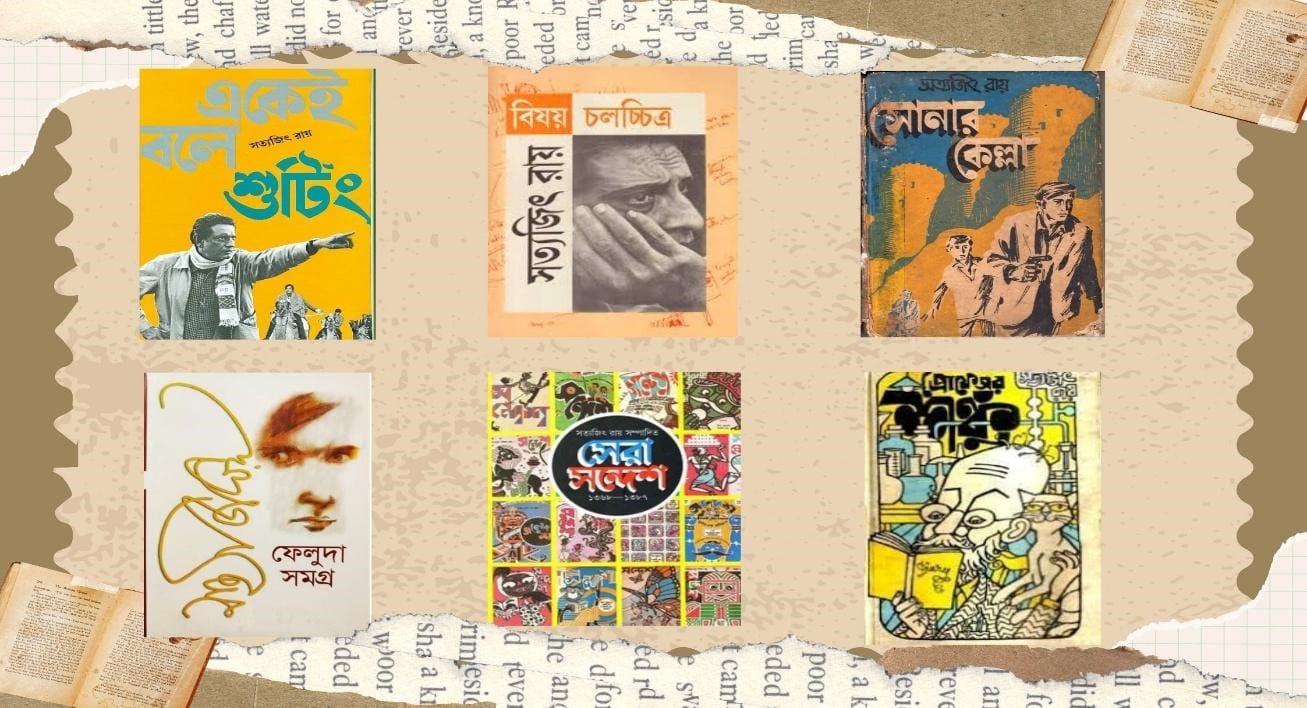
What unites these diverse pursuits is a singular creative philosophy. For Ray, storytelling was never limited to celluloid; it lived equally in ink, design and imagination. Whether crafting a detective narrative, designing a book cover or editing a children’s magazine, he approached each medium with the same meticulous care and respect for the audience. This polymath reveals a boundless humanism at the core of his work—a belief that stories, in whatever form they take, have the power to shape how we see and understand the world.
Why Ray still feels contemporary
The films of Satyajit Ray pulse with a quiet, timeless urgency—their themes of class divide, humanism, loneliness and modernity mirroring the fractures of today's world with uncanny precision. In an age of Instagram-filtered facades and the gig economy, Ray's gaze feels not archival but prophetic. His characters, suspended between aspiration and limitation, echo the realities of our present—urban migrants scrolling through job alerts in Dhaka's teeming streets or workers navigating the uncertainties of a rapidly shifting economy.
This relevance is perhaps most powerfully felt in Pather Panchali and across The Apu Trilogy, where class divide is rendered not as distraction but as lived experience. Barefoot Durga scavenging a candy wrapper from monsoon-soaked earth, a family's fragile home bending under the weight of poverty; these are not isolated images but enduring realities. Harihar dreams of poetry while Sarbajaya measures survival in handfuls of rice, their eventual displacement to the city reflecting a pattern that continues to define South Asian life. Today the trajectory finds new forms: gig workers weaving through traffic in Kolkata, garment labourers in Bangladesh stitching fast fashion for global markets, entire communities balancing hope against structural inequality. Ray's neorealism—captured in fleeting glances, in children’s games shaped by scarcity—reveals the quiet cruelty of class immobility, a condition that persists even as the world celebrates technological and economic progress.
Yet Ray’s cinema does not rest solely in realism; it expands into allegory without losing its human core. In Goopy Gyne Bagha Byne and its sharper, more political sequel Hirak Rajar Deshe, fantasy becomes a vehicle for critique. The whimsical journey of Goopy and Bagha, blessed with music and movement, unfolds into a subtle rebellion against authority. In Hirak Rajar Deshe, the satire deepens: a tyrannical ruler enforces obedience through hypnotic chants, reducing thought to submission while exploiting the labour of the powerless. Beneath its playful surface lies a striking commentary on power, control and the dangers of blind progress, echoing today’s realities of surveillance, algorithmic influence and populist narratives of “development” that often widen inequality. And yet, Ray resists cynicism. His faith in humanism endures, suggesting that creativity, empathy and innocence can still challenge even the most rigid systems.
Modernity, in Ray’s world, is not merely a backdrop—it is a force that reshapes relationships and interior lives. Loneliness, in particular, emerges as one of his most enduring themes. In Apur Sansar, Apu’s intellectual pursuits pull him away from familial bonds, leaving behind a quiet emptiness that success cannot fill. Similarly, in Charulata, emotional isolation unfolds within the confines of privilege; a woman surrounded by comfort yet deprived of connection. These portraits resonate deeply in today’s hyperconnected yet isolating world: elderly parents speaking to distant children through screens, young professionals navigating crowded cities while feeling profoundly alone. Ray’s restrained style, his use of silence, his attention to small gestures—allows this solitude to breathe, making it palpable and painfully real.
Yet Ray’s engagement with modernity did not remain confined to rural struggle or allegorical critique. As his cinema evolved, so did his gaze—turning inward to the shifting realities of urban life and the quiet dilemmas of identity. If his earlier films trace the contours of poverty and inner life, his later works move towards a more intimate interrogation of social change, moral courage and the fragile architecture of belief.
In Mahanagar, the story of a middle-class housewife stepping into the workforce becomes a quiet yet radical exploration of gender and urban transformation. Ray turns his gaze to the city’s swelling middle class, where Arati, a housewife turned door-to-door saleswoman, steps out of domestic silence into the competitive world of the marketplace. Her tentative independence, earning her own salary, negotiating with sceptical relatives, unfolds with remarkable subtlety, mirroring the quiet revolutions still taking place in drawing rooms across Bengal and Bangladesh, where women continue to balance family expectations with professional ambitions. Yet Ray refuses the comfort of a simple narrative of empowerment. As Arati’s confidence grows, so too does the emotional distance within her marriage; her husband’s wounded pride revealing the quiet tensions that accompany change. The film lingers in these in-between spaces, suggesting that social progress, however necessary, is rarely neat or without cost.
A similar depth of inquiry shapes Agantuk, one of Ray’s final works, where the arrival of a long-absent uncle unsettles the certainties of a modern, urban household. Returning as an anthropologist with quietly anarchic ideas, he questions civilisation, religion and the very notion of “progress” itself. What begins as suspicion gradually unfolds into a philosophical exchange; his calm, almost playful scepticism cutting through the family’s polite hypocrisy. In doing so, Ray exposes the fragility of the values they take for granted—values built as much on conformity as on conviction. In an age marked by rigid ideological positions and the noise of social media orthodoxy, Agantuk feels uncannily current. It offers no fixed answers, no doctrinal message; instead, it invites doubt, urging us to reconsider who we are and what we truly believe.
To return to Satyajit Ray today is not to revisit the past, but to confront the present with greater clarity. His cinema reminds us that progress, when stripped of humanity, becomes hollow. In the shifting landscapes of Bengal and beyond, where technological advancement coexists with deep inequality, Ray remains not a figure of nostalgia, but a mirror. And in that mirror, we are asked a quiet but urgent question: what kind of world are we choosing to build?
Perhaps the world has not changed as much as we imagine. Or perhaps it is we who have changed, moving faster, looking quicker and seeing less. The same narrow village path that Apu and Durga once ran down in Pather Panchali may now echo with the hum of mobile towers and the cold glare of LED screens, yet the wonder in their eyes—the quiet thrill of chasing a distant aeroplane, a fleeting dream—remains untouched by time. That sense of curiosity, of reaching beyond the visible horizon, continues to define us, even as the world around us grows louder and more fragmented.
In the cinema of Satyajit Ray, we find these continuities preserved with remarkable clarity. His films do not merely belong to another era; they hold a mirror to our present. The gig worker scrolling endlessly through job alerts in Dhaka’s crowded streets, the lonely parent reaching across continents through a flickering video call, the artist struggling to create meaning in an age increasingly shaped by algorithms; all seem to exist, in some quiet way, within Ray’s frames. His characters, though born of a different time, carry the same uncertainties, the same fragile hopes, the same longing for connection that defines contemporary life.
What makes Ray’s work endure is not simply its realism, but its insistence on humanity. His frames are never hurried, never overwhelmed by spectacle. Through minimal dialogue and evocative scores, he allows silence to speak, allowing emotion to emerge with a quiet intensity that lingers long after the moment has passed. In doing so, he reminds us of something we risk forgetting: that progress, when stripped of empathy and attention, becomes hollow. A world driven solely by speed and efficiency may advance, but it does not necessarily understand itself.
Perhaps that is why we continue to return to him. Not just for stories, but for something more essential. In the stillness of his images, in the spaces between words, we rediscover the act of looking itself. And in that rediscovery, we find a possibility of building a world where wonder, not want, defines the chase; where connection outweighs noise; where we learn, once again, how to truly see!
Syeda Samia Hossen Shreya is an undergraduate student in the Department of Journalism, Media and Communication at Daffodil International University.
Send your articles for Slow Reads to slowreads@thedailystar.net. Check out our submission guidelines for details.