


Bangladesh off US IP watch lists

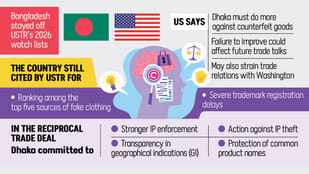
- Bangladesh avoids US intellectual property watch lists
- USTR urges Dhaka to strengthen IP enforcement
- Vietnam named priority foreign country for violations
Bangladesh has stayed off the latest United States intellectual property (IP) rights watch lists, but Washington has still urged Dhaka to strengthen enforcement to prevent unfair trade practices.
In its annual Special 301 Report released on Thursday, the Office of the United States Trade Representative (USTR) identified 26 trading partners for intellectual property protection and enforcement concerns.
 For all latest news, follow The Daily Star's Google News channel.
 It grouped them into three categories -- Priority Foreign Country, Priority Watch List and Watch List.
In this year’s report, Vietnam has been designated a Priority Foreign Country, a rare and severe classification that can trigger a trade investigation. The USTR said Vietnam has failed to address long-standing concerns over intellectual property protection and enforcement.
The designation is reserved for countries with the most serious IP-related practices that have a significant impact on US industries and are not making meaningful progress in negotiations or reforms.
The report said Vietnam had shown a persistent failure to resolve long-standing concerns. The United States first raised the issue in 2020 through a proposed IP Work Plan, followed by a revised proposal in 2023.
The USTR report added that Vietnam has made little progress in later bilateral engagement, including talks linked to an Agreement on Reciprocal, Fair, and Balanced Trade. Vietnam’s actions or inactions are causing significant damage to industries reliant on intellectual property in the US and other markets.
This year, the USTR placed six countries on its Priority Watch List. Those are Chile, China, India, Indonesia, Russia and Venezuela.
It said it would seek to engage intensively with these partners over the coming year.
A further 19 trading partners have been placed on the Watch List. Those are Algeria, Argentina, Barbados, Belarus, Bolivia, Brazil, Canada, Colombia, Ecuador, Egypt, the European Union, Guatemala, Mexico, Pakistan, Paraguay, Peru, Thailand, Trinidad and Tobago and Türkiye.
Argentina and Mexico have been moved from the Priority Watch List to the Watch List, reflecting improvements in intellectual property policy. Bulgaria has been removed from the list, while the European Union has been added.
Regarding Bangladesh, the USTR pointed to commitments made under a recently signed Agreement on Reciprocal Trade. This includes broad commitments on market access, economic and national security, and trade standards, including intellectual property.
Apart from Bangladesh, the United States has so far completed such agreements with Argentina, Cambodia, Ecuador, El Salvador, Guatemala, Indonesia, Malaysia and Taiwan.
These agreements, the USTR said, contain commitments aimed at strengthening intellectual property protection and enforcement against piracy and counterfeiting.
Citing a study by the Organisation for Economic Co-operation and Development (OECD) and the European Union Intellectual Property Office (EUIPO), released in May 2025, the USTR report said global trade in counterfeit and pirated goods reached $467 billion in 2021, equal to 2.3 percent of global imports.
USTR said Bangladesh was among the top five source economies for counterfeit clothing globally.
In fiscal 2025, China and Hong Kong together accounted for more than 87 percent of the value of counterfeit and pirated goods seized by US Customs and Border Protection, measured by manufacturers’ suggested retail price.
The report also highlighted ongoing US concerns over the EU’s aggressive geographical indication policies.
It said that the EU’s rules on geographical indications unfairly block American exporters from selling goods under familiar names or trademarks. To counter this, the US is pressing its case in trade talks and global forums such as the Asia-Pacific Economic Cooperation, World Intellectual Property Organization and the World Trade Organization.
It is also negotiating directly with individual countries, including Bangladesh, Brazil, Canada, China, Mexico and others, to ensure American producers can keep access to foreign markets.
The USTR said the Agreement on Reciprocal Trade signatories included provisions aimed at protecting US market access for cheese and meat producers using common names. It said these agreements also include commitments on transparency and fairness in geographical indication protections.
Delays in trademark registration, the report added, remain a major obstacle to protecting intellectual property rights.
Stakeholders identified Bangladesh, Iraq and South Africa as countries with severe delays in processing applications.
Comments