


Petroleum import bills surged 52% even before Iran war



Bangladesh’s petroleum import bill soared 52 percent year on year in the July-February period of the current fiscal year, even before the war in the Middle East broke out, raising fears of a heavier economic impact ahead.
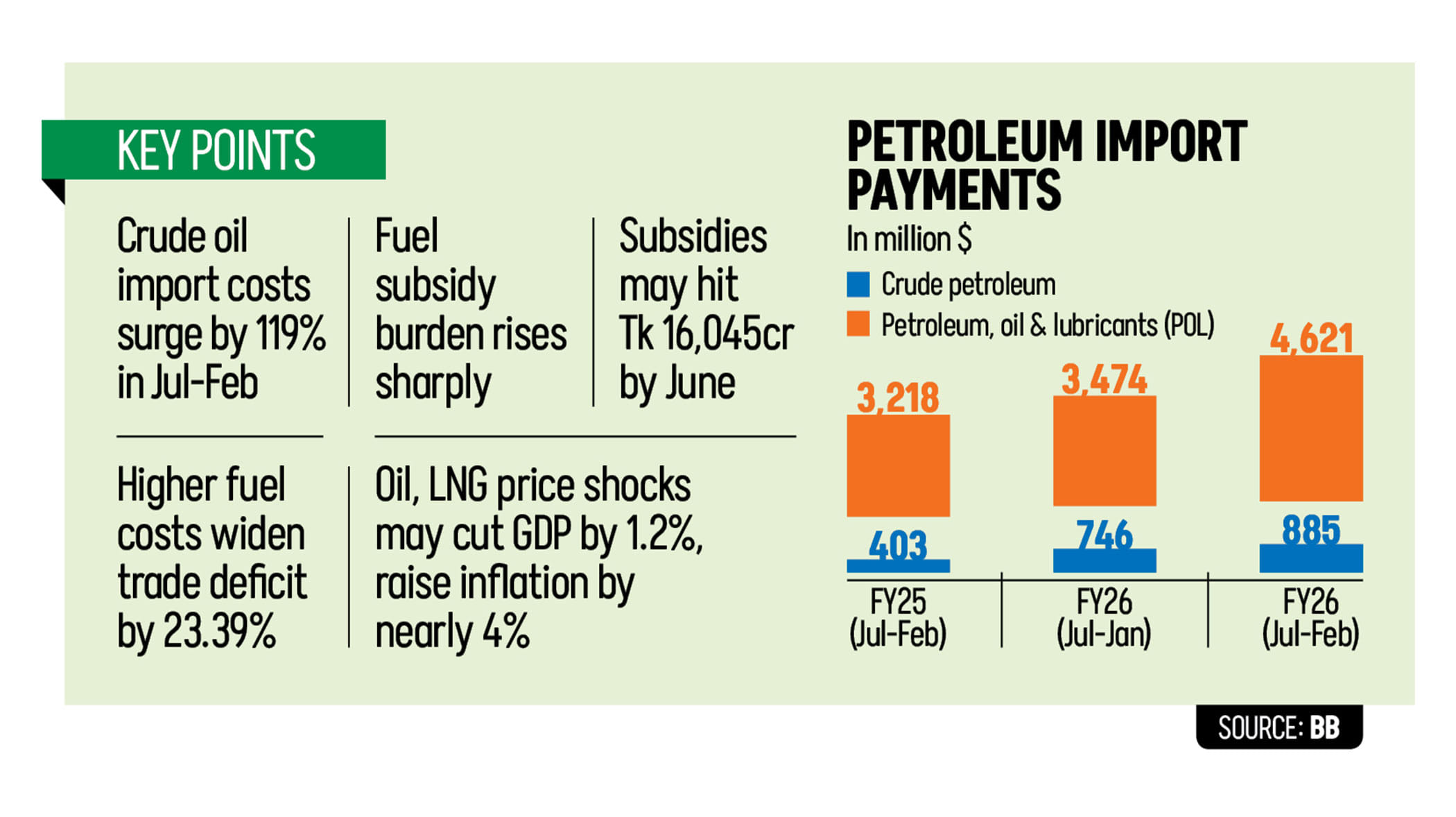
The country spent $5.50 billion on crude oil, petroleum, oil and lubricants (POL) imports in the first eight months of FY2025-26, according to Bangladesh Bank (BB) data.

Of it, the cost of crude petroleum imports surged 119 percent to $885 million during the period. Meanwhile, payments for POL rose 43.6 percent year-on-year to $4.62 billion.
The data on spiralling import bills for petroleum come as Bangladesh faces a fuel crisis. This follows the US-Israel’s war on Iran and Iran’s closure of the Strait of Hormuz. The strait is a key energy chokepoint that normally carries about one‑fifth of the world’s oil and liquefied natural gas (LNG) flows to Asia.

Bangladesh depends on imports for 95 percent of its annual petroleum demand of 70 lakh tonnes and nearly one-third of its gas consumption. Saudi Arabia, the United Arab Emirates and Qatar supply most of the country’s fuel.
Since these nations transport their energy through the strait, the conflict and soaring oil and LNG prices have raised concerns about the wider economic impact.
“The unprecedented closure of the Strait of Hormuz has set off a massive energy crunch in Bangladesh, revealing its extreme sensitivity to disruptions to supply chains originating in the Middle East,” said the South Asian Network on Economic Modeling (Sanem) in a statement yesterday.
It said that the conflict could hit Bangladesh’s economy through energy, remittance and trade channels, with energy posing the most immediate threat.
Mustafizur Rahman, distinguished fellow at the Centre for Policy Dialogue (CPD), said the sharp rise in petroleum import costs was likely driven mainly by higher prices rather than increased import volumes, as the conflict began only at the end of February and had a limited impact during the period.
Energy ministry officials said the import-adjusted cost of diesel had reached about Tk 198 per litre in March, while the retail price stood at Tk 100.
For octane, the cost was Tk 150.72 per litre, compared with a retail price of Tk 120. In March alone, this translated into an estimated subsidy burden of roughly Tk 4,231 crore for diesel and Tk 779 crore for octane.
In early April, Energy Minister Iqbal Hassan Mahmood said the government might need to spend up to Tk 16,045 crore in subsidies by June to maintain current fuel prices.
Besides, the additional cost of LNG would require another Tk 15,077 crore in subsidies for the April-June period, according to calculations made until March 30.

Rising petroleum costs come alongside a surge in fertiliser import bills, which increased by 60.2 percent to $3.17 billion during the first eight months of FY26, according to BB data.
Overall import bills for the July-February period rose 5.6 percent to $46.17 billion, widening the trade deficit.
Rahman said further import cost increases in March could push the deficit higher, add pressure on the current account, and affect the overall Balance of Payments (BoP), a summary of a country’s transactions with the rest of the world.
 For all latest news, follow The Daily Star's Google News channel.
During the July-February period, the trade deficit widened to $16.91 billion, up 23.39 percent year-on-year, largely due to high petroleum import costs amid negative export growth. Export earnings fell 2.6 percent to $29.26 billion.
The current account deficit narrowed to $1 billion, from $1.47 billion in the same period last year. Meanwhile, the financial account recorded a surplus of $4.08 billion, up from $435 million, according to BoP data.
Rahman said that the impact on the overall BoP may not be severe immediately, as part of the imports is financed through external loans, supporting the financial account.
He added that while Bangladesh’s BoP position has improved due to strong remittance inflows and higher external financing, the country ultimately needs stronger export growth to sustain the gains, as financial account inflows create future debt obligations.
BB data showed the overall balance for the eight-month period turned positive at $3.42 billion, compared with a $1.15 billion deficit a year earlier.




Comments