


Banks below Tk 2,000cr capital barred from cash dividends

Only one bank will be able to pay cash dividends next year after the Bangladesh Bank barred lenders with paid-up capital below Tk 2,000 crore from making such payouts.
In a circular issued yesterday, the Bangladesh Bank (BB) said the move is aimed at strengthening the capital base of the banking sector. It also seeks to improve the ability of commercial lenders to absorb future risks amid a challenging global and domestic financial environment.
 For all latest news, follow The Daily Star's Google News channel.
 Only BRAC Bank and National Bank PLC (NBL) meet the higher paid-up capital threshold among listed lenders.
However, National Bank remains in significant losses, leaving BRAC Bank as the only institution effectively positioned to meet the requirement for cash dividend payments.
Even for banks that meet the paid-up capital threshold, the central bank has capped cash dividends at 50 percent of the declared payout, with the remainder to be issued as stock dividends.
The new rules will take effect from dividend declarations for the year ending December 31, 2026 and onwards, according to the Supervision Policy and Coordination Department of Bangladesh Bank.
The policy is expected to affect most listed banks, raising concerns among market participants about shareholder returns.
While the measure may improve the resilience of the banking sector in the long run, it is likely to reduce flexibility for banks that are otherwise financially stable.
Mashrur Arefin, chairman of the Association of Bankers, Bangladesh (ABB), the apex body of the country’s commercial bank executives, said, “This is a good move towards strengthening the capital base of the banks.”
He said a few banks with weak capital bases did take cash out in the past. But the shareholders of healthy banks will now suffer. “That’s not good.”
The ABB chairman said the dividend rule should instead have been linked to the Capital Adequacy Ratio, which he argued would have been fairer for shareholders of well-performing banks.
“Shareholders have a reasonable expectation of cash returns when a bank is performing well. That incentive for supporting strong banking institutions is being overlooked,” said Arefin, who is also managing director and chief executive officer of City Bank.
“This will not help our agenda to encourage people to go to the capital market for their investments. I don’t know why CAR wasn’t considered. Is it because the government is seeking higher credit growth? But that connection is too distant.”
Banks can raise paid-up capital through rights shares to meet the Tk 2,000 crore threshold and retain eligibility for cash dividends. A rights issue allows existing shareholders to buy additional shares, usually at a discounted price, in proportion to their current holdings.
Asif Khan, president of CFA Society Bangladesh, also opposed linking dividend eligibility to paid-up capital, suggesting it should instead be tied to shareholders’ equity, capital adequacy ratio and provisioning levels.
He said that only one bank now effectively meets the Tk 2,000 crore threshold. So, most of the commercial lenders will be unable to pay cash dividends from next year, which could affect the capital market.
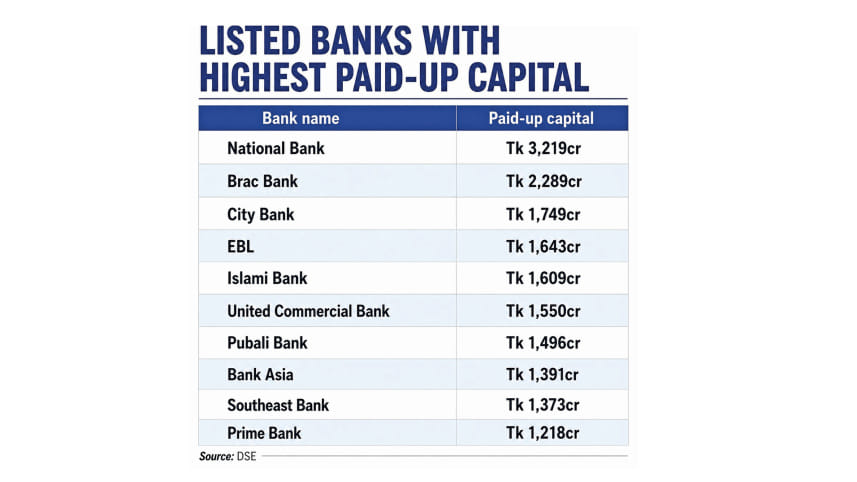
According to Dhaka Stock Exchange (DSE) data, National Bank PLC has the highest paid-up capital among listed lenders at Tk 3,219 crore, followed by BRAC Bank at Tk 2,289 crore and City Bank at Tk 1,749 crore.
Other major lenders include Eastern Bank (EBL), Islami Bank Bangladesh, United Commercial Bank, Pubali Bank, Bank Asia, Southeast Bank and Prime Bank, all of which fall below the paid-up capital threshold.
EBL’s paid-up capital stands at Tk 1,643 crore, Islami Bank Bangladesh’s at Tk 1,609 crore and United Commercial Bank’s at Tk 1,550 crore, according to Dhaka Stock Exchange (DSE) data.
Pubali Bank has Tk 1,496 crore, Bank Asia Tk 1,391 crore and Southeast Bank Tk 1,373 crore, while Prime Bank’s paid-up capital is Tk 1,218 crore.
Khan said many of these banks maintain strong capital adequacy ratios and have no provisioning shortfalls.
“So, why would they be barred from giving cash dividend?”
He also pointed to a possible policy conflict with the National Board of Revenue (NBR), which imposes higher tax on listed firms that do not pay cash dividends.
The Bangladesh Bank said the decision was taken considering the overall condition of the banking sector, depositor protection, financial resilience and the need to strengthen capital conservation buffers.
A senior central bank official said the policy was intended to improve the health of the banking sector and protect depositors’ interests.
Other eligibility criteria for dividend payout would remain unchanged, he added.
Comments