


Dholaikhal: The scrapyard that keeps Bangladesh moving


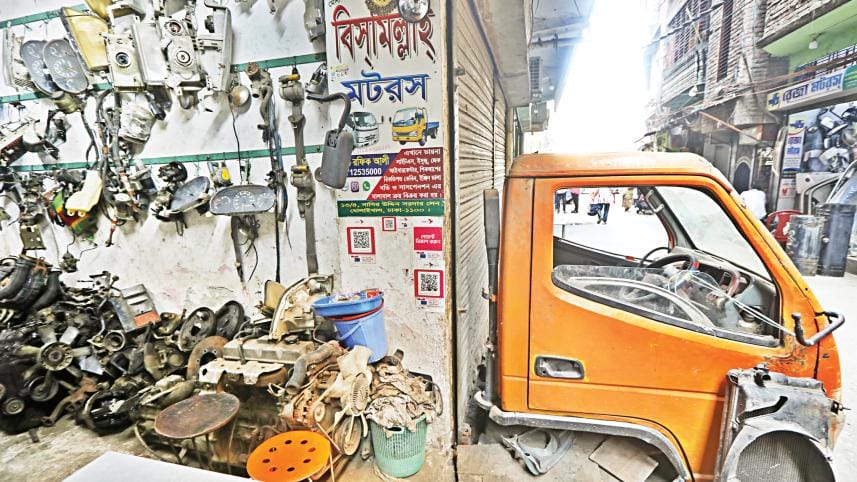
Go to Dholaikhal and see if you can find it there: this is the cruel joke your friends might have hurled at you once you lost your car. In many cases, it would be true.
There are an estimated 30,000 parts in a typical modern car, and the saying goes that there is no part you cannot find here. Any repair you might ever need, Dholaikhal is the place to go when all else fails.
 For all latest news, follow The Daily Star's Google News channel.
Known for its illiterate mechanics who can dismantle an entire car in less than an hour and who built everything from miniature medical ventilators during the Covid-19 pandemic to repairing gigantic water vessels, the junk yard carries a mix of shame, pride and surely history.
Its proximity to Sadarghat makes Dholaikhal what it is today.
Old Dhakaites say larger paddle steamers once carried passengers from faraway districts to Dhaka's Sadarghat in the British period. Those vessels often needed anything from minor fixes to major overhauls, gradually giving birth to Dholaikhal on the banks of the Buriganga.

This place came to be seen as the beating heart of inland water transport in Bangladesh's old river-based era, and it also paved the way for the shift from paddle steamers to motor vessels.
As time passed, the 550-sq-yard engineering hub of old Dhaka evolved, adopting auto repair to become a small parts supplier to the garment sector. It now repairs refrigerators, sells old air-conditioners, and makes light and heavy machinery.

Bordering Bahadur Shah Park and Tipu Sultan Road, it houses some 7,000 to 8,000 workshops. Its narrow, choked lanes are filled with the constant smell of grease, engine oil and metal.
"Everything here is used," says Md Rafiq of Tansen Motors, a veteran trader who has spent more than 40 years in these lanes. "Almost everything is reconditioned, second-hand."
He does not say this as a complaint. Rather, it is the reason the area exists at all. Dholaikhal supplies what many industries and transport operators need: functioning parts at prices they can manage.

RECOVER, RECONDITION, REUSE
The flow of material begins thousands of kilometres away. Most of the parts traded in Dholaikhal come from Japan, a country known for strict maintenance habits and reliable components.
Vehicles that reach the end of their domestic life cycle are shipped to dismantling hubs, often in Dubai, where the cars are taken apart piece by piece. Engines, suspension units, compressors, electronic modules and filters are packed into containers and sent to Bangladesh. Then Dholaikhal takes over.
Inside the workshops, parts are cleaned, repaired, polished, repainted and tested. Some arrive in scrap condition and need extensive work. Others need only minor adjustments. Either way, the process keeps equipment in circulation and lowers costs for consumers.

For bus owners, truck operators, small factory managers and everyday motorists, buying new parts is often too costly or too slow. Import procedures can drag on for weeks. Dholaikhal offers a faster, cheaper fix.
The inventory is encyclopaedic, covering Japanese, Korean and even discontinued models no longer supported by manufacturers.
"Bolts, mirrors, bearings, springs, brakes, boosters, hangers, tyres -- you name it. Everything is available here at a reasonable price, often 50 to 70 percent cheaper than a new import," said Md Nasir Uddin of Bhai Bhai Motors.
The scale is immense.

In the 1980s, Dholaikhal had around 500 to 600 shops, according to Mosharraf Hossain Mir of the Bangladesh Engineering Association. "Today, more than 5,000 officially registered shops run in the core area, with many more informal stalls surrounding them."
It employs 60,000-70,000 people, including mechanics, lathe operators, welders, polishers, assembly workers, transporters and the middlemen who negotiate, source and distribute parts.
FROM MUGHAL CANAL TO INDUSTRIAL CLUSTER
The name Dholaikhal comes from a canal dug during the Mughal era. The canal was completely filled in by 1973, making more room for the growing light engineering cluster.
After independence, import restrictions and a lack of domestic machinery pushed small workshops to produce and repair parts on their own. They experimented with casting, lathe work, welding and assembly. Over time, these skills developed into a specialised sector.

A turning point came in 1986 with the Dholaikhal Zinzira Project, which offered Tk 5 crore in government loans. By then, the area had developed a reputation for mechanical problem solving. The loans helped formalise parts of the trade and enabled workshops to expand.
Today, Dholaikhal remains central to Bangladesh light engineering sector, often described as the mother of all industries.
According to the SME Foundation, light engineering contributes around 3 percent to GDP with a value addition rate of 30 to 35 percent. Dholaikhal alone hosts an estimated 7,000 to 8,000 factories and workshops, involving roughly Tk 2,500 crore in investment and around Tk 5,000 crore in annual turnover.
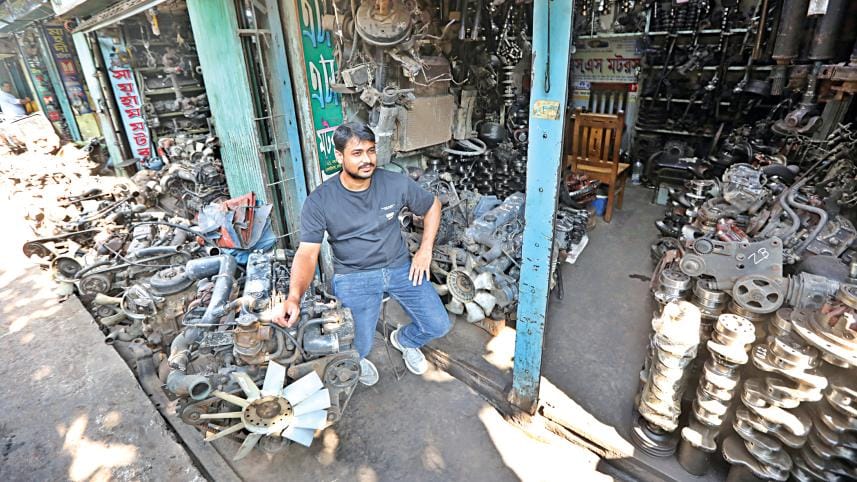
Much of this operates informally, without central planning or modern infrastructure.
Workers earn widely varying wages depending on their expertise. A polisher or dismantler may pocket daily wages, while skilled lathe operators and troubleshooters earn way better. Many take on extra work after hours, repairing custom components or upgrading old machines.
Md Kamal, while polishing a suspension part, said the pay is not high. "But there is plenty of extra income if you know your work... I enjoy the challenge, the precision needed."
At Dholaikhal, it is common to find engines lying in rows, waiting for inspection. Scrap metal is sorted and sent to recycling yards. Tyres are cleaned, repainted and reshaped, then sold for Tk 800 to Tk 3,000 depending on quality.
Md Harun, owner of a junk yard, said properly reconditioned tyres "can easily last a year."
Navigating the lanes requires patience, but the density of parts is exactly why customers like Hasibur Rahman return. For many older cars, resident Ali Azgar says, "only Dholaikhal can help."

Workshops produce concrete mixers, brick crushers, stone crushers, roof hoists, moulds, agricultural tools, pipe elbows, soldering parts, engine filters and components used in textile, steel, sugar, dyeing, spinning and jute mills.
Several items, such as concrete mixers and farming tools, are also being exported. According to business owners, shipments could grow if proper testing and certification facilities were available.
But the cluster faces serious constraints. Modern machinery is scarce. Computer numerical control (CNC) equipment, standard elsewhere, is almost absent because of high costs.
Most workshops depend on manual lathes, basic welding sets and simple drills. Cramped spaces limit expansion, power outages cut productivity, and electricity bills strain small operators. Training opportunities are limited, so younger workers often leave for other jobs.
A HOSPITAL FOR MECHANICAL CREATURES
Entrepreneurs believe light engineering exports, which recently touched $796 million, could rise further with modern technology and product testing.
Md Abdur Razzaque, president of the Bangladesh Engineering Industry Owners Association, has watched the sector evolve.
He began making lathe machines in the 1980s. One machine had 317 parts, and Dholaikhal workshops made 310 of them. Motors, belts and bearings were the only imported items.
"Back then, this was a good business. After paying all the workers, we made around Tk 10,000 to Tk 15,000 profit per month, which was a big amount," he said.
But from 1994, imported machines from India and China flooded the market. Local manufacturers could not match the price or the technology.
"Today, Dholaikhal is no longer a manufacturing hub. It has become a repair centre, a hospital for mechanical creatures," he said.
Engineers from factories across Bangladesh come here when one broken part halts an entire production line. Skilled machinists often reproduce the needed component within hours. "But this area still runs as part of the informal sector, with huge potential but no investment."
He notes that the Light Engineering Industry Development Policy 2022, which promised better infrastructure, industrial parks, financing and incentives till 2027, has not been implemented. "If it had been, this sector would be far ahead."
HOW TO SAVE IT
The SME Foundation has outlined several recommendations for Dholaikhal.
Short-term measures include specialised training in mould design, machine operation and troubleshooting; accredited testing labs; and dedicated loans for technology upgrades. The foundation also suggests fairs and buyer-seller meetings at home and abroad.
Medium-term steps include exposure visits and technology exchanges with China, Taiwan, Vietnam, Malaysia, South Korea and Thailand. The creation of common facility centres is also advised.
In the long term, the foundation calls for full implementation of the Light Engineering Industry Development Policy 2022 and new industrial clusters across the country.
The goal is to modernise a sector that has grown despite little formal backing.
For now, Dholaikhal continues in its usual form, crowded and resourceful. It may not resemble a modern industrial zone, but it performs the work of one. It keeps factories running, maintains transport fleets and supplies equipment to industries from construction to agriculture.
Comments