


Revisiting Humayun Azad’s classic, ‘Koto Nodi Shorobor’
The relationship between mutual intelligibility and linguistic classification is famously complex, often boiling down to politics rather than purely linguistic differences. In Scandinavia, Danish, Norwegian, and Swedish are treated as separate languages primarily because they belong to different countries, a separation cemented by historical events that dissolved pan-Scandinavian political unions.
Our Bangla is a great counter-example. Obviously, the varieties spoken on the two sides of the border, in Bangladesh and West Bengal, have many differences but they are, nonetheless, Bangla, and their speakers identify themselves as speakers of the Bangla language. This starkly contrasts with Hindustani, which, after the birth of India and Pakistan, was purposefully developed into two national languages: Hindi and Urdu. A similar, more recent fragmentation can be seen in the Balkans, where Serbo-Croatian was deliberately split into Serbian, Croatian, Bosnian, and Montenegrin to match new national identities. Bangla, however, for a very long time, has resisted this powerful political tide.
 For all latest news, follow The Daily Star's Google News channel.
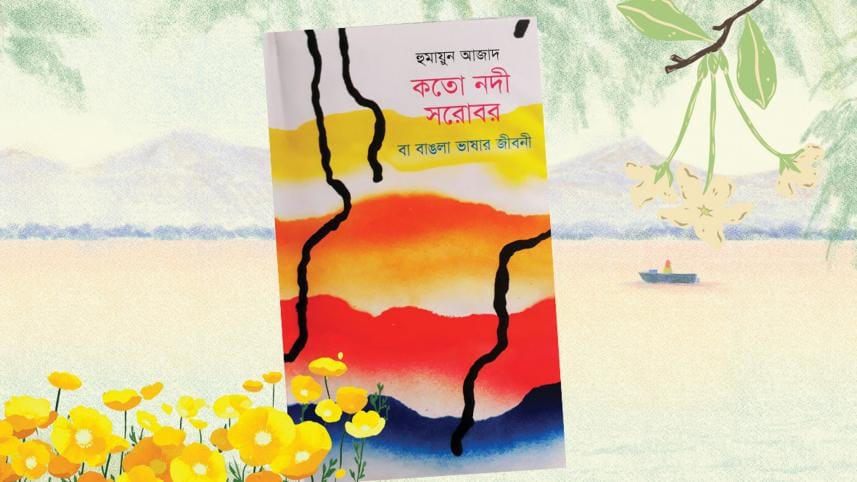
 Certainly I didn't know all this when I was in high school but I was deeply intrigued by a little book back then. It had a fascinating title: Koto Nodi Shorobor (1987) and Humayun Azad's prose was enchanting to that little teenager. Fast forward to early November of this year, and as I was walking down a particularly suffocating alley of Nilkhet, a dusty old version of this book caught my eyes. I bought it for just 50 taka without much thought. Back in my room, when I read it, I was enamored, more so than the little teenager. I study linguistics now, and so I am quite familiar with what Azad has written and even now this seemed a particularly enthralling read. I couldn't put it down.
This renewed enchantment, I realise, stemmed from finally understanding the analytical power of Azad's central metaphor: the 'jiboni' or life story of Bangla (the subtitle of the book is Bangla Bhashar Jiboni). In my early teens, I took it literally and didn't give it much thought but now I can see that this framing was his core argument. By giving Bangla a biography, Azad emphasises its continuous, unbroken lineage and its ability to adapt, borrow, and grow just like any living organism.
And while there's a powerful romance in the idea that a life story cannot be severed by a border, this is not a permanent condition. The protagonist of W H Auden's "Partition" (1966) may have failed to cleave our language in name, but he set in motion an inexorable bifurcation. The geographical chasm will continue to widen the linguistic one, until, perhaps a few hundred years from now, politics or time will do the trick, turning one language into two.
Azad's brilliance lies in anchoring us to the shared history of the language that has so far defied it. He traces Bangla's origins to the spoken Magadhi Prakrit, framing our language's birth as a vernacular defiance against a rigid literary establishment. From this point of origin, Azad takes us on a thousand-year journey, presenting its evolution as a dynamic story of encounters. The arrival of Perso-Arabic influence, for instance, is depicted as a vital enrichment that gave the language new textures, sounds, and a worldly flexibility. This continuous life is given a spine, a verifiable timeline, through its literary milestones, which he presents as proof of consciousness: the cryptic verses of the Charyapadas emerge from the mist of time, followed by the devotional ecstasy of Vaishnava poets and the grand narratives of the Mangalkavyas, culminating in the standardisation in the works of Ishwar Chandra Vidyasagar, Rabindranath Tagore and others. Azad here does more than merely listing these events, he weaves them into the biography of a single, continuous entity.
The book's enduring magic comes from its prose, a hypnotic instrument Azad uses to speak to us about our own language. The genius of Koto Nodi Shorobor lies in its brilliant use of metaphors and comparisons. The first chapter of the book illustrates this perfectly. He compares our innate thirst for the mother tongue to the mythical chatok bird, which thirsts only for the first drops of pure rainwater and will not drink from any other source. This image transforms language from a social contract into a primal, existential need. He deploys this technique throughout the book. Whenever needed, he does state the phonological changes that occurred but he also personifies the sounds themselves, and by anthropomorphising these abstract processes, translating concepts like vowel harmony or lenition into tales of transformation, Azad makes the history of a word as dramatic and magnificent as the life of a character in a novel.
This narrative method serves as a vehicle for Azad's arguments. His biography of the language is a celebration of hybridity. In a region where linguistic identity is often weaponised through appeals to purity, Azad's history is a powerful polemic against such rigid thinking. In his telling, the arrival of a Persian or Portuguese word is as natural and vital as a river absorbing a new tributary and each addition strengthens the current and enriches the ecosystem. He shows, for instance, that some of our most intimate and essential words, words that purists might disdain as foreign, are now part of Bangla's soul. By doing so, he constructs a rationalist history of a people reflected in their tongue: one of trade, conquest, love, and intellectual exchange. Any attempt to purify this language is an act of historical violence, a denial of this rich past. To freeze the language in a pure state, a vain attempt anyway, is to kill it, to stop the flowing river and turn it into a static block of ice. Koto Nodi Shorobor, ultimately, stands as Azad's precious paean to our language.
All of this is not to say that the little book is free of vices. Its intended audience of children and laypeople makes a degree of simplification necessary, but this approach has its drawbacks. Problems arise when Azad's sweeping statements obscure crucial sociolinguistic and historical realities. For example, his assertion that languages "borrow when needed, to stay lively" is a glaring oversimplification. It erases the power dynamics of conquest and colonialism that drove the entry of Persian and English into Bangla.
This tendency to smooth over complex histories extends to his claims about universal constructions. In his admirable effort to make language feel structured and familiar, Azad occasionally makes sweeping declarations that are questionable and wrong. For instance, he states definitively that "in all languages of the world, there are these three persons of pronouns" (ami, tumi, shey). A few pages later, he makes a similarly bold claim: that "in all languages of the world, there is a difference in the form of nouns and pronouns for singular and plural." Languages of the world have such a breathtaking diversity that they defy such easy categorisation. Many languages across East Asia, like Chinese and Vietnamese, manage perfectly without mandatory plural markers on nouns. Others have pronoun systems far more complex than our own, including the crucial distinction between an "inclusive we" (you and me) and an "exclusive we" (me and others, but not you). By presenting the structure of our language as the default, Azad's book, however inadvertently, flattens this rich diversity that makes its study so endlessly fascinating.
Furthermore, when Azad recounts how even Sri Chaitanya was mocking Sylheti, he does so with a historical detachment that feels unsettling. Reading this now, I can't help but feel a pang of disappointment. The issue is that Azad presents this historical mockery as a neutral, almost charming anecdote. For his young audience, this serves to normalise a deeply ingrained social prejudice. Here, I wished Azad the linguist had intervened. He was perfectly capable of explaining that this form of joking is not harmless fun, but a classic expression of a power dynamic, where the speech of the center mocks the speech of the periphery to reinforce its own prestige.
Later in the book, in describing the victory of the Language Movement, Azad's praise culminates in the assertion that Bangladesh is a unique country named after its language, "The language is Bangla, the country is Bangla." This is, frankly, not far from the monolithic views that he lambasted in his more politico-religious books. The minority languages of the country are at a great peril now. For the speakers of these languages, many of which face the very real threat of endangerment, the declaration of a proudly monolingual state would not come as comforting, nor is it very characteristic of the Azad the rationalist who championed a pluralistic society and here he was momentarily eclipsed by the nationalist celebrating a singular identity.
Obviously, these shortcomings don't take much away from the writer's magnificent love letter to the beautiful language that is Bangla. It is the text that awakened in me a profound thirst: a need to understand the origins of the words we speak and the history that lives in our mouths. The critiques I have now are a direct result of the curiosity it first instilled. Azad's book did not give me all the answers, but it taught me, indelibly, how to love the question.
Najmus Sakib studies Linguistics at the University of Dhaka. Reach him at kazis713@gmail.com.
Comments