

Cash transactions hold back economic growth
In principle, there is nothing wrong with cash financial transactions. The problem arises when they are used to evade tax, launder money, facilitate illegal deals or pay bribes. In such cases, the transactions become questionable.
3 December 2025, 18:00 PM
3 December 2025, 18:00 PM

Merger of financially weak banks
After a long period of faulty medical treatment, when a patient is sent to the ICU, doctors then have a limited scope for any aggressive treatment, and the chance of recovery becomes faint. A similar situation has unfolded in the banking sector.
24 November 2025, 19:43 PM
24 November 2025, 19:43 PM

Reforms overdue on tax assessment
Unlike in many other countries, honest taxpayers in Bangladesh often face higher taxes, harassment and injustice, and are sometimes pushed towards corruption. Meanwhile, tax evaders get away by resorting to corrupt practices, false financial reporting and underpayment. This situation has led to lower tax collection, a narrow tax base, excessive reliance on indirect taxes, an unfavourable investment climate and, ultimately, slower economic growth as seen over the past many years.
11 November 2025, 18:00 PM
11 November 2025, 18:00 PM

Strengthening governance in Bangladesh
Governance is essential at all levels, whether in a family, a company or a government. It is not rocket science but a matter of standard operation and administration. This includes, among other things, compliance with rules, regulations and policies, with due importance placed on avoiding misrule and mismanagement, and ultimately protecting the public interest. These are basic requirements.
7 July 2025, 18:00 PM
7 July 2025, 18:00 PM

FY26 budget is far from expectations
Among many other things, the current interim government is pro-reform in many sectors. Unfortunately, there is almost no reflection of this in the recently presented budget.
17 June 2025, 18:00 PM
17 June 2025, 18:00 PM

Fallacies in financial reporting in Bangladesh
Credible financial reporting is a matter of public confidence, yet in many cases, it has failed to meet expectations, especially in recent times. Debates and discussions have taken centre stage, with arguments and counterarguments being fervently exchanged. Let us revisit the fundamentals.
19 May 2025, 18:00 PM
19 May 2025, 18:00 PM
Dealing with financial corruption with zero tolerance
It is a matter of great concern that Bangladesh has been experiencing widespread corruption for many years at almost all levels, impacting the growth of the economy and the country as a whole.
13 May 2025, 18:00 PM
13 May 2025, 18:00 PM
FDI scenario in Bangladesh
Bangladesh has struggled for decades to attract foreign direct investment (FDI). Occasionally, promising prospects emerged, only to fade away for various reasons. For a country with no significant mineral resources and a large population of unskilled and semi-skilled workers facing high unemployment, FDI is vital.
28 April 2025, 18:00 PM
28 April 2025, 18:00 PM

Minimise tax evasion and combat graft
There is no denying the fact that Bangladesh’s economy has grown at a steady and relatively fast pace since the early 1990s.
23 March 2025, 18:00 PM

Accelerating revenue collection by NBR
There is no denying that Bangladesh’s economy has grown at a fast and more or less constant rate since the early 90s. Similarly, our dependence on foreign loans and grants for development budget had also reduced after, among others, the introduction of VAT.
24 November 2024, 18:00 PM

Personal guarantee against corporate lending: how effective is it?
Providing securities and guarantees is very common in corporate lending. Securities are immovable and moveable tangible assets and might be in the forms of pledge, hypothecation or in any other form.
25 September 2024, 18:00 PM
Siphoning public money and its fate
In recent years, Bangladesh’s position in the global corruption index has been a major concern. Under the previous regime, the situation deteriorated, especially as people in power and their families became more deeply involved in corruption. While corruption exists in most countries, the question is its magnitude. If it goes beyond a tolerable level, it can severely affect the economy and its growth. There is a general perception that a 10 percent reduction in corruption can positively impact GDP growth by 1 percent, although this relationship varies by country and requires further research.
18 September 2024, 18:00 PM

More effective steps needed to widen tax net
With 53 years having passed since Bangladesh gained independence, it is now considered as one of the next emerging economies in Asia and has the prospect of being ranked among middle-income countries.
20 August 2024, 18:00 PM
Large Taxpayers Unit deviating from basic principles
The idea of establishing a Large Taxpayers Unit (LTU) in Bangladesh originated from the government’s desire to introduce modern methods of tax administration, although in a limited scale. It started functioning in 2003.
8 May 2019, 18:00 PM
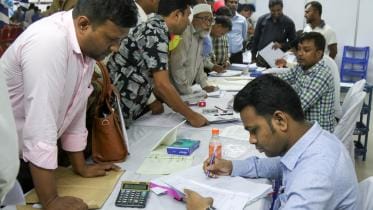
Expansion of tax net should be a top priority
Bangladesh has an estimated population of more than 16 crore, but the number of registered taxpayers (e-TIN holders) is roughly 38
6 May 2019, 18:00 PM