


Tiny Cape Verde craft towering tale
The group stage of the World Cup unfolded largely as expected. Most of the traditional heavyweights secured their places in the Round of 32, reaffirming the established hierarchy of international football. If there was one notable casualty, it was Uruguay, whose early exit stands out as perhaps the tournament’s biggest disappointment so far.
The stars who arrived carrying the burden of expectation have, by and large, delivered, sustaining the romance that only a World Cup can offer. Iran’s campaign, overshadowed by political issues beyond football, has also drawn global attention.
 For all latest news, follow The Daily Star's Google News channel.
 Yet beyond the familiar rhythm of favourites advancing and superstars shining, there is one story that best captures the spirit of this World Cup: Cape Verde.
In an era when football is increasingly measured by money, infrastructure and market size, Cape Verde’s rise is a reminder that success is not determined solely by geography, population or economic weight.
Spread across 10 islands in the Atlantic, Cape Verde covers just 4,033 square kilometres and has a population of about 561,900. Its economy is largely service-driven, anchored by tourism, and produces a GDP of roughly USD 2.77 billion. By conventional measures, it is a nation that should struggle to compete with football’s established powers.
Instead, Cape Verde have become history-makers.
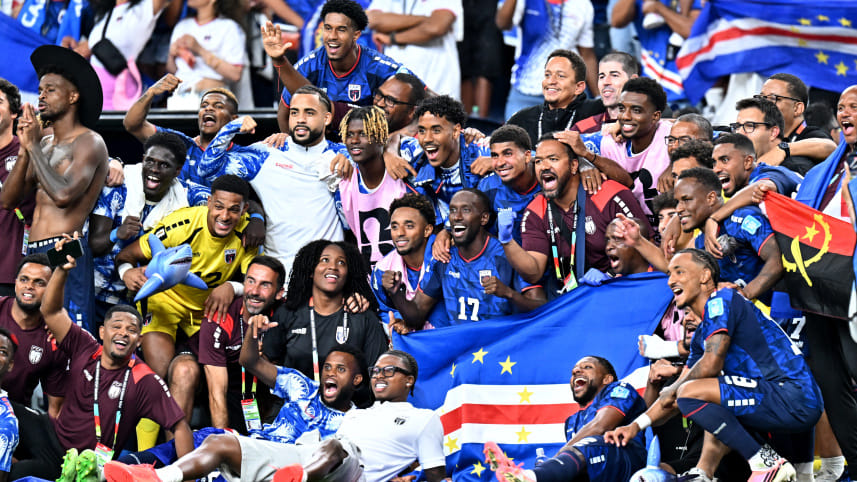
The Blue Sharks are now the smallest nation ever to reach the knockout stage of a World Cup. Ranked 64th before the tournament, they finished second in Group H ahead of Saudi Arabia and two-time world champions Uruguay, securing progression with three draws, including a memorable goalless draw against pre-tournament favourites Spain and a courageous 2-2 stalemate with Uruguay. Their reward is a meeting with defending champions Argentina.
More significantly, they have challenged long-held assumptions about what defines progress in international football, showing that structure, continuity and clarity of method can matter as much as resources.
The Cape Verdean Football Federation (FCF) deserves immense credit for recognising and harnessing one of its greatest assets: its diaspora. Successive droughts and economic hardship over the last century has left sizeable Cape Verdean communities in Portugal, the Netherlands and beyond, particularly in Rotterdam, and the FCF has turned that reality into an advantage. Fourteen members of the 26-man squad were born outside the country, including six from Rotterdam, allowing Cape Verde to combine national identity with European football education.
Continuity has mattered just as much. Coach Bubista, a former Cape Verde centre-back, has been in charge since January 2020, given time to build a compact, disciplined side that blends defensive organisation with technical assurance.
This is the same group that upset Ghana and held Egypt en route to the Africa Cup of Nations quarterfinals, a decade after their tournament debut, and had nearly made the cut in the 2022 edition. Their defensive discipline has been striking. Against Spain, they committed just one foul throughout the match -- the fewest by any team in a World Cup fixture since 1966. Veteran goalkeeper Vozinha, now 40, produced seven saves in that match and again proved decisive in subsequent games.
“We always train and play as a unit,” has become the defining philosophy of the Blue Sharks.
That unity was evident in Houston yesterday (Bangladesh time), where players huddled around a mobile phone awaiting confirmation of Spain’s result before celebrating. In the stands, supporters embraced, danced and wept as a nation of just over half a million secured its place among football’s top 32.
Cape Verde's emergence has also become the most persuasive argument in favour of FIFA's expanded 48-team World Cup. Critics warned that expansion would dilute quality; instead, it has widened football’s narrative, creating space for stories that might otherwise never surface.
As former England defender Gary Neville put it: “I think those sceptics who thought expanding the World Cup wasn’t the right thing might be rethinking it watching these Cape Verde fans, because this is really special. A country of 500,000 people getting to the knockout phase. We’ve seen Uruguay, one of the biggest countries, going out and then one of the smallest teams making it. What a moment for them.”
Football, indeed, belongs not only to the elite but also to those willing to dream, plan and persevere.
Cape Verde’s achievement is not a fairy tale built on chance. It is the product of of vision, organisation and belief.
For Bangladesh’s football-loving millions, their journey poses a sharper question: if a country of barely half a million can reach football’s biggest stage through structure and clarity of purpose, what holds others back?
In a tournament filled with familiar giants and celebrated names, Cape Verde may yet leave behind the biggest lesson.


Comments