


Level playing field and the science behind it
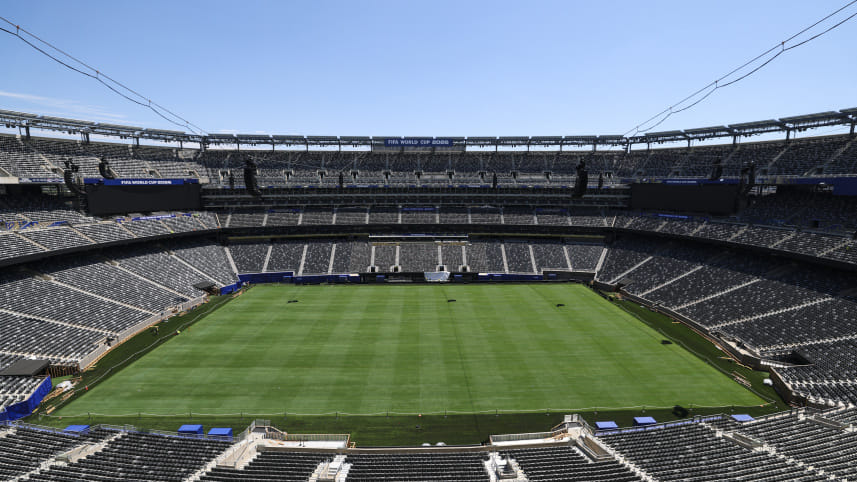
With just three days remaining for the start of the 2026 FIFA World Cup, the world’s attention is firmly fixed on the superstars ready to grace the pitch in the USA, Mexico, and Canada. Yet, beneath the boots of Lionel Messi, Kylian Mbappe, and Erling Haaland lies what is arguably the greatest engineering feat in sporting history -- the grass itself.
For the first time, football’s ultimate tournament has been expanded to 48 teams, with 104 matches scheduled across 16 venues spanning an entire continent. From the extreme high altitudes of Mexico City to the unforgiving heat of Texas, the geographic diversity is staggering. To combat this, FIFA took a revolutionary step, mandating that every single stadium feature an absolutely uniform, high-performing natural playing surface.
 For all latest news, follow The Daily Star's Google News channel.
The eight-year crusade
Achieving this required an unprecedented multi-million-dollar scientific crusade. Eight years ago, FIFA commissioned a specialised research grant, partnering with the world’s elite turfgrass programs at the University of Tennessee (UT) and Michigan State University (MSU). Led by renowned experts Dr. John Sorochan and Professor John "Trey" Rogers III, scientists have spent nearly a decade in climate-controlled test fields, obsessively engineering the perfect blades of grass, capable of withstanding high traffic while providing consistent ball roll and traction.
Science meets sport
FIFA’s engineers went beyond selecting seed varieties. Specialised testing, including the fLEX system, measures interactions between cleats and turf, tracking factors like rotational resistance and penetration. This ensures that players experience a similar surface whether they sprint in Miami or Guadalajara, or that a ball rolls exactly the same way in Vancouver as it does in Mexico City. Each pitch has been fine-tuned using years of data to create near-identical playing conditions across venues.
Converting NFL strongholds to football arenas
The core challenge lay in the stadiums themselves. Out of the 16 venues, five are entirely domed, severely restricting natural sunlight, while eight are traditional NFL strongholds that strictly utilise synthetic turf. To meet FIFA’s rigid criteria, stadiums like New York's MetLife Stadium -- host of the final -- had to undergo a total metamorphosis. Over 82,000 square feet of artificial turf was ripped out and replaced with a temporary natural marvel grown for months under pristine conditions in North Carolina before being shipped hundreds of miles north.
The underground blueprint: sand, vacuum, and custom seeds
The engineering behind these fields resembles an intricate puzzle. The pitches are built on an 18-inch deep foundation of specialised sand and gravel, integrated with advanced subsurface vacuum ventilation and automated irrigation systems. Rather than standard turf, researchers settled on specific, tailored grass blends: primarily a highly resilient mixture of Kentucky bluegrass and perennial ryegrass for cooler climates, and specialised Bermudagrass for shaded and warmer Mexican venues like Monterrey's Estadio BBVA.
Weaving the future: Hybrid stitching and AI testing
But the real magic happens at the surface layer. To withstand the bruising traffic of 104 matches over six weeks, FIFA is deploying state-of-the-art hybrid technology. Once the natural sod is laid in interlocking rectangular chunks, massive sewing-machine-like robots traverse the pitch, stitching millions of synthetic polyethylene fibers deep into the root zone. These artificial fibers account for roughly 3% of the pitch, acting as an anchor that prevents the natural grass from tearing or divoting under rapid turns.
Maintaining excellence during the tournament
Unlike a one-off championship event, the World Cup demands elite pitch quality across 39 days. Advanced monitoring systems track temperature, moisture, and grass health in real time. Grow lights, automated irrigation, and on-site maintenance crews are deployed to address changing weather and heavy usage, ensuring the surface remains consistent from the opening match to the final whistle.
Ready for kickoff
As the final countdown begins, the logistical masterstroke is complete. Over 88 total miles of natural sod have been transported, laid, and stitched across North America. FIFA’s eight-year effort has turned the playing field into a feat of engineering, blending nature with technology to create arguably the most advanced World Cup pitches ever seen.
Comments