The expansion of wage labour and the message of May Day

The emergence and development of the wage labourer is deeply linked to the emergence and development of capitalism. The existence and expansion of capitalism are impossible without the growth of the wage-earning class. Therefore, during the Industrial Revolution in Europe, while the capitalists established dominance, the working class was simultaneously formed. The picture was much the same in the United States. As working hours and wages were not fixed, numerous protests and demonstrations broke out, and organisations were formed to change the unspeakable living conditions of workers, including women and children. Following the labour movements of the 1860s, 1870s, and 1880s, a massive rally in Chicago was attacked on May 1, 1886, during a strike involving over 300,000 workers. Workers were killed in the firing, and later, labour organisers were hanged following a farcical trial. This sacrifice did not go in vain. The demands that were once labelled as terrorism and counter-development were eventually accepted by the whole world, and May Day became known worldwide.
One of the major changes in Bangladesh's society and economy over the last few decades is the shift in the composition of the working class. In the name of economic reforms, many state-owned enterprises have been declared closed since the 1980s. Adamjee Jute Mills was closed in 2002, and all remaining jute and sugar mills followed. Until the 80s, the state-owned sector’s workers were primarily the organised segment of the country's industrial workforce. The closing of state-owned factories, regardless of the government in power, was not merely a process of privatising state assets; it was simultaneously part of a long-term project to break the organised strength of industrial workers.
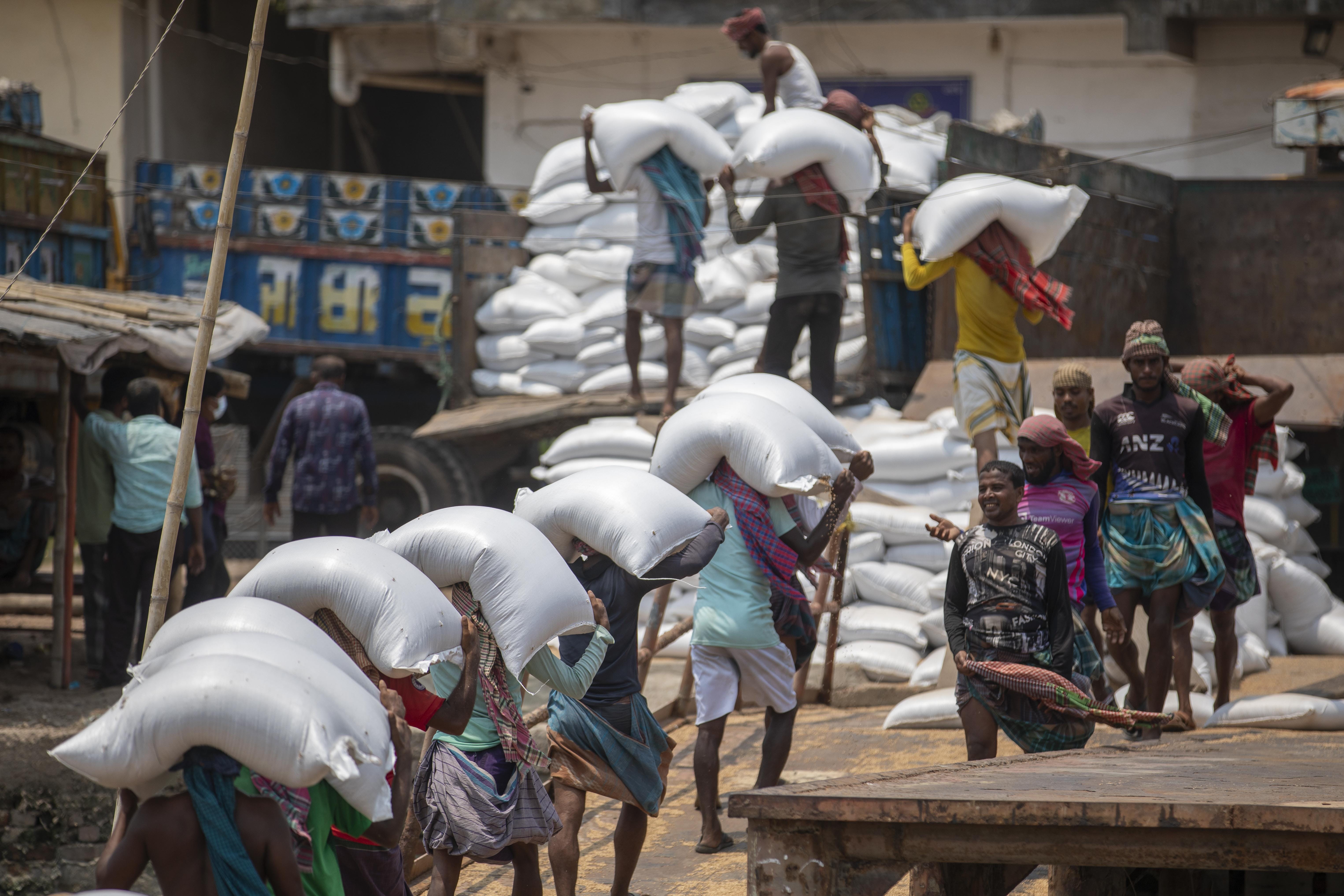
The garment industry now dominates as an export-oriented sector and employs the highest number of industrial workers. Despite the significant attention this sector enjoys, the number of unions is negligible, and the state of other workers’ organisations is weak.
Thousands of predatory looter billionaires have emerged during Bangladesh’s economic reform in the last few decades. Various state institutions actively protect them. Rather than continuing and developing productive processes, their primary task is the rapid concentration of wealth through hyper-exploitation, occupation, plunder, and money laundering, and to ensure this by crushing the democratic rights of the public, especially the working people. The politics and economy of Bangladesh are primarily under their control. For this reason, the largest portion of the population—workers and labouring people—are deprived of their minimum democratic rights. In most industrial factories, the minimum living wage, 8-hour workday, appointment letters, weekly holidays, and safety at work and working environment are either entirely or mostly absent. Establishing trade unions remains a struggle against continuous oppression and deception. Incidents of arrests, attacks, and harassment for working on trade union rights occur frequently. Among those that exist, "pocket unions" are predominant.
With the development of the garment industry, there has been a significant gender shift in the composition of the working class. The majority of workers in this sector are women. Beyond this, women's participation has increased in various other professions. We hear many stories of women's empowerment. But the news of insecurity, murder, rape, and harassment of these working women that appears in daily newspapers reflects only a fraction of the reality. In facing continuous deprivation and oppression, women workers have turned into a new protestive social force.
While the majority of people live in poverty and deprivation, Bangladesh's GDP and average per capita income have increased manifold without any significant improvement in their lives. The cruelty remains hidden behind statistical deceit.
Driven by the evolving demands and structural shifts of modern capital, precarious employment—including temporary, daily, part-time, and informal work—is surging across nearly every sector. Workers in the informal sector are completely unorganised, and their lives are a struggle for survival amidst extreme uncertainty. The number of online workers is also rising rapidly, and their uncertainty is even greater. These include riders, people in food delivery, and outsourcing work, known as gig workers. The core demand of May Day—eight hours of work with a wage sufficient for a decent living—remains far out of reach for workers across all sectors in Bangladesh, including labourers, the toiling masses, and even these educated, online-based earners.
The opportunity to organise is also very slim for educated working people. Consequently, even banks, insurance, media, NGOs, private schools, colleges, universities, clinics, or the online sectors lack work or income security. There is no institutional mechanism for redress against the arbitrary dismissal or injustice faced by people working in these places. The government is a silent spectator everywhere. There are few systems as inactive as Bangladesh's legal and institutional monitoring systems when it comes to protecting the interests of the majority.
While the majority of people live in poverty and deprivation, Bangladesh's GDP and average per capita income have increased manifold without any significant improvement in their lives. The cruelty remains hidden behind statistical deceit. The high rate of growth is built on the blood and sweat of farmers, garment workers, and migrant workers. On the other hand, the cost of education and healthcare has increased due to commercialisation. Transport costs and house rents have risen. In the last few years, most people have faced hardship in work and income, resulting in increased unemployment and poverty. To finance massive infrastructure projects and sustain an import-heavy economy, the government continually raises taxes, fees, and utility prices. At the same time, runaway inflation on essential goods is steadily shrinking the real income of the average citizen. By ruining the livelihoods of the people and destroying the river systems, life, nature, and environment of Bangladesh, the GDP has increased, but permanent, stable, and environment-friendly decent work opportunities have not.
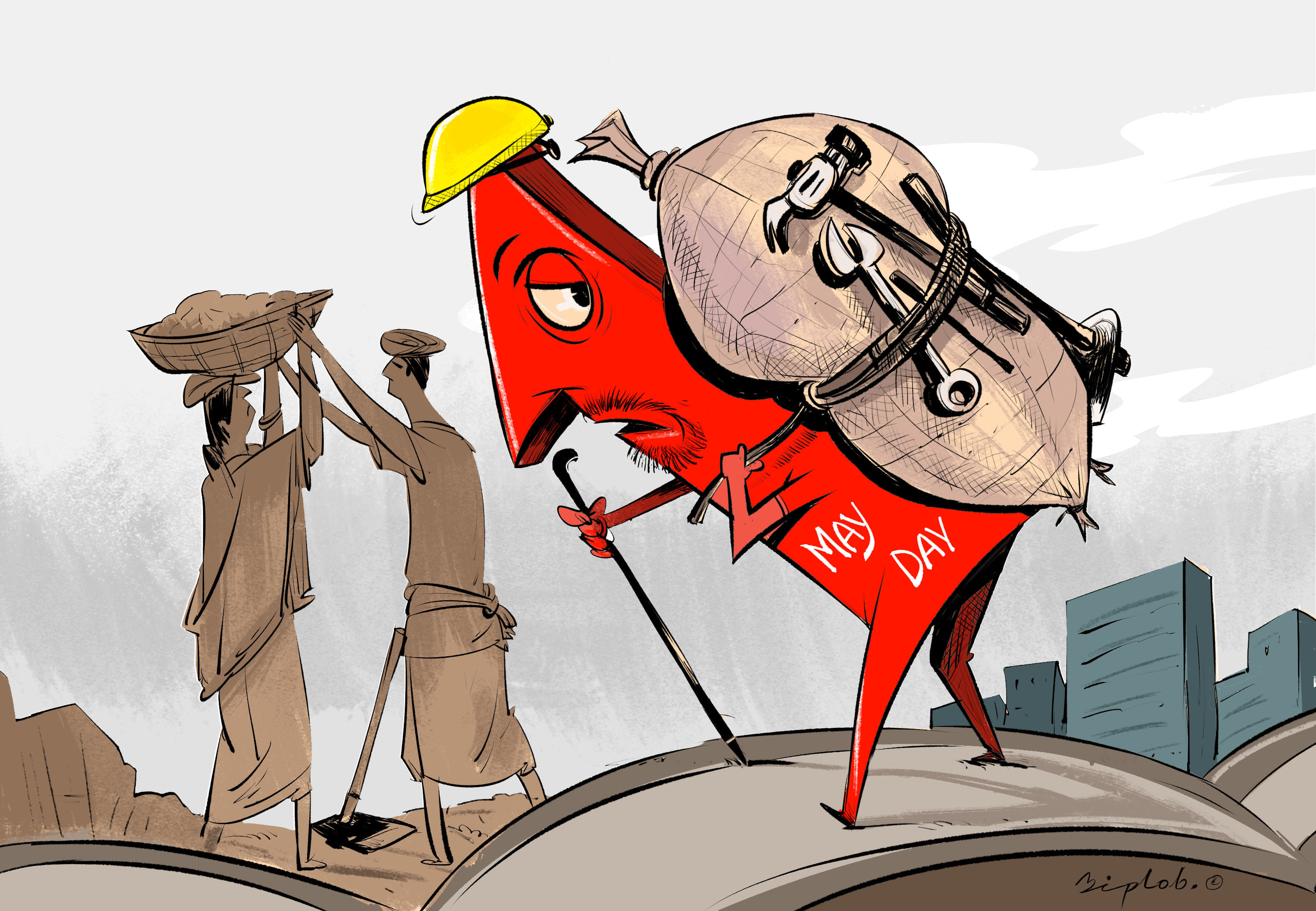
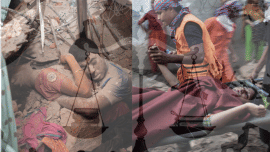
In the capitalist world, the message of May Day repeatedly arises in the struggle for the existence of the majority. May Day highlights the challenges workers face in organising politically to combat exploitation. Bangladesh serves as a stark reminder of how deeply the working class suffers when this organised resistance is weak. The structural killing of workers in the 2013 Rana Plaza tragedy laid bare these weaknesses. Even after such a disaster, the state of safety, wages, and the right to organise in the country reflects the same fragility. Because of this weakness, factories repeatedly turn into mass graves as a result of the limitless greed of local looter billionaires and international profiteers and their political influence. In recent years, preventable disasters in places like Rupganj, Sitakunda, and Old Dhaka have claimed the lives of well over a hundred labourers. Working-class people continually remain the primary victims of these deadly fires, building collapses, and chemical explosions. Construction workers are regularly killed or injured at their workplaces. Recently, working people lost everything in fires in various places, including the Korail slum, Bangabazar, and New Market. There are reasonable grounds to believe that these fire incidents are part of the development projects of certain groups.
Driven by capitalism, the number of wage earners is growing globally and expanding across all social classes. How capitalism operates today cannot be truly understood if only factory workers are pictured. Technology has transformed the workforce, forcing many degree-holders into jobs that seem middle-class but are actually highly precarious. Because of this, the solidarity of May Day speaks to 99 percent of the population. The global rallying cry of "We are the 99%" is simply the modern-day continuation of the May Day legacy.
Anu Muhammad is former professor of economics at Jahangirnagar University.
Send your articles for Slow Reads to slowreads@thedailystar.net. Check out our submission guidelines for details.
Interactive: Bangladesh Labour History · 1881 - 2026 / Fight for Justice
In conversation with Richard Wolff / Can workers seize the opportunity as Western capitalism declines?

The expansion of wage labour and the message of May Day
A closer look at Bangladesh’s new labour law: Gains and gaps

Fixing a labour justice system that fails workers

Servants of an algorithm: May Day and the fight for the South Asian digital working class
Beyond reform: Securing dignity for Bangladesh’s workers