East Bengal’s victory and the memory of lost homes

On Thursday night at the Kishore Bharati Krirangan in Kolkata, something shifted in the emotional geography of Indian football. East Bengal FC won their maiden Indian Super League title, defeating Inter Kashi 2–1 in the final matchday, ending a 22-year national league drought.
For the neutral, this is an excellent story — a giant club rediscovering itself, a Spanish coach who believed when few did. But the goal that sealed it was scored by Mohammed Rashid, a Palestinian midfielder.
And that detail, once you know who East Bengal's fans are and where they come from, feels less like a coincidence and more like history completing a sentence it had been writing for a century — a man from a displaced people scoring the winning goal for a club built by and for the displaced.
This club was not built in a boardroom. It was built from humiliation, in 1920, by men who had been told — politely and then not so politely — that they did not quite belong.
It grew its support base from waves of the dispossessed: refugees who arrived in Calcutta with nothing but the clothes on their backs and the memories of a homeland the British, and then history itself, had twice severed from them.
What happened at Kishore Bharati was not just a football club winning a league. It was millions of people — descendants of the displaced — winning something back.
A continent carved by rulers who left
Bengal has been partitioned twice, and both times the consequences were catastrophic and deliberate.
In July 1905, Viceroy Lord Curzon announced the partition of Bengal, splitting the vast Bengal Presidency into two provinces — Bengal proper, and a new province of Eastern Bengal and Assam with its capital at Dhaka.
Justified as an administrative measure, it was seen by many in Kolkata as a political move to weaken the growing nationalist movement by dividing Hindus and Muslims.
The partition catalysed the Swadeshi and Boycott movements and contributed to the formation of the Muslim League in 1906, fundamentally altering India's political landscape.
The British reversed that partition in 1911 after mass protests — but the sectarian seed had been planted, and it would germinate for another thirty-six years.
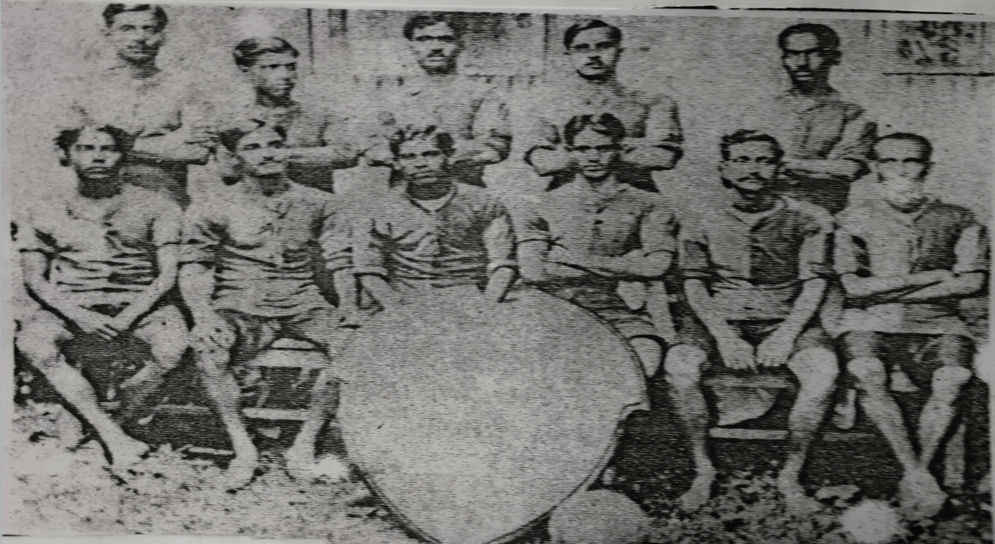
Mohun Bagan's historic victory in the IFA Shield in 1911, the first Indian club to beat a British side, was experienced as a nationalist event — Bengal striking back at its colonisers through football during a moment of political awakening.
It was India's first great football story. The second would belong to a different club, born nine years later from a different wound.
On 28 July 1920, Jorabagan was due to play Mohun Bagan in the Coochbehar Cup. Player Sailesh Bose was dropped from the squad. Vice-president Suresh Chandra Chaudhuri's protests fell on deaf ears, and within days, he and his associates formed a new club.
East Bengal embodied the grievances of communities from the eastern region who felt excluded from the Ghoti establishment — the upper-caste Hindus of West Bengal, for whom Mohun Bagan had long served as a social and sporting citadel.
The name chosen was radical in its explicitness. Not a neutral, invented word — a geographic declaration: we are from the East, and we are here.
1947 and 1971
The 1947 Partition was permanent, and it was savage. Between 12 and 20 million people were displaced across the subcontinent. An estimated 3 million crossed the Bengal border in either direction in 1947 and 1948 alone, fleeing communal violence.
The journey itself was laced with danger: trains packed with refugees were attacked by communal mobs on both sides of the border. By the end of 1947, approximately 344,000 Bengali Hindus had crossed into West Bengal; the following year, the influx reached about 786,000.
The cultural allegiance to East Bengal FC intensified precisely in the aftermath of these two displacements — 1947 and 1971 together forged a fanbase rooted not in geography but in shared loss.
These were not statistics. They were families arriving at Sealdah station with bundles and no address, flooding into a city that had no room and often no welcome. As Bengali writer Manoranjan Byapari noted in his autobiography, to "the people of West Bengal, the words 'refugee' and 'Bangal' are synonymous. And the word 'Bangal'...was also, for all practical purposes, a word of abuse." A slur handed to people who had just lost everything.
For the dispossessed, East Bengal Club became a source of identity and hope — with rivalries between immigrant and native populations spilling across every sphere of life, from jobs to schools to football pitches.
Then came 1971. What the Partition had begun, the Liberation War compounded. Over nine months, an estimated 10 million Bengali refugees fled to India. Even after Bangladesh’s independence, many of them did not return. Instead, many more migrated from Bangladesh to India in the following years.
Thus, West Bengal — still unhealed from 1947 — absorbed a second wave of the traumatised and dispossessed. They arrived to find a city already straining, already fractured along the Ghoti-Bangal fault line. And they found the club.
The cultural allegiance to East Bengal FC intensified precisely in the aftermath of these two displacements — 1947 and 1971 together forged a fanbase rooted not in geography but in shared loss.
The Kolkata Derby became a proxy war over belonging — Mohun Bagan representing the established Ghoti bastion, East Bengal, the home of immigrants often treated as outsiders.
Carrying nothing else from home, the refugees could at least carry colours. Red and gold. The club became the flag that they were no longer permitted to fly.
The club that built an empire, then stumbled
East Bengal's honours are formidable: a record 41 Calcutta Football League titles, triple crowns in 1949 and 1990, and in 2003, the first Indian club to win an ASEAN regional title.
After dominating the domestic landscape under legendary coach Subhash Bhowmick — clinching consecutive National Football League titles in 2002–03 and 2003–04 — the Red-and-Gold Brigade entered an unprecedented drought.
The modern era was particularly cruel. When investor Quess Corporation acquired a 70 percent stake, clashes over footballing control turned the association sour, and Quess pulled out, leaving the club in tatters.
Their ISL debut in 2020–21 ended in ninth place; in 2021–22, they finished last among 11 teams. In four years of ISL football, they cycled through coaches at a rate that suggested administrative panic.
For a community that had already lost its homeland twice, watching their football club publicly disintegrate carried a specific, familiar sting.
The night it ended
Entering the final matchday tied with arch-rivals Mohun Bagan at the top of the table, East Bengal suffered an early blow when Inter Kashi's Alfred Planas slotted home a clinical opener in the 14th minute. The stadium went quiet with the particular dread of a crowd that knows its own history too well.
In the 49th minute, Golden Boot winner Youssef Ezzejjari latched onto a defence-splitting long ball from Anwar Ali to equalise. Then in the 72nd minute, Mohammed Rashid met a spectacular Bipin Singh cross and fired past the keeper — 2–1.
For a brief, terrifying period, Mumbai City FC took a lead that momentarily threatened to leapfrog both Kolkata clubs to the summit. Then the whistle blew. Supporters stepped over the fencing onto the pitch and celebrated with their players.
The wider significance
Apart from giving a huge boost to the fanbase that predominantly consists of descendants of Bengali Hindu refugees who fled during and after the 1947 Partition, as well as during and after the 1971 Liberation War, the recent context adds another layer.
Just weeks before East Bengal lifted the ISL trophy, the BJP won the West Bengal Assembly elections, taking power in the state for the first time. The party had campaigned heavily on CAA and the SIR electoral roll revision — policies directly aimed at the Bangal refugee community’s oldest anxiety: whether they truly belong here, whether their citizenship is secure, and whether the state that sheltered them after Partition will one day demand they prove it.
The SIR process spread panic in border districts, where many Hindu refugees lack the documentation required to prove residency before 2002. The Bangal community finds itself — again — at the centre of a political argument about legitimacy and belonging, asked to produce papers for a home they have lived in for seventy years.
Against that backdrop, East Bengal's ISL win is not merely a sporting footnote. It is a cultural counterpoint. Whatever the state’s new government decides about citizenship and electoral rolls, nobody can take back what happened at Kishore Bharati.
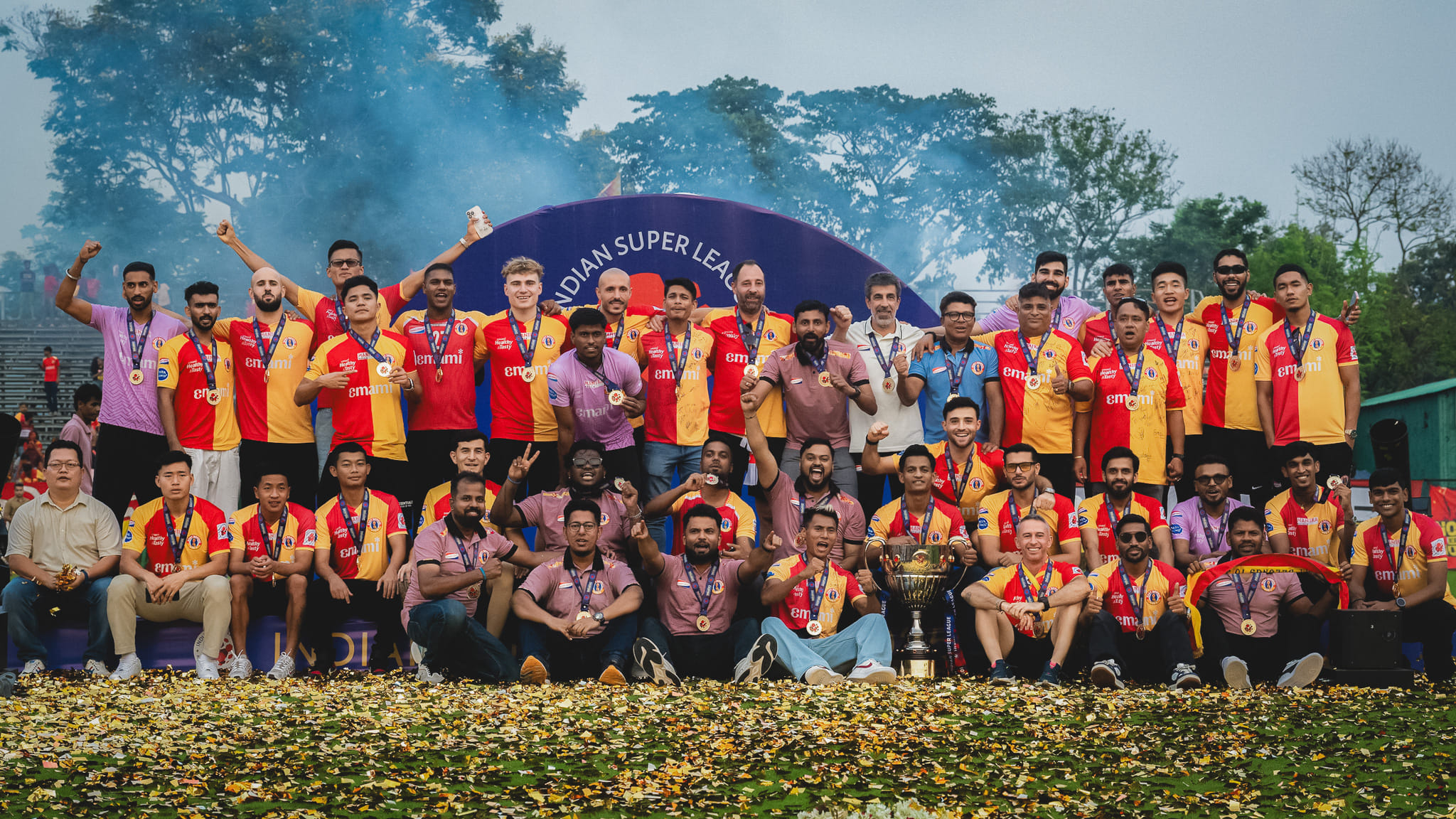
The community that built this club from displacement, that filled it with the grief of two partitions, that stayed through the ISL years of finishing last — they are, right now, champions of India.
That a Palestinian scored the winner is not a footnote either. It is the whole story in miniature — a man from a people defined by dispossession, playing for a club built by the dispossessed.
When Rashid’s shot hit the net, somewhere in Kolkata, a grandfather who had crossed the Radcliffe Line, or whose children carried his stories, or whose grandchildren know the East only through food and football and fading photographs, felt something that language struggles to name. Not healed — history doesn’t do that. But acknowledged.
The torch, as the crest on East Bengal’s emblem promises, is still burning.
Jannatul Naym Pieal is a Bangladesh-based writer, researcher and journalist. He can be reached at jn.pieal@gmail.com
Send your articles for Slow Reads to slowreads@thedailystar.net. Check out our submission guidelines for details.
Reading Nazrul in an age of inequality
The stolen haq of Qurbani hides

Tagore’s Dan Pratidan and the colonial remaking of Bengal’s moral world
Memories of Indigo Rebellion and the question of national identity
Part 1 / The forgotten art of Bengali advertising
Re-reading Nizamuddin Auliya in history and memory

Remembering Mrinal Sen: Through rain, memory, and cinema

Rethinking the origins of Bongabdo through Bengal’s ecological civilisation
The forgotten front: Rumour, resistance, and the uprising of 1857 in Eastern Bengal