


Promises and pitfalls of the new education budget

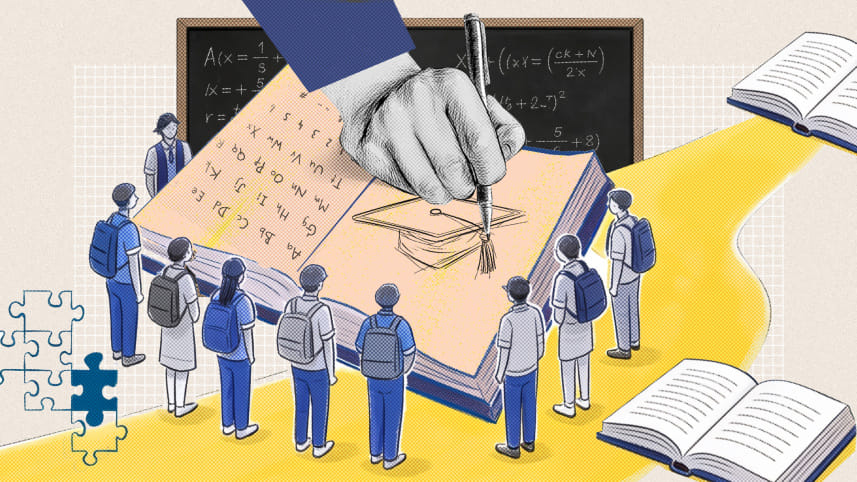
The allocation for education in the proposed budget for FY2026-27 reverses the trend of shrinking outlay for the sector in recent years. The outgoing year’s revised budget has proportionately the lowest allocation in a decade, at around 1.4 percent of GDP. For the incoming fiscal year, an allocation of Tk 1,22,495 crore has been proposed for the three main public education agencies: the Ministry of Primary and Mass Education, Secondary and Higher Education Division, and Technical and Madrasa Education Division. Adding allocations for other government ministries and agencies, including textiles, railways, defence, agriculture, fisheries, and ICT, the total allocation amounts to Tk 1,36,606 crore—14.56 percent of the total budget.
 For all latest news, follow The Daily Star's Google News channel.
The proposed budget, the BNP government’s first in two decades, promises a shift away from physical infrastructure to human capital development and a journey towards a democratic, humane and inclusive economy. Can these promises be delivered?
The budget speech touched on themes of school curriculum reform and a compulsory third language instruction in school. “Free education” for female students up to undergraduate level, school uniforms, shoes, and school bags for children, mid-day meals at schools, and specialised learning materials and assistive technologies for children with special needs were mentioned. Technical and vocational education will be introduced from Class 6, and new subjects and textbooks on sports and culture and “learning with happiness” will be added.
Quality enhancement programmes in science, mathematics, English, and information technology will be initiated in madrasas alongside religious education. “One Teacher, One Tab,” multimedia classrooms, and free Wi-Fi in educational institutions are to be supported by the education budget.
Reconfiguring curriculum, textbooks and student assessment, easing economic burden on families, incentives and encouragement for students, and large-scale use of digital technology are continuing tasks in a dynamic system. However, we have trodden this path before, not often with happy outcomes. The devil is in the details—contextualisation and adaptation with the right emphasis, nuances that lead to the right actions, and eventually lead to results.
Many education analysts question the apparent emphasis on curriculum rewriting instead of curriculum implementation in the classroom with the essential adaptation. The idea of a compulsory additional foreign language besides English is considered by many as misguided and impractical. Compulsory vocational courses at the secondary level is a discarded idea because it has generally proven to be unworkable. Schools have a tough enough job teaching basic competencies, which is the critical lacking now for young people’s preparation for life and work. Distribution of digital devices is not seen by many as the first or most useful step for harnessing the benefits of digital technology for education. Critics ask: is there a tendency to showcase symbolic and performative actions? The most trenchant critique of education sector moves has remained unanswered: that they are a collection of fragmented and partial measures to alleviate symptoms rather than a holistic strategy to treat the disease.
It can be fairly argued that there is a “curriculum reset” fatigue. Teachers, students, and parents are wary of undergoing multiple textbook and curricular overhauls after every political shift. Recent reversals have not proven to be helpful: after July 2024, the return to the 2012 curriculum and then the partial swing back to the 2023 content, and now inserting new subjects like “Learning with Happiness.” Arguably, it is a pedagogic approach to be practised by teachers and students, rather than a subject to be taught. Teachers are at risk of suffering operational fatigue from trying to adjust to continuously shifting guidelines about teaching content, pedagogy, and assessment.
One set of numbers can be cited to illustrate what may be called a structural problem in the education system. Primary education is the foundation upon which the edifice of education stands.
Between 2013 and 2024, enrolment in government primary schools dropped from 1.5 crore to around 90 lakh, according to data from the Directorate of Primary Education. During the same period, the number of primary-level madrasa students increased from 12 lakh to 17 lakh. Kindergartens and other private schools increased their enrolment from 18 lakh to 43 lakh. The enrolment loss of government schools was partly due to a demographic reduction in the school-age population, but it is clear that a significant number of parents decided to take their children out of government schools. National student assessment and other independent surveys have shown that most children at the primary level don’t acquire basic foundational skills of reading, writing, and counting, but the performance of students in government schools (and madrasas) is the worst. Madrasas still attract students because they are the least costly to parents, and there is also a religious motivator in some cases.
Amid the buzz about system reform, technology, and innovation, is old-fashioned pedagogy in the classroom being forgotten, where teachers and students engage in learning and where basic conditions are ensured? Such a system includes having a sufficient number of teachers to keep the class size manageable, a headteacher who leads the school team that works and plans to serve the children, and teachers who are not overburdened and receive guidance and supervision from the upazila education office and resource centre as needed. Where attractive textbooks and well-designed teachers’ guides are available, classrooms and the school premise are safe and friendly, and teachers keep in touch with parents. Too many schools in Bangladesh don’t meet these basic conditions.
Arguably, at least half of the families in the country, including those under or close to the poverty line (and others disadvantaged by ethnic, cultural or ecological reasons), face insurmountable challenges in bearing the cost of their children’s education. A standard government school is not likely to be equipped or able to provide the help and support many of these children need. This is where education NGOs of proven capability can play a role, provided that the government recognises the necessity and supports a government-NGO-community partnership with appropriate policy and financial backing.
An annual budget is not an instrument for designing reform. Practical and pragmatic reform ideas must exist, which a budget can help implement. More homework is needed to formulate and shape realistic reforms in the education sector within a framework of comprehensive change in the sub-sectors over the next five to ten years.
Dr Manzoor Ahmed is professor emeritus at BRAC University, chair at Bangladesh ECD Network (BEN), and adviser to the Campaign for Popular Education (CAMPE). Views expressed in this article are the author’s own.
Views expressed in this article are the author's own.
Follow The Daily Star Opinion on Facebook for the latest opinions, commentaries, and analyses by experts and professionals. To contribute your article or letter to The Daily Star Opinion, see our guidelines for submission.




Comments