

How Bangladesh is leaving tobacco tax revenue on the table

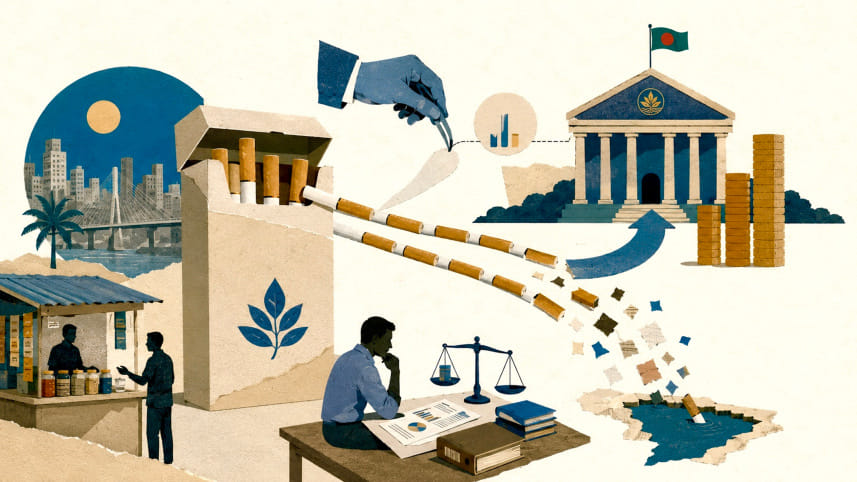
Bangladesh’s tobacco tax policy has long been framed around two objectives: reducing tobacco consumption and mobilising revenue. Both objectives are legitimate and urgent, particularly at a time when the government faces growing pressure to expand domestic revenue. Yet, there remains a broad disconnect between the tax policy being set and the ground reality of how cigarettes are sold and consumed in the country.
One clear example of this disconnect is the gap between official pack-based pricing and the reality of loose-stick sales. The tax structure is set on the basis of the minimum retail price for a 10-stick pack, but in Bangladesh, cigarettes are very often sold by the stick. The problem becomes clear when we look at the current fiscal year’s low-tier price. Low-tier cigarettes have been set at Tk 62 per 10 sticks, up from Tk 60, which means that one stick costs Tk 6.20. But in the actual market, how would a consumer pay Tk 6.20 for a single cigarette? In practice, the price is likely to be rounded up to at least Tk 7. In that case, the consumer pays Tk 7, while the government’s tax calculation remains based on Tk 6.20. The remaining Tk 0.80 per stick stays outside the declared tax base.

A similar issue arises in the medium tier. The current price of medium-tier cigarettes has been set at Tk 92 per 10-stick pack; therefore, the price per stick would be Tk 9.20. Sellers are likely to round up the price to Tk 10; thus again creating a value gap of Tk 0.80 per stick. Now, according to the National Board of Revenue (NBR), 4,108 crore low-tier sticks and 2,011 crore medium-tier sticks were supplied in FY2024–25. Taken together, low and medium-tier cigarettes accounted for a total sale of 6,119 crore sticks in FY2024–25. Applying the Tk 0.80 gap per stick—which is likely to remain outside the tax base—to this volume, assuming similar sales of low- and medium-tier cigarettes this fiscal year, suggests that a total of Tk 4,895 crore in sales would remain outside the tax base.
Considering the overall tax rate of 83 percent on tobacco products, the potential revenue loss for the government comes to around Tk 4,063 crore. This calculation should of course be treated as an indicative estimate rather than a precise revenue forecast.
The NBR has been given a revenue target of Tk 6,04,000 crore in the current fiscal year, which constitutes 86.9 percent of the total revenue collection target. In such a fiscal context, it is difficult to justify a tobacco tax structure that appears to leave substantial revenue uncollected simply because the official pricing system does not reflect market reality.
The other concern is the nature of the price increase itself. In this year’s budget, the low-tier price has increased by only Tk 2, which is an increase of just over 3 percent. By contrast, the medium, high and premium tiers—which were priced at Tk 80, Tk 140, and Tk 185 per 10-stick pack, respectively, last fiscal year and hiked to Tk 92, Tk 160, and Tk 210, respectively—have seen increases of around 14 to 15 percent. In other words, the top three tiers have broadly moved in line with inflation-adjusted benchmarks, while the low tier has not. Without an official explanation, it is difficult to understand what a Tk 2 increase in the low tier is expected to achieve, especially when low-tier cigarettes have historically accounted for the largest share of cigarette sales. Keeping this tier relatively cheap means that the most affordable segment of the cigarette market remains protected.
However, based on NBR data, it appears that the supply of low-tier cigarettes has fallen over the past two years. One possible interpretation could be that the earlier price increase from Tk 50 to Tk 60 had some effect in reducing demand. If that were the full story, it would be a positive sign for tobacco taxation. But tier-wise data suggests a more complicated picture. Over the past five years, the share of medium-tier cigarettes has increased substantially, from around 9 percent in FY2021–22 to around 42 percent in FY2025–26, based on NBR data updated till May 2026. During the same period, the low-tier share declined from around 77 percent to around 49 percent. This indicates that at least part of the decline in low-tier supply may not reflect quitting or reduced consumption, but rather movement from low-tier to medium-tier cigarettes.
One possible reason is that the price gap between the low and medium tiers narrowed after the January 2025 revision. Low-tier cigarettes increased from Tk 50 to Tk 60, while medium-tier cigarettes increased from Tk 70 to Tk 80. The difference between the two tiers, therefore, became smaller, making the shift to medium-tier cigarettes more manageable for some smokers.
The overall supply and revenue data also deserve attention. As per NBR data, total cigarette supply declined from 9,026 crore sticks in FY2023–24 to 6,757 crore sticks in FY2024–25, and then to 5,826 crore sticks in FY2025–26 till May. Yet, total revenue increased from Tk 40,229 crore in FY2023–24 to Tk 40,893 crore in FY2024–25 and Tk 44,756 crore in FY2025–26 till May, even without the full June data. This shows that higher prices can raise revenue even when supply falls.
Bangladesh, therefore, needs a tobacco tax policy that is closer to market reality. Official prices should take loose-stick sales into account, and the tiered structure should be simplified, particularly by merging the low and medium tiers, so that smokers and companies have less room to shift within the cigarette market. At a time when the government is under serious revenue pressure, leaving more than Tk 4,000 crore outside the effective tax base is not only a tobacco control concern, but also a public finance concern.
Mohammad Ihtesham Hassan is senior research associate at Power and Participation Research Centre (PPRC).
Views expressed in this article are the author's own.
Follow The Daily Star Opinion on Facebook for the latest opinions, commentaries, and analyses by experts and professionals. To contribute your article or letter to The Daily Star Opinion, see our guidelines for submission.
 For all latest news, follow The Daily Star's Google News channel.


Comments