


Ensure justice for wildlife cruelty
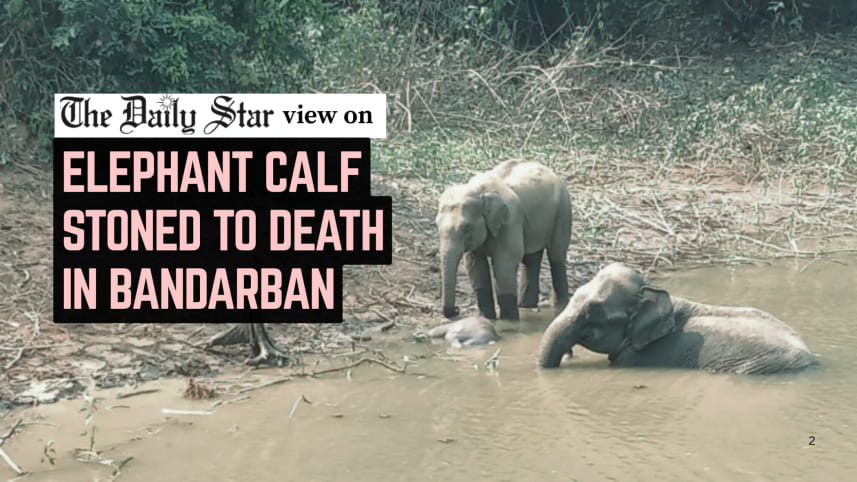
A heartbreaking image has been circulating on the web for the past few days—two grown elephants standing next to a dead baby elephant in a shallow ditch. The pair stood by the deceased calf for three days before finally walking away. Initially, it was thought that the calf might have fallen from a hill, or perhaps it was yet another of nature’s cruel tricks. But turns out, the baby elephant was a victim of human cruelty—the calf was stoned to death. The ditch where the grieving elephants stood for days was later identified as an illegal fish enclosure in Naikhongchhari upazila in Bandarban.
Regardless of the circumstances that led to the stoning—multiple blows, in fact—the question remains: why? Why would anyone with an iota of humanity inflict such harm on a defenceless child, regardless of its species? And what does such cruelty say about the state of our society?
 For all latest news, follow The Daily Star's Google News channel.
 If we zoom out, cruelty towards wildlife and animals in general in Bangladesh is far from uncommon; it is becoming alarmingly frequent. In particular, human-wildlife conflict has been rising in recent years, often as a direct result of expanding human activities into forested areas. As development projects, settlements, and unregulated land use continue to shrink natural habitats, animals are increasingly forced into human localities.
This is particularly evident in the case of elephants. Their traditional corridors, used for generations, have been replaced by roads, settlements, and agricultural expansion. The situation has been further aggravated in recent years by large-scale deforestation linked to the influx of the displaced Rohingya population. With fewer safe pathways, elephants often wander into farmlands, destroying crops and livelihoods. For example, we may remember the case of an elephant that was electrocuted in 2023 in Sherpur, after locals set up live wires to keep animals away from crops.
So, we call upon the government to investigate the Bandarban killing and hold those responsible accountable. The widening gap between crimes committed against animals, including wildlife, and the justice delivered must be bridged. It is also imperative to protect elephant corridors, regulate illegal land use, and invest in conflict mitigation strategies that support both communities and wildlife. For example, beehives have proven to provide a natural fence from wild animals, and promising results have been seen in Teknaf. All in all, we must treat this incident with the urgency it requires. If we fail to do so, the images of grieving elephants may not remain disturbing anomalies but a haunting norm with a worrying indication as to where we are headed as a society.
Comments