


For Rohingya camps, measles control requires tailored interventions

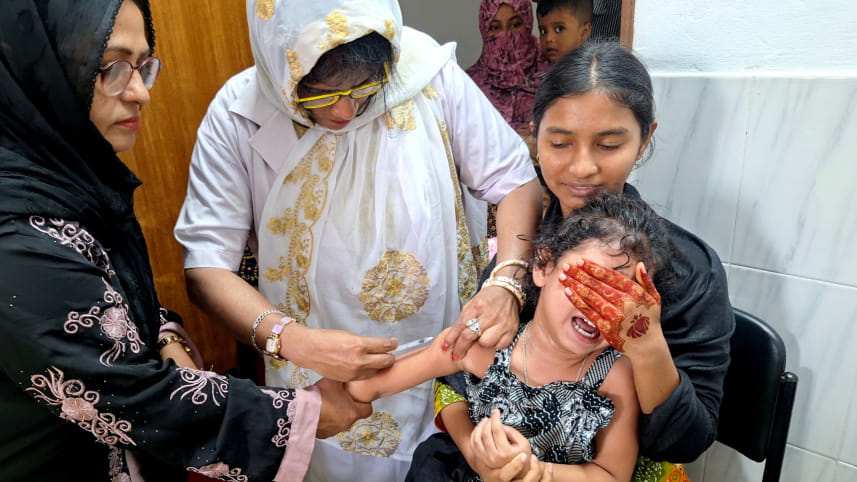
Bangladesh is once again facing a public health threat that is both familiar and preventable. Since early January 2026, the country has seen a surge in measles cases, with thousands of suspected infections and a rising number of deaths. What is particularly concerning is where this outbreak began and continues to intensify: the Rohingya refugee camps in Cox’s Bazar. The camps are extremely overcrowded, hosting over 1.1 million refugees (UNHCR, December 31, 2025), around 190,000 of whom are children under five years of age. This demographic and living context creates conditions highly conducive to the rapid spread of a contagious disease like measles. The background of Rohingya refugees further amplifies vulnerability, as they arrived in Bangladesh with extremely low measles immunity. Many children had never been vaccinated due to long-standing gaps in immunisation in Rakhine State, creating a large susceptible population that rapidly fuelled the 2017 measles outbreak, with over 1,700 suspected cases within months of their displacement.
In response, the Bangladesh government and partner organisations launched rapid, large-scale measles-rubella vaccination campaigns. These campaigns reached thousands of children aged six months to 15 years within months, substantially increasing first-dose coverage and quickly reducing transmission. Follow-up campaigns were rolled out to reach children who had been missed in the first one.

While effective in containing the immediate outbreak, these efforts were largely emergency responses. Sustaining high levels of immunity through a complete two-dose schedule and strong routine immunisation has remained challenging. At the same time, high birth rates, population movement, and periodic service disruptions continue to generate susceptibility. Moreover, Rohingya refugees continue to enter Bangladesh, many of whom have similarly low immunity. These dynamics create a growing pool of partially immunised or unvaccinated individuals, turning the camps into a persistent hotspot where measles can spread rapidly and re-emerge despite earlier control.
This epidemiological reality has direct consequences for Bangladesh beyond the camps. Cox’s Bazar is closely connected with surrounding communities through markets, labour, transport, and shared services. Daily interactions between refugees and the host population create continuous pathways for disease transmission. When a large vulnerable population exists in such proximity, the risk does not remain contained within the camp boundaries; the danger of infection extends to nearby areas, and from there to wider districts and urban centres.
This pattern is already evident: the first wave of infections was identified in the Rohingya camps on January 4 this year, after which cases increased and spread beyond Cox’s Bazar. Within weeks, transmission was reported across multiple districts, including major urban centres, with current estimates indicating as many as 7,600 suspected cases of infection and at least 113 suspected deaths nationwide between March 15 and April 5. Although early signals suggest widespread transmission, epidemiological data specific to the camps remain limited and are often less visible within broader national reporting. This relative lack of focus, combined with the refugees’ poor health conditions, including high levels of undernutrition and overstretched, overcrowded healthcare facilities, could lead to more severe complications and higher mortality among infected children.
This interconnected reality means that the health of Rohingya refugees and Bangladeshi nationals cannot be separated. Protecting one group protects the other, while neglecting one undermines both. In epidemiological terms, refugee camps can act as high-risk reservoirs that sustain transmission and spread infection beyond their immediate geography. In public health terms, they represent a frontline that must be secured if national containment is to succeed. At the same time, ensuring equitable attention to Rohingya refugees is not only a public health necessity but also a responsibility of Bangladesh as a host country, grounded in the principles of human rights and dignity.
In response to the current outbreak, the government has initiated an emergency vaccination campaign. High-risk areas, including Cox’s Bazar, have been prioritised, with plans for nationwide expansion. These efforts reflect the country’s strong commitment to immunisation and outbreak control. However, the current response has an important limitation: much of the strategy is designed around geographic coverage of districts and the general population, rather than fully addressing the distinct transmission dynamics within the Rohingya camps. While refugees are included in district-level planning, the camps require more sustained and tailored interventions. Ensuring full two-dose coverage is difficult due to continuous births, mobility, and gaps in routine services. Children born after earlier campaigns and those previously missed are not always systematically reached. As a result, a sizeable cohort of susceptible children continues to accumulate within the camps.
This creates a critical gap in Bangladesh’s outbreak response. As long as transmission persists within the Rohingya population, measles can continue to circulate and spill over into the surrounding communities. Without placing the camps at the centre of response planning, the national effort remains incomplete.
What needs to be done, then? Vaccination efforts in the Rohingya camps must be intensified and sustained as part of a continuous strategy, ensuring all children, including newborns and those previously missed, receive full immunisation. Surveillance systems should be integrated across refugee and host populations to enable rapid detection and coordinated response. Public health messaging must reach both communities, addressing misinformation and encouraging vaccine uptake. Equally important is stronger alignment between humanitarian and government-led initiatives. Refugee health services should be embedded within national planning, with clear coordination and shared accountability.
Ultimately, addressing measles in the Rohingya camps is not a peripheral task—it is central to containing the outbreak in Bangladesh. The current situation is both a warning and an opportunity: a warning that unresolved gaps can drive widespread risk, and an opportunity to adopt a more inclusive and effective response. Bangladesh has demonstrated leadership in public health before. It can do so again by ensuring that no population is left behind. If measles anywhere is a threat everywhere, then safeguarding the country must begin in Cox’s Bazar.
Dr Md Nuruzzaman Khan is research fellow at the Melbourne School of Population and Global Health of the University of Melbourne in Australia. His research focuses on refugee health. He can be reached at nuruzzaman.khan@unimelb.edu.au.
Views expressed in this article are the author's own.
Follow The Daily Star Opinion on Facebook for the latest opinions, commentaries, and analyses by experts and professionals. To contribute your article or letter to The Daily Star Opinion, see our guidelines for submission.
 For all latest news, follow The Daily Star's Google News channel.


Comments