


Politics is still an uneven playing field for women
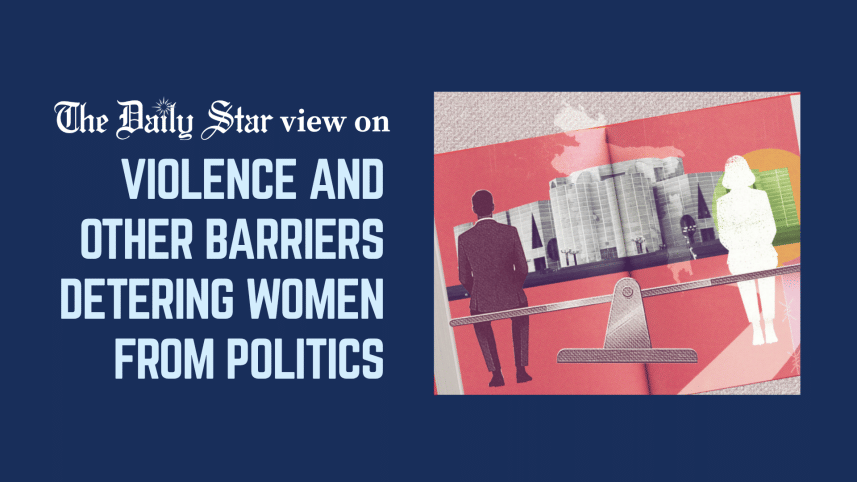
The findings of a new study on women’s political participation, representation, and leadership in Bangladesh confirm the long-held concerns of activists and advocates of equal rights. It is not just the shortcomings at the party level that fail to create space for women in politics. Our society’s patriarchal structure and perceptions, financial constraints, familial responsibilities, physical, sexual, and technology-facilitated violence, and the overall lack of safety—both online and offline—combine to create barriers for women.
The study by BRAC Institute of Governance and Development (BIGD), with support from the United Nations Electoral Assistance Programme (DRIP/BALLOT), analyses the obstacles at the entry, leadership, electoral participation, and representation levels in national and local settings. This analysis, based on 43 in-depth interviews with women parliamentarians, local government representatives, political party members, and public officeholders, as well as engagement with gender experts and civil society advocates, points to areas where changes can be initiated.
 For all latest news, follow The Daily Star's Google News channel.
 For instance, violence both online and offline remains a major barrier to women’s entry into politics. While international data on violence against women in politics (VAWP) is available, in Bangladesh, this particular category of violence is not even recognised in legal or data systems, as per the study. VAWP is underreported because women fear retaliation, the possibility of being sidelined, and mistrust the institutional capacity of their respective parties to take appropriate action. This is because violence does not always come from rival political parties; it often originates within the same party.
In Bangladesh, where violence and infighting at the grassroots level often determine the future of local political leaders, women face slim prospects of gaining influence. In most cases, they need to have a strong political lineage or be ready to pay a heavy price, because attacks on their reputation sometimes even extend to their families. Often, a formal channel to report such violence is also absent.
The issues raised in the study cannot be addressed solely by enacting laws, which often remain unenforced, such as ensuring 33 percent female representation in political party committees, as mandated by the Representation of the People Order (RPO). Moreover, laws cannot change the misogynistic political culture that often spills over to social media, where women politicians, and even elected and reserved-seat MPs, are frequently targeted. This requires a societal shift in perceptions towards women, which can be achieved through public education over the years. However, some immediate actions can be taken by political parties, the government, and the Election Commission, including making parties’ membership processes transparent and establishing a women-friendly complaint mechanism in line with the 2009 High Court ruling. Similarly, a commitment from all MPs to establish a sexual-harassment-free environment not only in the House or party offices but also in their respective constituencies would go a long way towards addressing VAWP and encouraging women’s political participation. The question our lawmakers should ask is not why equal participation is crucial; it should be why it is absent.


Comments