


Shortage of nurses an urgent crisis
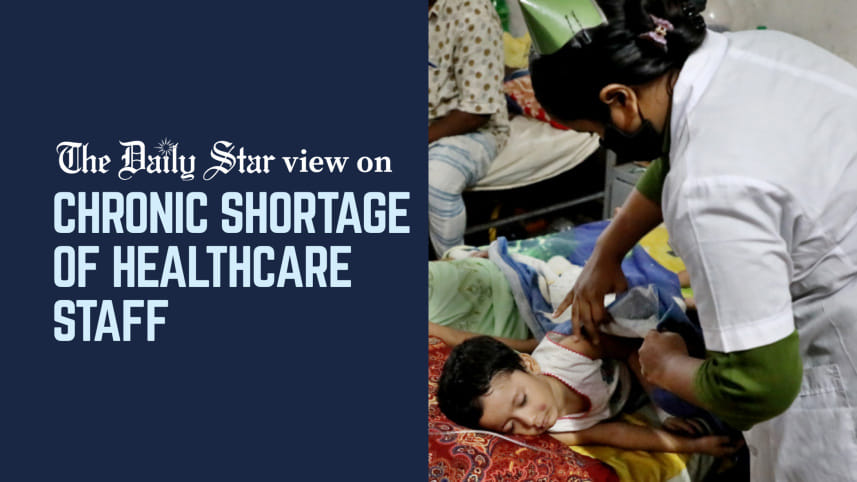
A country that does not have enough nurses and midwives, and which builds hospitals but cannot staff rural wards, is not really investing in healthcare. It is investing in the appearance of healthcare. That uncomfortable truth sits at the heart of a government-funded study on Bangladesh’s health workforce—and its implications reach far beyond hospitals. Reportedly, Bangladesh has only 12.78 doctors, nurses, and midwives per 10,000 people, against the World Health Organization’s recommended 44.5. More damning still is the internal imbalance: the doctor-to-nurse-midwife ratio stands at 1:0.75:0.74, where the WHO standard calls for 1:3:5. Bangladesh has, in effect, built a medical system desperately thin on the nursing and midwifery workforce that delivers the bulk of day-to-day care.
Although Bangladesh has met the WHO’s minimum threshold of 0.5 doctors per 1,000 people, this achievement deserves more scrutiny than celebration. The WHO floor is precisely that—a floor, not a standard of adequacy, and one that sits well below average provision across South and Southeast Asia. Our health workforce crisis is rooted in decades of misaligned priorities. The private sector now accounts for the majority of both medical and nursing seats. Still, predictably, the market has not directed graduates to where they are most needed. Nearly 75 percent of doctors and nurses work in cities, even as 62 percent of the population lives in rural areas. There is also a troubling aspiration gap, as more than half of doctors and pharmacists say they want to work abroad; and 46 percent of nurses share that ambition. Yet, only 7 percent of those interested have actually applied for overseas positions, held back by visa hurdles, credential recognition issues, and licensing costs.
 For all latest news, follow The Daily Star's Google News channel.
 The study rightly recommends scaling up nurse and midwife training, enforcing rural deployment, and aligning graduates with actual service needs. A government-supported mechanism to facilitate overseas employment would at least channel remittances back into the system. What is lacking is political will. The health authorities report nearly 72,000 vacant posts for doctors, nurses and midwives. Recruiting into those positions costs money and demands a sincere administrative push. But the cost of continued vacancy is higher still. Bangladesh has made strides in public healthcare over the past generation—reducing child and maternal mortality, extending life expectancy. It would be a strategic error to allow a fixable workforce crisis to erode these hard-won gains. Incentive schemes, enforced rural postings, and a serious recruitment drive are not ambitious tasks. They are the minimum the moment demands.


Comments