


Not just a wave
01 - The Result
A Majority, Earned
The Seat Count Flatters
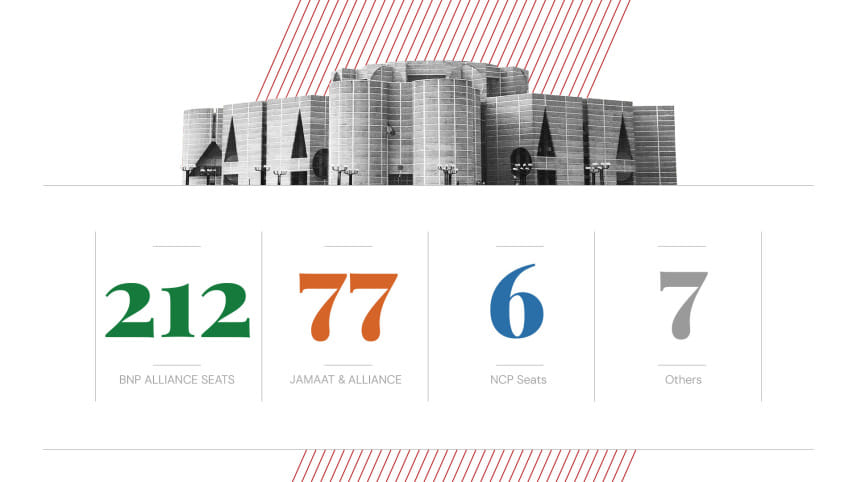
212 seats. That number will dominate the headlines. But large numbers can hide uncomfortable things, and this one does.
Nearly half of all contested seats were decided by a margin of less than 15% of votes cast. Almost one in five came down to under 5%. In Sirajganj-4, the winner beat the runner-up by 594 votes out of 327,000 cast - a margin of 0.18%. Not a mandate. A coin flip. These are the seats where a slightly different day, or a better-organised opponent, changes the headline number entirely.
One in Three Close Races Goes to Jamaat
77 seats. That is three and a half times Jamaat’s previous best. And here is the context that makes it even more striking: in roughly 90% of the seats they contested, Jamaat was fielding a candidate for the first time in 26 years. For a generation, they had been BNP’s coalition partner - given 30 seats, asked to support BNP in the rest. This election was the first time they ran independently across the country. And they still won 77.
In the closest races - seats decided by under 5% of votes cast - Jamaat won 44% of their contests. BNP won 54%. That gap sounds comfortable. It isn’t. In easy seats, BNP wins 87% of the time. In the tightest races, that number falls to 53%. The more competitive the fight, the more Jamaat closes the distance. Wherever the margin is thin, they are showing up.
There is one more finding that every moderate party in Bangladesh should study carefully. In the constituencies with the highest voter turnout - where more than 65% of registered voters showed up - Jamaat won 25 of 57 seats. In the lowest turnout group, they won just 11. When more people vote, Jamaat does better. That is not luck. That is an organisation that knows how to move its people to the polls.
04 - The Seats That Could Change Everything
55 Seats on a Knife-Edge
The three closest Jamaat-over-BNP victories in the country were decided by a combined margin of fewer than 3,000 votes. If those seats had gone the other way, Jamaat’s headline number drops and the national story changes overnight. These are the seats campaign managers will study for the next five years.
At the other end: BNP holds constituencies where the result was never really in doubt. Bandarban-1 by 66%. Rangamati-1 by 65%. Chattogram-12 by 64%. The same party that nearly lost a seat by 594 votes won another by over 115,000.
05 - The Geography of Competition
East vs West
There were marked contrasts along Bangladesh’s east and west. Along the western side from north to south, Jamaat had a strong showing.
Khulna went to Jamaat. 25 of 36 seats, a 69% win rate. Rangpur went to Jamaat too – Jamaat 18, BNP 14 out of 33 seats. These are not close calls in a national race. These are regions where Jamaat is the dominant political force and BNP is the challenger. In Rajshahi, although BNP took 28 and Jamaat 11, the margins were tight enough that the next election could look very different.
Towards east, the picture inverts. Sylhet returned BNP in 18 of 19 seats – a near-total sweep of a division. Barishal was similarly lopsided. Dhaka, the most seat-rich division, gave BNP 57 of 70, which is where the headline majority was built. The numbers from Dhaka alone could make any election look like a landslide. But even in Dhaka, 21 seats were decided by under 10% - a reminder that the capital is not as settled as the seat count implies.
Seat counts show who won each division. Vote share shows how competitive it was. And the conversion -- how a vote lead became a seat lead -- shows where the electoral map was most and least fair to each party.
Across five divisions the pattern is almost mechanical: a 28–33 point BNP vote lead turned into a 58–89 point seat lead. The first-past-the-post system amplified BNP’s geographic spread into something approaching a sweep. The three western divisions are the exception. In Rangpur, Jamaat Alliance led in both votes (50.9% vs 46.3%) and seats (18 vs 14). When NCP’s votes are counted as Jamaat Alliance, the picture sharpens. In Khulna, Jamaat’s 10-point vote lead became a 39-point seat lead.
The same ballot paper, the same election -- but the map it produced depended almost entirely on where you live.
06 - Closing
With Great Power Comes Great Responsibility
212 seats is a real result, earned on the ground. But the voters who chose BNP are watching, and they will not be patient. Roughly 44% of the electorate was under 37. The old rules - patronage, incumbency, going through the motions - will not work with this generation. If BNP does not deliver on governance and real economic opportunity, the space it occupies today will not stay empty.
The Jamaat result is the other story that will define the next five years. Seventy-one seats, built on first-time candidates in their first independent national campaign, is a foundation, not a ceiling. Political analyst Dr. Ashikur Rahman framed it plainly: if the moderate center does not commit to good governance, political reconciliation, and genuine opportunity for young people, the Islamist wave will deepen. That warning is written into the 71-seat count, and it applies to every moderate party in the country.
One absence shapes all of this. Awami League was not in this election. Had they been - and had they shown genuine remorse for the events of July 2024 - this could have been a three-party race. Awami League would almost certainly have been the parliamentary opposition, Jamaat’s numbers would look different.
Bangladesh got the election it had. What the new government does with it is the only question that matters now.
Comments