


Shakil Mridha shows why folk art defines Bangladesh’s identity

For visual artist Shakil Mridha, art did not begin in a studio or classroom; it began in his very own ancestral home. “Art, to me, was the minimalist form of a toy parrot I saw at a village fair. I used to try to imitate its specific eyes and tail in my notebooks, and that’s how my understanding of 'how art should be' began to grow,” he recalled with a smile.
From women stitching Nakshi Kantha under afternoon light to the making of pithapuli, Mridha grew up surrounded by creativity that was part of daily life. These experiences created an affection for folk styles that stayed with him.
 For all latest news, follow The Daily Star's Google News channel.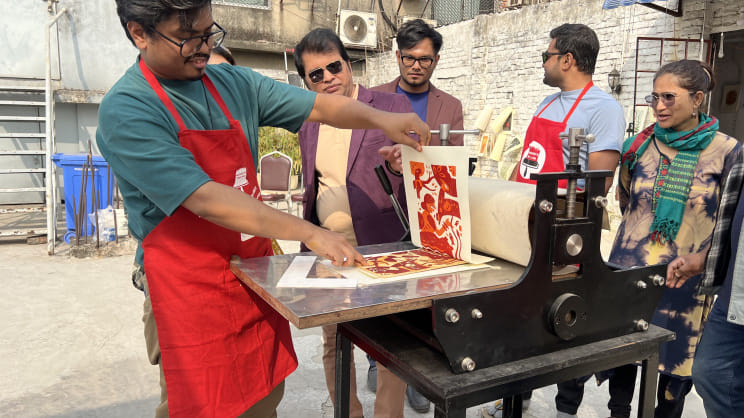
Shakil Mridha was a student of the Department of Printmaking, Faculty of Fine Arts, University of Dhaka. After moving to this city, unlike many, he experienced what he called a visual shock the moment he encountered the city’s rickshaw and the art in it.
He said, “I had seen rickshaw art in the village, but seeing it in the city made me realise it is perhaps the purest and most powerful Bangladeshi art form.”
According to him, the rickshaw art form is surprisingly small in scale but massive in impact. “Maybe only 50 to 200 artists are actively working in this tradition,” he explained. “But their visual language defines the whole city.”
He is especially fascinated by how the art form evolved under pressure. When human figures were once discouraged on rickshaw panels, artists did not stop; they adapted.
“They started painting animals doing human things – Zebras controlling traffic, foxes going to school. It became surreal, almost playful,” he described. “That creativity under restriction is what makes it so special.”

A printmaker who thinks beyond boundaries
Although his inspiration comes from folk traditions, Mridha identifies primarily as a printmaker. His home doubles as a studio, filled with sketches, carved woodblocks and experiments in colour.
“My studio is not a complex place. It is a room in my home where I have my setup for canvas painting and printmaking,” he stated. “Following the philosophy of Picasso, I do whatever I feel like – if I want to draw, I might fill an entire sketchbook in seven days.”
For prints, he works at Safiuddin Shilpalay, where traditional printmaking presses allow him to bring his ideas to life on a bigger scale.
Between fantasy and memory
Mridha remarked, “I am a person of the fantasy world. To me, a scene of a woman cutting fish with a ‘boti’ while a cat watches is a deep place of fantasy – a simple, innocent life that is now becoming extinct.”
One recurring symbol in his art is the bird. It comes from childhood memories of lying under the roof and watching nests outside his window. “I used to whistle at them. I felt like they responded,” he laughed. “That feeling never left me.”
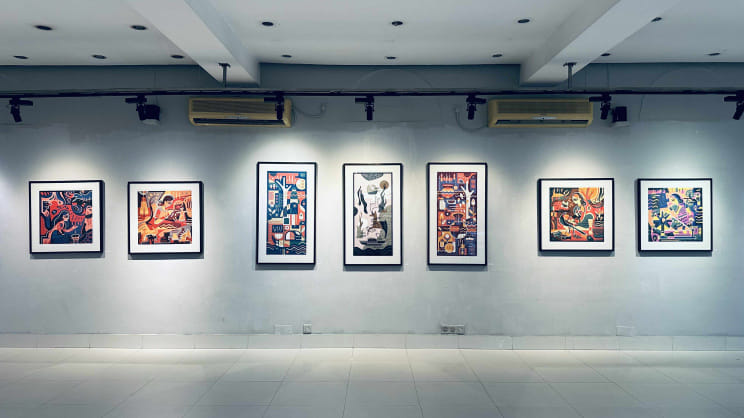
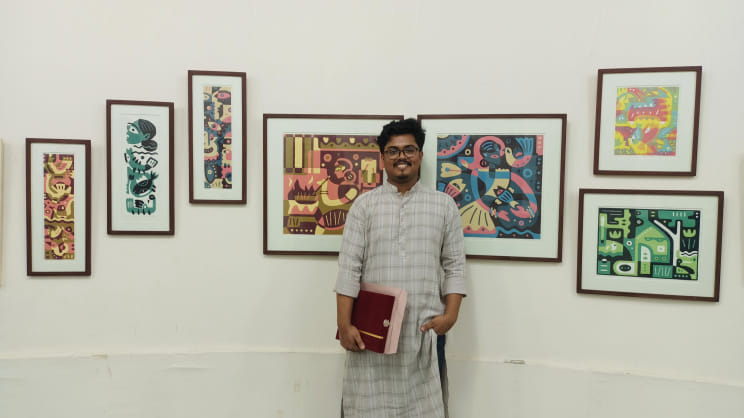
Mridha’s work reflects a thoughtful mixture of tradition and modern design. He appreciates modern minimalism for its calmness, while folk art is the opposite.
“I take the traditional folk forms and apply geometric abstraction and flat colours to find a new, modern language,” he said simply.
In his academic years, he began experimenting with a mix of both. “It was my way of bringing two worlds together,” he claimed.
A concern for the future of folk art
Beyond his personal practice, Mridha is deeply concerned about the survival of folk traditions, especially rickshaw painting. Even though it has gained international recognition, including a UNESCO listing, he feels the artists themselves remain overlooked.
“If rickshaw painters stop their work today, this art form could become extinct overnight. We cannot let this legacy disappear,” he showed his concern.
The artist calls this crisis a “famine of taste” – a loss of appreciation for local visual identity. He believes academic and folk artists should work together more closely, through workshops and collaborative spaces.
For him, art is not just about beauty; it is about survival and identity.
“If we lose folk art. We lose a part of ourselves,” Mridha mentioned.
And yet, his work is not just nostalgic; it is energetic, colourful and full of life. Like the rickshaw art motives he first fell in love with in Dhaka.
Photo: Courtesy
Comments