


Finding beauty in forgotten garment industry scraps

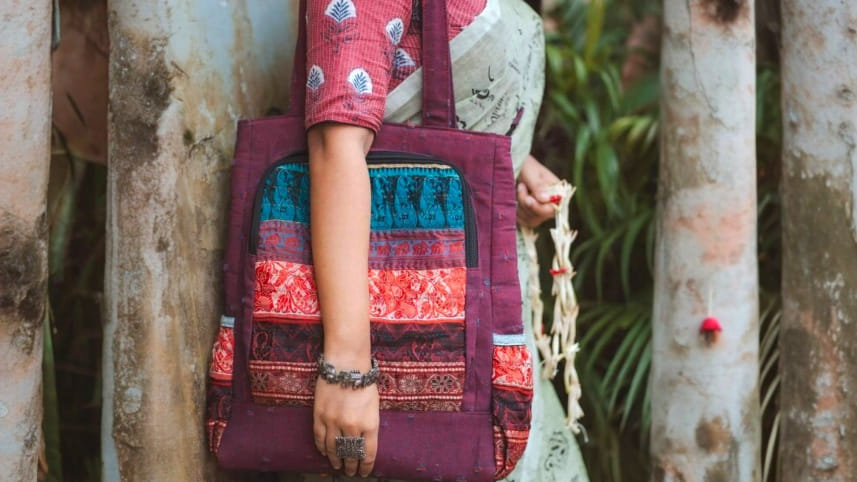
In the bustling alleys of Bangladesh’s garment districts, "waste" is a word used far too often. Mountains of denim scraps and leftover textiles are usually destined for landfills or low-grade burning. But for Sohali Sajia, the founder and CEO of Bidora Bags and Handicrafts, these remnants are not an end but a beginning.
Sajia is part of a growing movement of conscious entrepreneurs who believe that fashion should not come at the cost of the planet. She has turned the concept of the circular economy from a boardroom buzzword into a tangible, stylish reality.


The spark of a green revolution
The concept was not born out of a typical business plan. It was an emotional realisation that occurred during the pandemic's quiet period. Sajia, an MBA graduate from Chittagong University, had always felt a pull toward doing something meaningful for her country.
"Bangladesh is a global leader in garment production, but we also produce immense garbage," Sajia explains thoughtfully. "I started thinking about how we could give these high-quality leftovers a second life."
Unlike traditional recycling, which breaks down materials into a lower quality, upcycling takes remnants and transforms them into products of higher value. For Sajia, this meant taking industrial remains and turning them into sophisticated, hand-crafted fashion statements.

Combatting the cost of denim
Producing a single pair of jeans can require between 3,000 to 7,000 litres of water. When these jeans are discarded or the scraps are thrown away, that massive environmental investment is simply lost.
Sajia’s intervention is strategic. By sourcing discarded denim and factory leftovers, she bypasses the need for new water-intensive production.
"People don’t realise that denim is actually one of the most durable fabrics. A pair of jeans can last 10 to 15 years without losing its integrity," she notes earnestly.
At her factory in Gazipur, she works with a team of 27 skilled artisans. Most of these workers are women. They meticulously clean, cut, and reassemble the fabric chaff. The result is a collection of bags that are both eco-friendly and visually stunning. Because every scrap is different, no two bags are exactly alike.

The zero-waste challenge
Maintaining a zero-waste production model is an uphill battle. It requires more than just good intentions; it requires technical ingenuity.
Traditional leather-working machines are often too harsh for textile-based upcycling, so Sajia had to invest in specific machinery and train her staff to handle the delicate balance of durability and design.
In her studio, even the smallest offcuts are used. These tiny pieces are often transformed into bag charms, dolls, or decorative patchwork.

"We don't throw anything away. Everything has a purpose," Sajia opines firmly. This commitment to the planet has resonated far beyond the borders of Bangladesh.
Recently, Sajia represented the country at the 30th China Kunming Export-Import Fair. Her collection, which stood out for its hand-made precision in a market dominated by machine-made goods, was a massive success.
"The international buyers were shocked that these were made from leftover materials. They appreciated the honest texture of the cloth," she recalls with pride.

 For all latest news, follow The Daily Star's Google News channel.
 Building a legacy of conservation
As the global focus shifts toward climate conservation, Sajia believes that the fashion industry must lead the charge. She urges young entrepreneurs to look beyond the green label and focus on the actual quality of the product. For her, a product is not sustainable if it doesn't last.
Sohali Sajia’s journey is a testament to the fact that style and sustainability are not mutually exclusive. By weaving the story of climate conservation into every stitch, she is proving that the future of fashion is about what we save.
Photo: Courtesy
Comments