


Behind Ghonoghota 2: The people who made Dhaka dance

Five-year-old Rigvedita Wriddhi Mitro does not always wake up easily for school. On the morning of Ghonoghota 2, however, her father had little trouble getting her out of bed. Dance was waiting.
Wriddhi learns alongside her mother at Arthy Ahmed Dance Academy. Asked whether she ever wants to miss a class, she answers a firm “No.” She enjoys dancing, loves watching her mother perform and has equally direct affection for her teachers: “I love Arthy Miss very much. I love Elizabeth Miss very much too.”

Her excitement reflects the larger spirit behind Ghonoghota 2, staged on 17 July, 2026, at Bokultola of the Faculty of Fine Arts, University of Dhaka.

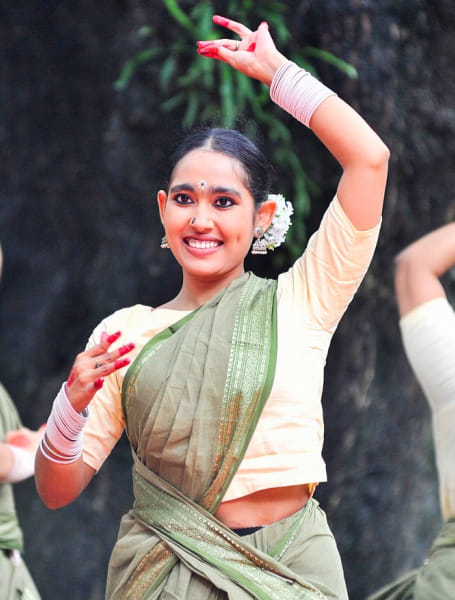
The open-air monsoon production brought together more than 300 performers aged from three to around 70. Its 16 presentations incorporated Bharatanatyam, Kathak, folk and contemporary dance, set to Rabindra Sangeet, Nazrul Sangeet, modern Bengali music and regional traditions.
Opening with Nirjher Chowdhury’s raag-based rendition of “Allah Megh De Pani De,” the programme was the academy’s first major production after its founder and director, Arthy Ahmed, received the Ekushey Padak 2026.
Yet, the performance audiences saw was only the final stage of a much longer process.

A production shaped by public demand
The original Ghonoghota began with Ahmed’s desire to help Dhaka residents experience the monsoon beyond waterlogging, traffic and mud.
“The motive was to take city people away from the difficulties of the monsoon and show them the true beauty of the season,” Ahmed says. “They could watch dance, listen to songs and poetry, and experience it under the open sky.”
According to Ahmed, around 3,000 to 4,000 people attended the first edition. After photographs and videos circulated online, requests for another production began arriving.
The second edition became considerably larger. The academy’s student population had increased, and more learners wanted to perform. Around 50 children participated, including several aged three or four who were appearing before a large audience for the first time.
“That is the beauty of children,” she explains. “They dance with joy, without the pressure of heavy makeup, jewellery or trying to appear perfect.”
Planning movement for hundreds
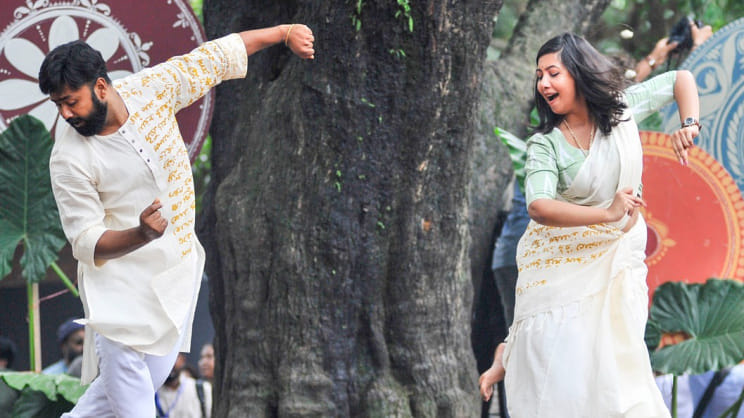
Coordinating more than 300 performers required much more than teaching dance steps. Ahmed had to decide where each group would stand, how they would enter and exit, and how hundreds of people could move together without confusion.
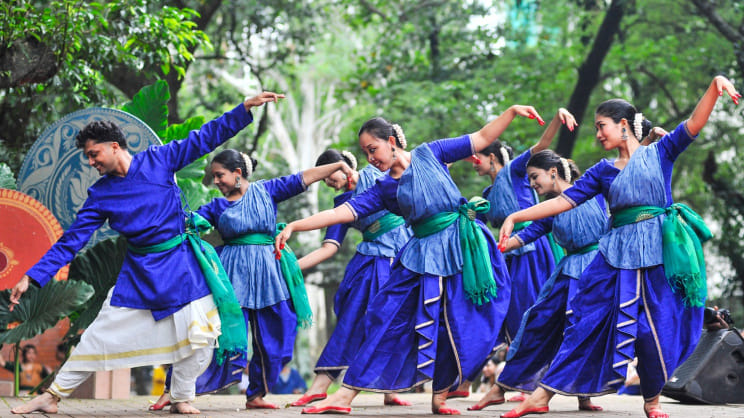
The concluding sequence brought nearly all the performers into the space at once.
“I spent nights without sleep, sketching and writing down who would enter from which direction and how they would move,” she says.
The visual simplicity of the production was intentional. Ahmed wanted dancers to appear recognisably themselves rather than hidden beneath heavy stage makeup.
“The biggest challenge was convincing them that they were naturally beautiful,” she says. “Many worried about pimples, dark circles or their natural complexion. I wanted them to understand that they did not need to hide those things.”
The performers used minimal makeup, mainly eyeliner and lipstick. After seeing photographs from the event, several students told Ahmed that they finally understood her decision.
 For all latest news, follow The Daily Star's Google News channel.
 “Helping Bengali girls believe that they look beautiful in their natural skin and hair was one of our major goals,” she adds.
Every safety pin mattered
Dance teacher Elizabeth Mankhin stepped back from the main student performances to help manage rehearsals and support the large number of participants.
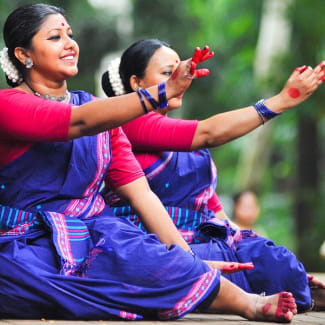
Her role extended far beyond teaching choreography. She checked sarees, jewellery, flowers, hairclips, bangles, teep sizes and safety pins.
“Since many of them are not professional dancers, we had to make sure they felt secure,” Mankhin said. “I checked every safety pin, hairclip and flower for around 300 people.”
For Mankhin, the most meaningful moment was personal. A single mother, she watched her daughter perform in Ghonoghota for the first time. “My biggest joy was being on the same stage as my daughter,” she shared.
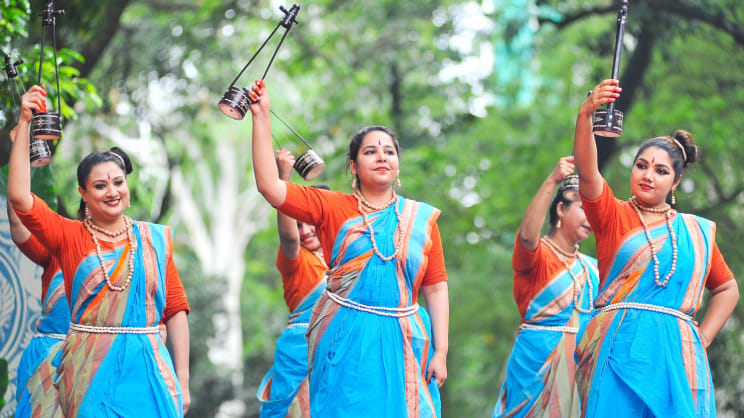
At the students’ request, the academy’s nine teachers also performed near the end. Their dance was arranged with almost no preparation, with the steps decided only the night before. The spontaneous appearance became one of the audience’s most warmly received moments.
Shared responsibility behind the stage
Ahmed is careful not to claim sole credit for the production.
The academy did not assign rigid production titles. Instead, members contributed according to their abilities. Those familiar with public relations handled communication, while others helped with presentations and coordination. Nine teachers divided responsibility for rehearsals across the academy’s three branches.
Manager Akib spent the final seven days at the Faculty of Fine Arts overseeing technical arrangements, including lights and sound.
“My name is attached to the production, but my credit is minimal,” Ahmed asserts. “It was the equal effort of everyone in the academy. Everyone considers the academy their own.”
An engineer returns to dance
Saumitra Mutsuddi, Head of Corporate Affairs at BSRM Group of Companies, was among the adult beginners reclaiming an ambition left behind in childhood.
He had always been interested in dance, but like many children in middle-class families, he was encouraged to prioritise education and professional security.
“My parents wanted their children to become doctors or engineers,” he says. “Because of that pressure, I focused on my studies and did not have the opportunity to learn dance.”
Years later, his daughter enrolled at Arthy Ahmed Dance Academy. Watching her classes revived his own interest. When the academy introduced an adult beginners’ course, he joined despite having no formal training.
Finding time was difficult, and performing before thousands initially frightened him. Ahmed’s ability to motivate students of different ages helped him continue.
“Through dance, I have fulfilled an old dream,” Mutsuddi says. “It has freed me from the monotony and stress of work and given me new energy. In a way, I have found a second life.”
He also discovered the discipline and teamwork required for a large group performance.
“These qualities are essential not only for dance, but also for our society and state,” he says. “There is no age limit for dreaming, and the main inspiration for me has been Arthy Ahmed.”
When the crowd exceeded the plan
The organisers had expected the conditions to limit attendance. The programme took place on a Friday morning, included a suggested dress code and discouraged umbrellas so visitors could experience the monsoon directly.
Instead, the crowd overwhelmed the venue.
Ahmed says the security team counted approximately 10,000 people before losing track as more spectators entered. She estimates that the total may have approached 15,000, although this remains the organiser’s estimate.
Many visitors could not see the stage clearly. Some stayed at the Faculty of Fine Arts until late afternoon, taking photographs, singing and continuing their own monsoon celebration.
For Ahmed, the turnout demonstrated that audiences will still gather for dance when it is presented thoughtfully and accessibly.
“It showed that if you present beautiful and tasteful dance, people will come,” she says.
The academy is considering restaging the production at another venue because many visitors were unable to enter. Ahmed also believes a future edition would require registration and stronger crowd-management systems.
Whether Ghonoghota becomes an annual tradition will depend on funding and logistics. But its impact is already visible in people such as Wriddhi and Mutsuddi. One wakes eagerly for dance at five years old. The other returned to a childhood dream after decades.
Between them stood hundreds of performers, nine teachers, a manager handling technical details, parents coordinating schedules and a team checking every flower, sari and safety pin.
That was the real production behind Ghonoghota 2: a carefully organised space where people of different ages could rediscover themselves through dance.
Comments