


Why Sirajganj sweets taste different from anywhere else

I have been eating sweets from Sirajganj for as long as I can remember. Every Eid my family goes back, and every Eid there is mishti — sticky packets on the dining table, bags on the bus home that everyone tries not to crush. I never asked where any of it came from. It was just part of the trip. This time I asked.
Walking through the bazaars, I have always noticed that the sweet shops outnumber the grocery stalls. Each lane has its own, and the locals are particular about them in a way people elsewhere are particular about restaurants. Not just proud, but specific. That one. Not the other one.
 For all latest news, follow The Daily Star's Google News channel.
 Out of the names I kept hearing, two came up more than any other: Subrata Sweets and Khan Sweet Meat.
Located at SS Road in the bazaar area, Subrata Sweets is one of the oldest sweet shops in the area. If you want to visit, it will take a little looking around to find the shop, although everyone knows it by name.
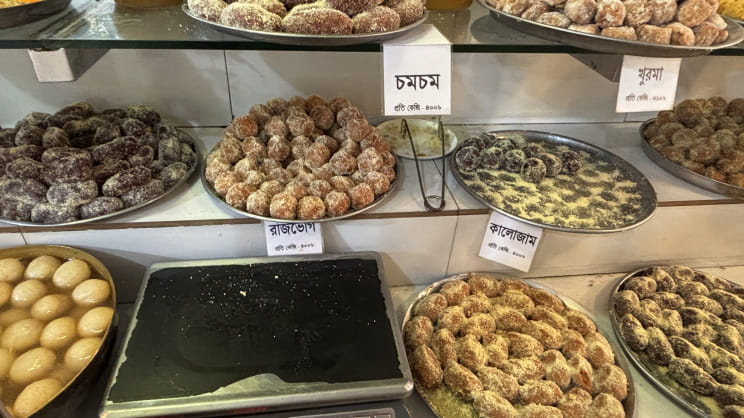
The shop is narrow, almost corridor-shaped, and you smell the curds and ghee before you see the glass case. Pradeep Bashak was at the counter when I walked in, a proud fifth-generation confectioner.
The menu runs the usual range. Kalojam, chomchom, and laddu, but those are not why anyone gives you directions here. Pradeep suggests I try the obak shondesh and the raghobshai. I do not argue with a fifth-generation confectioner. I should not have doubted there was even a choice to make.
I tasted the obak shondesh first. Smooth, but not processed smooth. The kind you only get from milk reduced over hours until it firms up on its own. Nutty, faintly buttery, barely sweet. I finished one in almost seconds.
The raghobshai is harder to describe. It held shape when I tried to dig in, but melted almost instantly when I put it in my mouth. The taste was milky and rich, with a ghee-like depth and something toasted underneath. Not burnt, just concentrated down to where the flavour actually lives.

Pradeep said, “The reason why our sweets taste the way they do is that the cows roam around free in the chars and eat organic grass.”
He also explained the science of why it matters. “When cows are stress-free, they produce better quality milk with higher fat content. This makes the sweets of our region so special.”
I left full and headed to the next one.
A short 10-minute walk from Subarata landed me at Khan Mishtanna Bhandar. Located in Khalifa Potti near Elliot Bridge,
Heavily crowded, I met brothers and second-generation owners, Akhlak and Bakul Khan, manning the counter and supervising their shop.
“My father opened this shop 70 years ago, and we have been serving people with the best quality sweets since,” said Akhlak Khan, the older brother.
They served me two sweets on a small floral plate. I tasted Mama mishti first: white, oval, and milky. It pulled apart cleanly and tasted mild in the way good milk tastes mild — not bland, just unforced. The sweetness was there, but it didn't push. It had a flavour profile almost similar to cheese. I ate it and immediately picked up the rajbhog.
Made from curd and ghee, denser, with a grainy sugar coating on the outside, the rajbhog is a must-try for anyone with a sweet tooth.
“Even now we make everything with ghee, which we make in-house. We also have our own cows from which we get our milk,” Bakul said, gleaming with pride. He also added that the recipes have remained the same for all 70 of these years.
I have been coming to Sirajganj every Eid for as long as I can remember, and I will keep coming. The sweets will be on the table, as always, sticky and familiar, but I will definitely have a better appreciation for the effort and the stories behind these sweets.


Comments