


Hidden danger: Thousands of Bangladesh’s schools lie close to toxic battery recycling sites

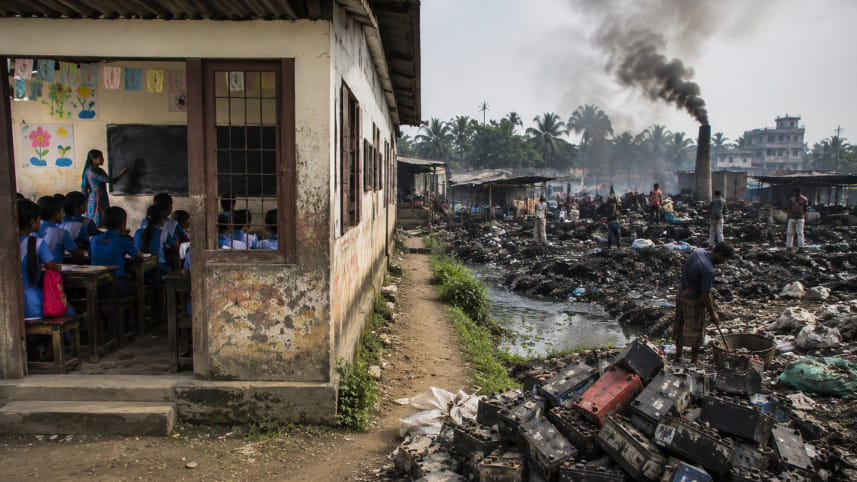
More than 8,800 schools in Bangladesh are located within five kilometres of a documented toxic site, and several sit less than 100 metres from informal battery-breaking yards. The findings come from a new study by the Center for Global Development (CGD), Schools in the Shadow of Toxic Sites: Pollution Proximity in Low- and Middle-Income Countries, which raises urgent questions about children’s environmental safety and learning conditions.
The Bangladesh profile paints a worrying picture. The country has the second-highest number of documented contaminated sites among those included in the study. Around 82 per cent of these sites are linked to lead pollution, overwhelmingly from informal used lead-acid battery (ULAB) recycling. While the study measures proximity rather than confirmed exposure, it highlights areas where further investigation is urgently needed.
 For all latest news, follow The Daily Star's Google News channel.
 To better understand the findings and their implications, The Daily Star spoke with Lee Crawfurd, Senior Research Fellow at CGD Europe and lead author of the study.
Crawfurd stressed that the findings should not trigger panic or prompt parents to withdraw children from school. Rather, they should serve as a warning that authorities need to identify where genuine risks exist.
“We don’t know that children are being exposed through all of these sites,” he said. “What we do know is that these are places where there may be risks, and they deserve proper environmental testing.”
Lead exposure is particularly concerning because there is no known safe level for children. Informal battery recycling often involves melting used lead-acid batteries in open environments with little or no pollution control. Tiny lead particles can become airborne, settle into surrounding soil, contaminate crops, and eventually enter children’s bodies through inhalation or hand-to-mouth contact.
“Children are especially vulnerable because lead affects brain development,” Crawfurd explained. “Particles can travel through the air, settle on the ground where children play, and even contaminate food grown kilometres away.”
The study also points to growing international evidence linking lead pollution with poorer educational outcomes. Previous research in Kenya, Mexico and Indonesia has shown that children living near lead-processing facilities perform worse in school. In Bangladesh, earlier studies have already documented elevated blood lead levels among children living close to battery recycling operations.
So, what should happen next? Crawfurd believes Bangladesh’s immediate priority should be low-cost environmental testing, particularly in the 887 schools located within one kilometre of documented toxic sites. Soil testing, followed by blood lead screening where contamination is suspected, would help identify communities requiring urgent intervention. At the same time, stronger regulation, safer recycling practices and relocating hazardous industries away from densely populated areas would significantly reduce long-term risks.
Importantly, he emphasised that schools themselves are not the problem. Rather, the goal is to ensure that children can learn in safe environments while governments use available data to make better planning decisions about industrial zoning and future school construction.
Bangladesh has made remarkable progress in expanding access to education. Protecting children from invisible environmental hazards must now become part of that success story. Safe classrooms are not simply about buildings and teachers—they also depend on the quality of the air children breathe, the soil beneath their feet, and the environment that surrounds them every day.
E-mail: tareq.salahuddin@thedailystar.net


Comments