


How World Cup songs predicted global music trends

Every FIFA World Cup leaves behind a soundtrack. Some become instant classics, others fade from memory, and a few achieve the rare feat of outlasting the tournament itself. Yet beyond their role as sporting anthems, World Cup songs offer something else: a snapshot of global popular culture at a particular moment in time. Viewed together, the official songs, opening ceremony performances, and major musical acts associated with successive World Cups tell a fascinating story about the changing geography of global entertainment. Long before streaming platforms and social media made cultural trends easier to identify, the World Cup was already showcasing where popular music was heading. In many ways, the tournament has functioned as a cultural time capsule, reflecting which sounds, genres, and regions were shaping the global music landscape.
The 1998 World Cup in France arrived at a pivotal moment for Latin pop. While artistes from Latin America had long enjoyed international success, they were still largely viewed as regional stars within much of the English-speaking world. Then came Ricky Martin and “The Cup of Life”. The song’s explosive performance before the tournament final introduced many viewers to an artiste who was already enormously successful across Latin America but had yet to become a household name elsewhere. Within a year, Martin’s self-titled English-language album would become a global sensation, helping to fuel what became known as the Latin Pop Explosion. Artistes such as Jennifer Lopez, Enrique Iglesias, Marc Anthony, and Shakira would soon follow. Looking back, the World Cup did not create the trend. It simply happened to place one of its most visible representatives on one of the world’s biggest stages just as Latin pop was preparing to break into the mainstream.
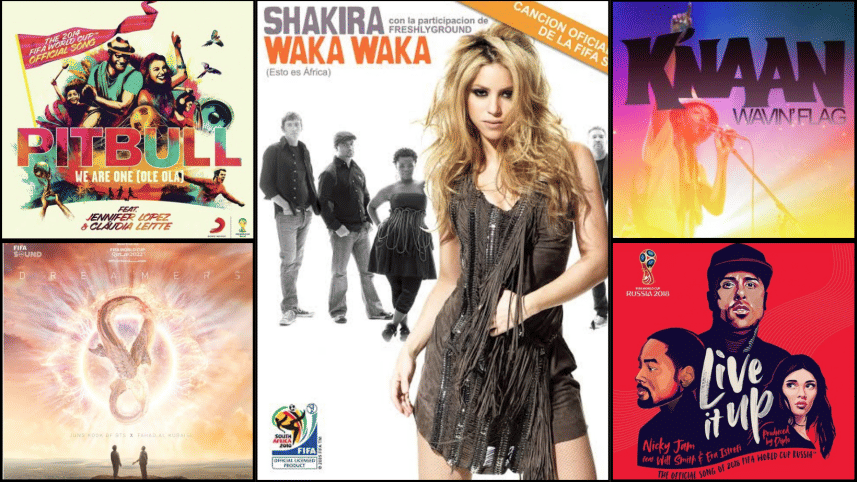
The 2000s reflected a different reality. By the time Germany hosted the World Cup in 2006, globalisation had accelerated, and international collaborations were becoming increasingly common. The tournament’s music embraced a blend of styles and influences rather than focusing on a single region or genre. This growing internationalism reached its peak in South Africa in 2010, a tournament widely regarded as one of the most culturally influential World Cups in modern history. The official anthem, “Waka Waka”, drew inspiration from Cameroonian music and incorporated African rhythms into a global pop format. At the same time, K’naan’s “Wavin’ Flag” became an unofficial anthem of the tournament, introducing millions of listeners to a Somali-Canadian artiste whose music blended African influences with contemporary hip-hop and pop. In hindsight, the significance of these songs extends beyond football. During the following decade, African artistes and African-inspired sounds would increasingly shape mainstream global music. Today, Afrobeats stars routinely dominate international charts, collaborate with major Western artistes, and headline some of the world’s largest festivals. While South Africa 2010 did not initiate this transformation, it offered many international audiences an early glimpse of the growing global appeal of African music and culture.
 For all latest news, follow The Daily Star's Google News channel.
Brazil 2014 represented another shift. By then, social media platforms were beginning to exert unprecedented influence over music consumption. The official song, “We Are One”, brought together Pitbull, Jennifer Lopez, and Brazilian singer Claudia Leitte in a collaboration designed for a globalised digital era. The emphasis was no longer on representing a particular region but on creating a cross-border pop spectacle capable of appealing to audiences everywhere at once. This reflected a broader trend within the music industry. As streaming services expanded and online platforms erased geographical barriers, international collaborations became increasingly common. Artistes no longer needed to belong to the same country, or even speak the same language, to create global hits.
The trend continued in Russia in 2018 with “Live It Up”, featuring Nicky Jam, Will Smith, and Era Istrefi. The collaboration combined Latin music, American pop culture, and European influences, reflecting a world in which music had become increasingly borderless. The rise of streaming had fundamentally altered how audiences discovered and consumed songs, making multinational collaborations not only possible but commercially advantageous.
Then came Qatar 2022, perhaps the clearest indication yet of how dramatically the cultural landscape had evolved. The tournament’s most notable musical moment was the performance of “Dreamers” by Jung Kook of BTS. Two decades earlier, it would have been difficult to imagine a Korean pop artiste occupying such a prominent position within the world’s largest sporting event. Yet by 2022, K-pop had become one of the most influential forces in global entertainment, driven by highly connected online communities and unprecedented international reach. Jung Kook’s appearance reflected a broader shift in the balance of cultural influence. For much of the twentieth century, global pop culture flowed primarily from North America and Western Europe. By the 2020s, audiences were increasingly embracing entertainment from a far wider range of regions, including South Korea, whose music, television dramas, and films had achieved remarkable international success.
The World Cup’s musical history suggests that the tournament often mirrors larger cultural currents rather than creating them. Its songs and performers tend to reflect the sounds that are already gaining momentum and the regions that are becoming increasingly influential within the global entertainment industry. This may explain why certain World Cup songs feel so closely tied to the eras in which they emerged. They capture more than the spirit of a tournament; they capture the spirit of a moment in global culture. From the Latin pop boom of the late 1990s to the rise of African musical influence in the 2010s and the global expansion of K-pop in the 2020s, World Cup music offers a surprisingly effective lens through which to view the evolution of popular entertainment. Every four years, billions of people tune in to watch football. Yet, in the process, they also receive an unexpected lesson in where global culture is heading. Long after the goals and trophies have faded from memory, the music remains as a record of the trends that would go on to shape the world beyond football.
Comments