


Rana Plaza anniversary sparks renewed calls for worker safety, justice
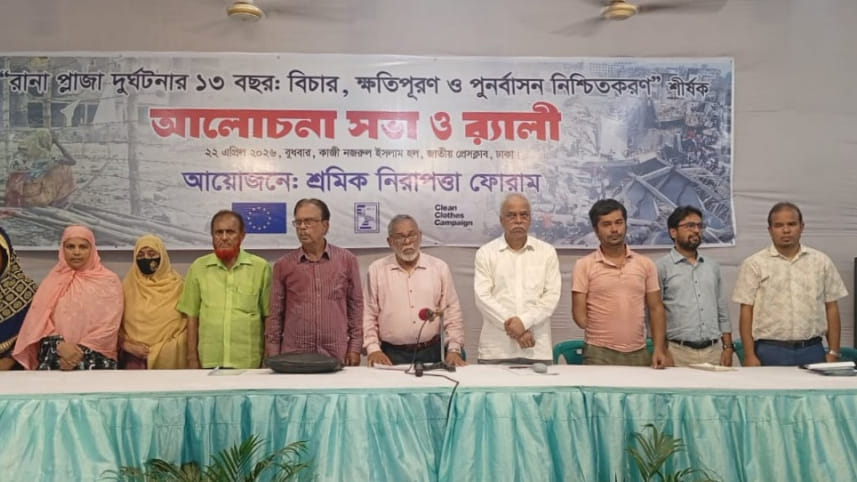
Weak law enforcement and a lack of accountability among individuals and institutions, along with negligence in fire safety, gas cylinder management, electrical systems, and chemical control, are the key causes of recurring industrial accidents in Bangladesh, speakers at a discussion said today.
The discussion highlighted that industrial disasters involving Tazreen Fashions, Spectrum, Hashem Foods, and the incidents in Mirpur and the recent Narayanganj gas lighter factory blast demonstrate persistent gaps in ensuring workplace safety.

The event, titled “13 years of the Rana Plaza tragedy: ensuring justice, compensation, and rehabilitation”, brought to light the current realities faced by victims of industrial accidents and outlined key recommendations for future action.
The Workers’ Safety Forum organised the discussion at the National Press Club, followed by a rally demanding justice, proper compensation, and sustainable rehabilitation for affected workers.
Leaders of national and sectoral trade unions, representatives of workers’ rights organisations, members of labour rights advocacy alliances, victims of industrial accidents, and their family members attended the programme.
Participants stressed the importance of a united movement to ensure justice for workers, noting that many families of deceased and injured workers are yet to receive proper compensation, rehabilitation, adequate medical care, or justice.
Despite the passage of time, they said, effective measures to ensure workplace safety, improve working conditions, and protect labour rights remain insufficient.
Barriers to unionisation have also prevented workers from organising effectively and advocating for their rights.
They further observed that industrial accidents continue across sectors, while authorities have failed to identify root causes and implement corrective measures.
Victims of the Tazreen fire and Rana Plaza collapse noted that the government has recently provided family cards to some affected households, which they described as a necessary support measure.
They also alleged that those responsible for the accidents are yet to face appropriate punishment, contributing to growing frustration and anger among workers and their families.
Speakers emphasised that without greater worker awareness, improved safety standards, and proactive government initiatives, the situation is unlikely to improve. Due to a lack of employer accountability, workers are often forced to take to the streets to demand their rights.
Ensuring worker safety, fair compensation, and rehabilitation will require sustained solidarity, awareness, and active initiatives, they said, adding that the state cannot evade its responsibility in this regard.
The speakers underscored that coordinated efforts from the government, employers, labour organisations, and civil society are essential to ensure justice, proper compensation, and long-term rehabilitation. Effective monitoring, stronger law enforcement, and increased worker awareness are also crucial for sustainable change.
The session was chaired by Anwar Hossain, vice chairman of the Bangladesh Institute of Labour Studies (BILS), and moderated by Ahsan Habib Bulbul, general secretary of the Socialist Workers Front.
 For all latest news, follow The Daily Star's Google News channel.
Comments