


FIFANOMICS: How Bangladesh cashes in on the World Cup


Khalid Hossain arrived at the Dhaka University TSC area at around 8pm, driving a van stacked with boxes of vuvuzelas. About three hours later, Argentina would face Austria in a FIFA World Cup match in Arlington, Texas.
Thousands of fans had gathered to watch the match on giant screens at TSC. For Khalid, it was the perfect time to sell plastic horns.

“If you time it right, you can make Tk 3,000-4,000 in profit within two to three hours,” he said, just minutes before kick-off, as his stock sold out while customers continued to queue.
He sells the vuvuzelas for Tk 50 or Tk 100, depending on the size. Buyers from his home district of Jhenidah -- or fellow Argentina supporters -- receive a Tk 5-10 discount.
Khalid works at a home décor shop in Paltan during the day. Selling vuvuzelas is a side hustle reserved for a handful of festive occasions. During the World Cup, however, the profits come quickly.
“You have to pick the right matches. Brazil and Argentina games draw the biggest crowds and the most customers.”

The scene around him bore this out. It was June 22, the middle of the week, and Argentina’s second group-stage match after winning their opener.
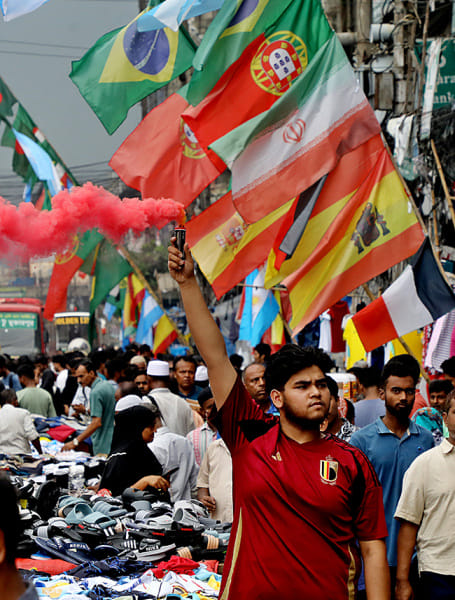
Some fans bought jerseys from roadside vendors, while others queued for pickles, peanuts, fruit, fuchka, ice cream and jhalmuri from the many hawkers doing brisk business.
Bangladesh, despite never qualifying for the World Cup, is renowned for its passionate celebration of the tournament, fuelled by a decades-old rivalry between Brazil and Argentina supporters. With every edition, the spectacle grows larger and more extravagant.
This year, Argentina fans in Pabna spent Tk 50,000 on a 2,022-foot flag. In Magura, a Germany supporter reportedly sold a piece of land to fund a seven-kilometre flag. Across Bangladesh, thousands of public screenings accompanied every match. Political and social organisations organised processions, feasts, friendly football matches and open-air broadcasts that attracted crowds of hundreds of thousands, collectively spending tens of crores of taka.
The scale of the enthusiasm is so vast that it ripples through the economy.
THE JERSEYS
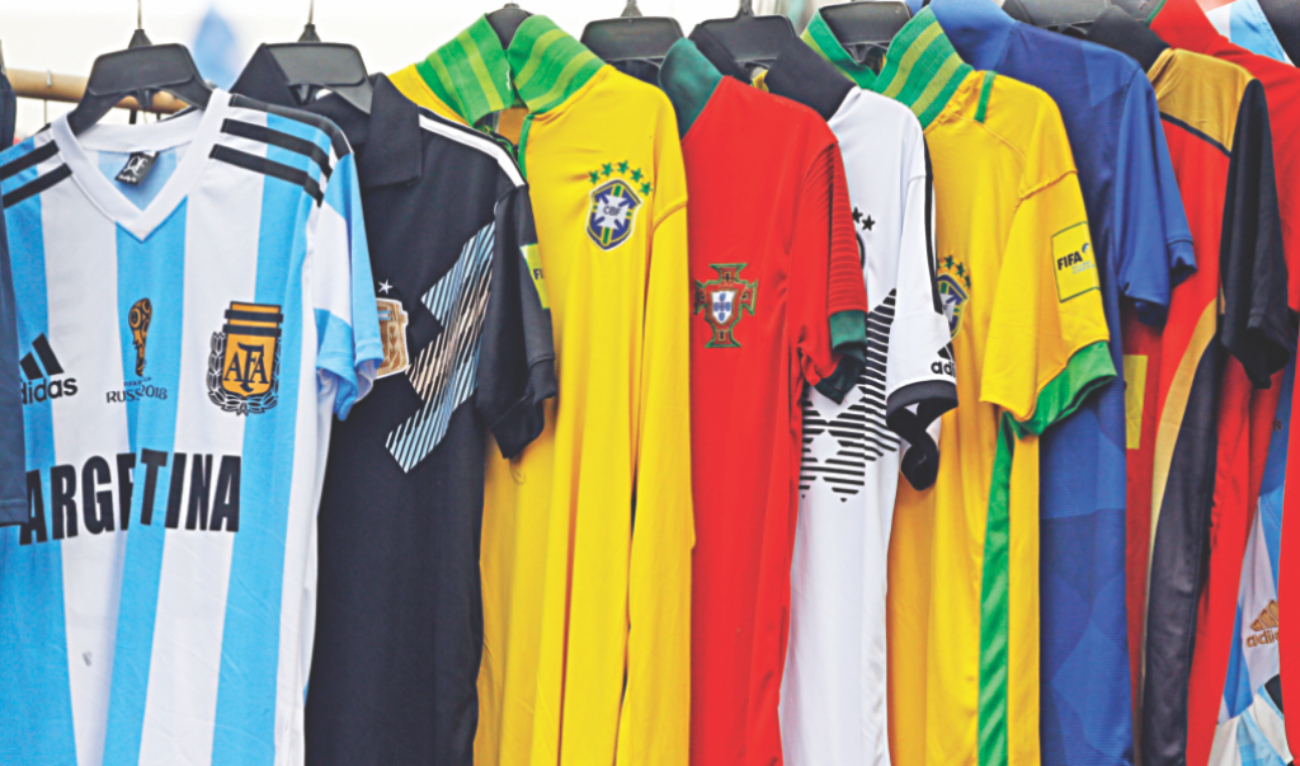
Apparel is among the first sectors to feel the World Cup effect. Sales of jerseys and flags begin rising weeks before the opening match. Fans drape flags from rooftops, balconies, offices, bedrooms and roadsides.
The Bangladesh Sports Accessories Merchant Manufacturers and Importers Association estimates the country’s sporting goods market at Tk 1,500-2,000 crore. During the World Cup, the market comes alive like at no other time.
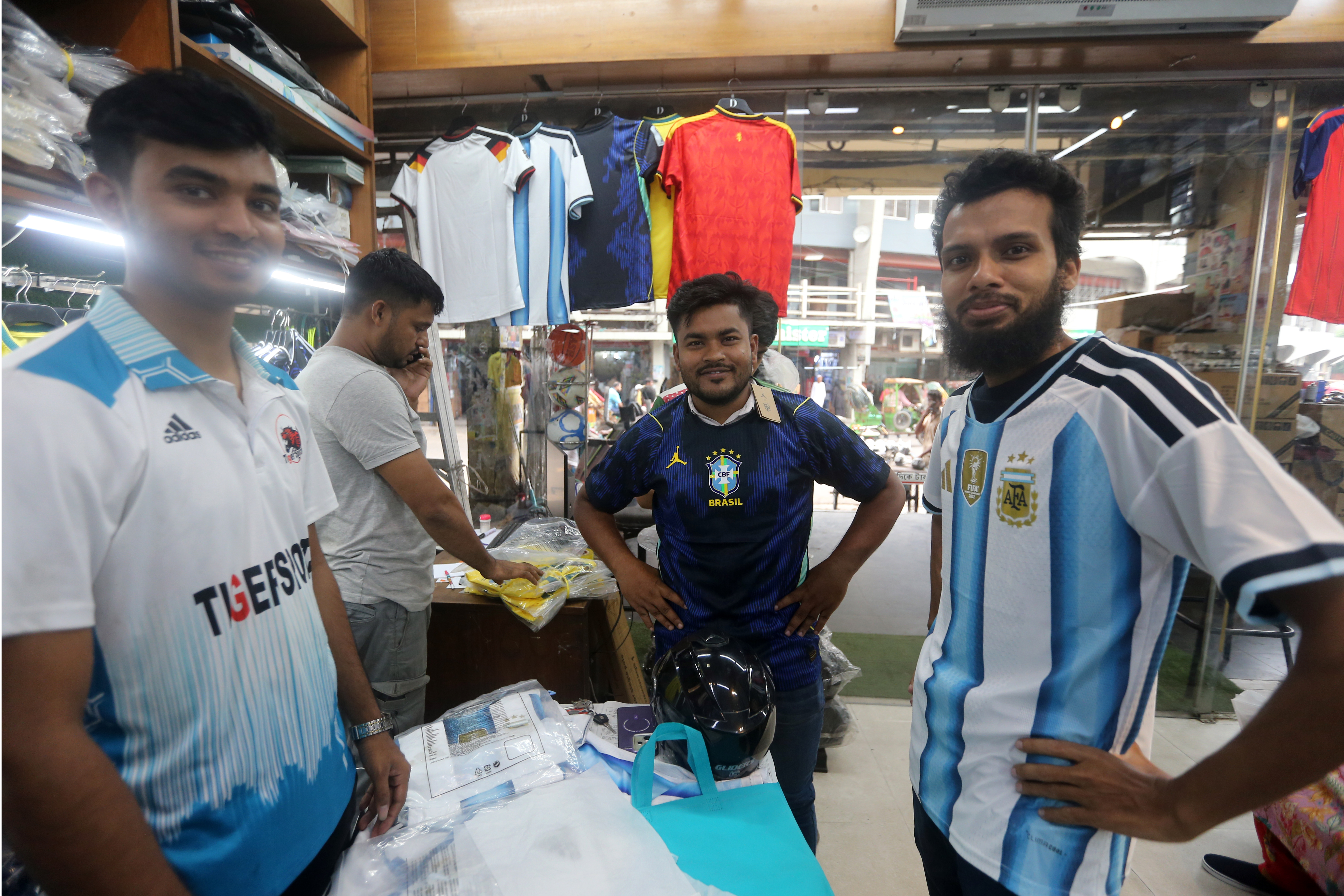
“Jerseys are selling the most, while footballs and other related items are also moving fast. Around 60 percent of the jerseys sold are for Argentina. There is also steady demand for France, Japan and Germany jerseys,” Mukul Patwary, manager of Galaxy Sports at Bashundhara City Shopping Mall, told The Daily Star recently.
Manufacturers are equally busy.
“Demand for jerseys during this year’s World Cup exceeded industry expectations,” said M R Shamim Patwari, president of the association. Production at his factory roughly doubled during the peak period ahead of the tournament, although he could not provide an industry-wide estimate.
Bangladesh also supplies World Cup apparel abroad.
At a factory in Turag, workers at Garments Manufacturing and Assembling Ltd spent weeks stitching jerseys for New York-based Capelli Sport, which were reportedly worn by Cape Verde during their tournament debut against Spain. The factory shipped 5,000 player jerseys for the team and another 13,000 fan jerseys to the same buyer.
 For all latest news, follow The Daily Star's Google News channel.
 In 2014, about 100 BKMEA member factories secured orders to produce fan jerseys worth more than $500 million, according to estimates by the association’s leaders at the time.
“There is no reliable industry data on World Cup-related export orders because manufacturers neither classify nor disclose them as tournament-linked,” said Fazlee Shamim Ehsan, executive president of the Bangladesh Knitwear Manufacturers and Exporters Association (BKMEA). Bangladesh primarily manufactures fan jerseys and T-shirts rather than official team kits, making such orders difficult to identify and track.

THE SCREENS
For many Bangladeshis, the World Cup began in 1986 with colour television. Diego Maradona’s exploits remain etched in a generation’s memory. Television still anchors the tournament for most households. Every World Cup brings a corresponding surge in business.
Md Mushfiqur Rahman, head of product for consumer electronics at Fair Electronics, said this year’s World Cup was expected to outpace previous editions, partly because it coincided with Eid-ul-Azha. Demand for large-screen and smart televisions has risen sharply.
“Overall, we estimate the TV market for the season could reach around Tk 1,000 crore,” he said.
The bigger shift, however, is unfolding on smaller screens.
During the 2022 Qatar World Cup, Banglalink’s streaming platform Toffee, which held the exclusive digital rights, recorded more than one billion views. The final alone drew 15.5 million unique viewers, marking the first time millions in Bangladesh chose a digital platform over television to watch a live World Cup match. Banglalink’s data usage jumped 33.2 percent in the fourth quarter of 2022 -- covering November and December -- a surge the company attributed to its streaming rights.
This year, the rights are more widely shared and the tournament has expanded. Toffee and Grameenphone’s Bioscope Plus are streaming all 104 matches of the 48-team competition, up from 64 in Qatar. BTV, T Sports and Somoy TV are broadcasting the matches under a consortium agreement. On opening night, all streaming platforms crashed as millions tried to tune in.
“Live streaming of this major global sporting event has driven a clear surge in streaming traffic, reflecting strong audience interest and a growing preference for digital-first viewing,” said Sharfuddin Ahmed Chowdhury, head of communications at Grameenphone.
The shift from broadcast to streaming is global, but its scale in Bangladesh is striking. Advertising spending tied to the 2018 Russia World Cup reached $12.6 billion, up just 2.8 percent from the previous tournament, according to WARC Media. Analysts attributed the modest growth to audiences fragmenting across platforms -- a trend that has only accelerated since.

LATE-NIGHT SNACKING
The ten-hour time difference between Bangladesh and the North American host cities means most matches land in the dead of night or the early morning. And while fans watch, they order food.
Pathao said it recorded approximately 20 percent higher order volumes during the tournament period, rising to 35 percent on high-profile match days.
“Because fans are staying up late or waking up early to watch the games, we are also seeing a shift in regular daily ordering patterns, with demand extending into time slots that are typically quieter for food delivery,” the company said.
Late-night matches boost orders for fried chicken, burgers and pizza, while early kick-offs drive breakfast and coffee sales.
Foodpanda, meanwhile, onboarded jersey vendors on its platform for the first time this cycle, letting fans receive merchandise in under an hour.
“This shows how food delivery naturally becomes part of the viewing experience while also benefiting restaurants, suppliers, and the wider ecosystem, creating additional earning opportunities for delivery partners,” said Zahedul Islam, the company’s head of public affairs and public relations.

THE ADS
Above the consumer economy sits the advertising industry, where the World Cup is less a sporting event than a commercial season.
“For the advertising industry, the FIFA World Cup is almost like Eid,” said Rabi Hasan, chief executive of Dhaka-based creative agency Artology.
“Even brands that do not run major campaigns try to join the football conversation through content, promotions and social engagement.”
Agencies begin planning months in advance, analysing brand positioning, audience behaviour and fan sentiment to help brands participate authentically in what Hasan calls one of the world’s most emotionally charged events. Football anthems -- branded songs built around the tournament -- have become a genre of their own in Bangladesh, often outlasting the competition itself.
The money is substantial, though widely spread. Smaller agencies handle projects worth a few lakh taka, while larger brands spend several crores on integrated campaigns.

“When media buying, production, digital marketing, campaign ambassadors, influencer partnerships, activations, events and promotions are taken together, the FIFA World Cup generates a few hundred crore taka in seasonal economic activity across Bangladesh’s advertising and marketing ecosystem,” Hasan said.
“Advertising works best when it taps into strong consumer emotions. In Bangladesh, World Cup excitement often rivals major festivals in public attention and conversation.”
Bangladesh has never qualified for the World Cup, and domestic football draws modest crowds. Yet every four years, it becomes one of the world’s most commercially vibrant football markets.
A joint socioeconomic analysis by FIFA and the WTO projects the 2026 World Cup will generate $80.1 billion in global gross output and support 824,000 jobs across 76 countries. Bangladesh invested nothing in creating that value, yet still captures part of the economic return.
Back at TSC, Khalid had sold out by half-time. Standing at the edge of the crowd, his empty boxes behind him, he watched Argentina take part in the greatest show on earth -- as dubbed by FIFA. The economy he had briefly profited from had already moved on. He was just another fan now.
Our correspondent Mokammel Shuvo contributed to this article

Quarterly VAT wins over businesses but stokes revenue fears
Avoidable delays stall farm climate project
Aman rice output hits record 1.73 crore tonnes

US shifting from aid to trade with Bangladesh

Dhaka Bank eyes top-tier status through digital, AI push

BRAC Bank rises from SME roots to banking leader
Chinese investors flock to Hong Kong as trading curbs tighten
Slowing US job growth poses midterms challenge for Trump
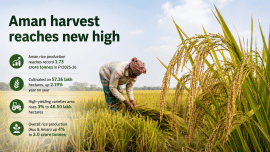
Aman rice output hits record 1.73 crore tonnes
