


Agriculture budget rises, but challenges remain for farmers: experts
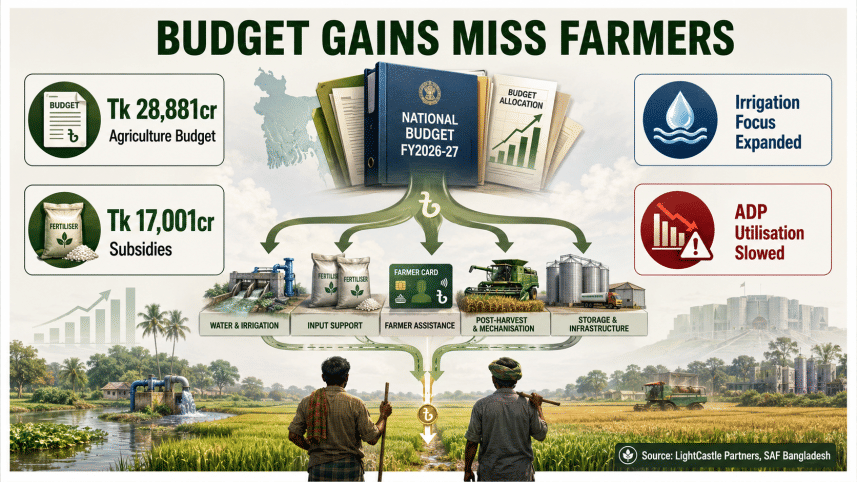
Public investment and policy support for the agriculture sector have increased over the years, but the benefits of budgetary allocations have yet to adequately reach smallholder and marginal farmers, experts said today.
At a discussion, experts discussed how proposed budget allocations, policy priorities, and strategic interventions for fiscal year 2026-27 can be translated into tangible benefits for farmers and contribute to the long-term transformation of the agriculture sector.
 For all latest news, follow The Daily Star's Google News channel.
 The observations came at a roundtable, titled "National Budget FY2026-27: Strategic Discussion on Crop Agriculture", jointly organised by LightCastle Partners and the Sustainable Agriculture Foundation (SAF) Bangladesh, at a hotel in Dhaka.
Bangladesh's crop agriculture sector remains crucial for ensuring food security, supporting rural livelihoods, driving agro-industrial growth, and generating export earnings. Between 1999 and 2019, the value of agricultural production grew at an average annual rate of 3.54 percent.
However, the sector continues to grapple with climate vulnerability, increasing dependence on agricultural inputs, and inefficiencies in post-harvest management.
Farmers continue to face mounting challenges, including rising input costs, post-harvest losses, climate-related risks, limited market access, and weak implementation of development programmes, the experts said.
Agriculture's contribution to Bangladesh's gross domestic product (GDP) has declined from nearly 38 percent in the 1970s to 11.2 percent at present.
At today's event, Zeeshan Abedin, social research and impact adviser at LightCastle Partners, presented a keynote analysis of the proposed agriculture budget.
According to the presentation, the proposed FY2026-27 budget allocates Tk 28,881 crore to the Ministry of Agriculture, including Tk 7,946 crore for development expenditure, up from Tk 27,224 crore in the original FY2025-26 budget.
The budget also proposes Tk 17,001 crore for agricultural subsidies, including fertiliser support and related activities.
The presentation highlighted that agriculture's allocation under the development budget has doubled to Tk 7,945 crore. However, the proposed subsidy allocation has declined by 1.4 percent, while support for industry players has shifted towards input tax reductions.
A notable feature of the proposed FY2026-27 budget is its greater emphasis on water management and irrigation, post-harvest management, and agricultural assistance through the Farmer Card programme.
However, concerns were raised over the utilisation of allocated funds. While Annual Development Programme (ADP) implementation reached 93 percent in FY2022-23 and 95 percent in FY2023-24, the rates fell to 60 percent in FY2024-25 and 62 percent in FY2025-26.
MA Sattar Mandal, emeritus professor at Bangladesh Agricultural University in Mymensingh and professorial fellow at the Bangladesh Institute of Development Studies, moderated the session.
Zahedul Amin, co-founder and managing director of LightCastle Partners; Md Farhad Zamil, executive director of SAF Bangladesh; Anwar Faruque, board director of Bangladesh Krishi Bank and former secretary of the Ministry of Agriculture; and Md Habibullah, director of the Administration and Finance Wing of the Department of Agricultural Extension, also spoke at the event.


Comments