


Sluggish RMG exports unlikely to rebound in coming months

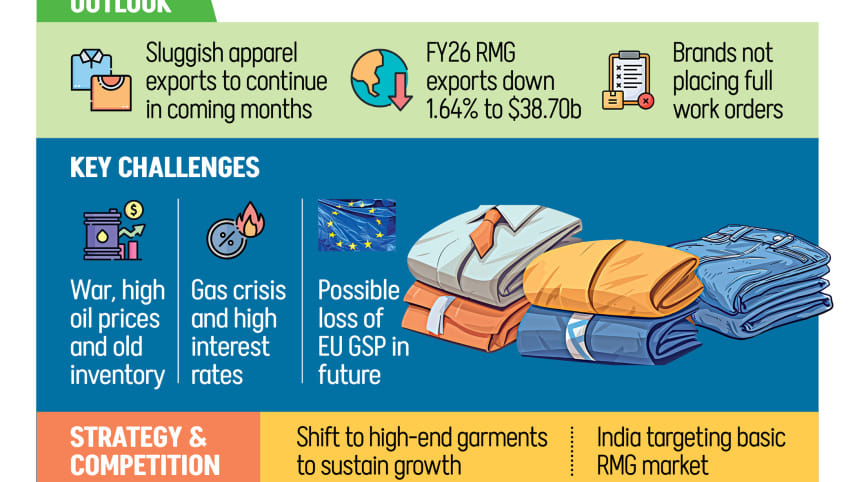
The country’s sluggish garment exports are unlikely to recover in the coming months as the war in the Gulf drives up energy costs, feeds inflation in key Western markets and leaves retailers with more unsold stock, according to exporters and major international buyers.
Apparel makers say buyers remain cautious and are avoiding large orders, even though uncertainty over US tariffs has eased.

Fresh apparel orders largely depend on retail sales in the United States and Europe. But the dragging US-Israel’s war on Iran has triggered an energy shock that is rippling through the global economy.
Higher energy prices have pushed up inflation in Bangladesh’s main export markets, weakening demand for clothing in Europe, Asia and the US. At home, rising energy costs have also increased production costs for manufacturers.
“We are facing a perfect storm now,” said Abrar H Sayem, director of Sayem Group, which supplies clothing to brands including US Polo Assn, British Ben Sherman and European fast-fashion retailer NewYorker.
The country’s readymade garment (RMG) sector earned $38.70 billion in the recently concluded fiscal year 2025-26 (July-June), down 1.64 percent from $39.35 billion in FY25, according to Export Promotion Bureau (EPB) data.
The FY26 decline was largely blamed on months of uncertainty over US tariffs. Although the Trump administration kept the newly announced tariff unchanged at 10 percent on Friday, easing one source of uncertainty, exporters say the broader market remains weak.
“The order placement is still slow as the global volatility is lingering,” said AK Azad, managing director of Ha-Meem Group, a leading garment exporter to the US.
The war, oil prices and old inventories have been affecting buyers’ decisions, Azad added.
“Western buyers are also going through a difficult period, which has affected their purchasing decisions,” said Tapan Chowdhury, managing director of Square Apparels, which also exports garments to the US and Europe.
“We have the challenges of continued energy supply, but still we are hopeful that the market will recover in the near future,” he also said.
Meanwhile, exporters also say the country’s heavy reliance on five basic garment items has left the industry vulnerable in an oversupplied market marked by intense price competition.
Western buyers say the country’s export performance is unlikely to improve over the long term unless it shifts towards higher-value products.
Bangladesh mainly exports trousers, T-shirts, formal woven shirts, underwear and sweaters. Together, these account for 78 percent of total garment exports, while about 95 percent of factories produce these five categories.
“Our old model of selling basic garments is no more relevant as India has been showing resilience in this segment recently because of incentives paid to the exporters,” said Md Fazlul Hoque, managing director of Plummy Fashions Ltd, whose buyers include Tommy Hilfiger, Calvin Klein and Zara.
“If we want to remain competitive in global supply, we have to maintain the growth, which is difficult to gain now,” said the exporter. “So, we have to wake up for positive growth,” he added.
Hoque said improving gas supplies and lowering bank lending rates should be priorities as manufacturers continue to face rising production costs.
Anwar-Ul-Alam Chowdhury (Parvez), former president of the Bangladesh Garment Manufacturers and Exporters Association (BGMEA), said Vietnam is in a much stronger position than Bangladesh in the current global supply chain because its production costs have remained stable, it has higher value addition, and it enjoys shorter lead times to Europe and the US.
A senior executive at a European garment retailer, who asked not to be named, said Bangladesh would struggle to maintain $50 billion in RMG exports by 2030, let alone achieve its $100 billion target, unless it diversified its product range.
He said the global market for the five main garment items exported by Bangladesh is already saturated. “We do not have any chance for further expansion for these five products. We need high-end garment items at affordable prices.”
 For all latest news, follow The Daily Star's Google News channel.
 Bangladesh’s graduation from least developed country (LDC) status and the subsequent loss of preferential market access could make the country a more expensive sourcing destination than its competitors, reducing its competitiveness in key export markets.
The buyer said major retailers and brands have already begun planning to source more products from other countries ahead of Bangladesh losing GSP benefits over the next few years, even if the transition is delayed.
He also said that if India secures duty-free access to the European market through a bilateral free trade agreement (FTA), buyers may push for even lower prices from Bangladeshi exporters supplying Europe.
Faisal Samad, a director of the Bangladesh Garment Manufacturers and Exporters Association (BGMEA), said the organisation would hold roadshows in the US, Japan and South Africa over the next few months to help revive export orders.
The BGMEA is also setting up a design studio to help exporters become more competitive by analysing markets, products and the latest fashion trends, he said.
Comments