


Rancon Auto, Mitsubishi form JV to make vehicles in Bangladesh
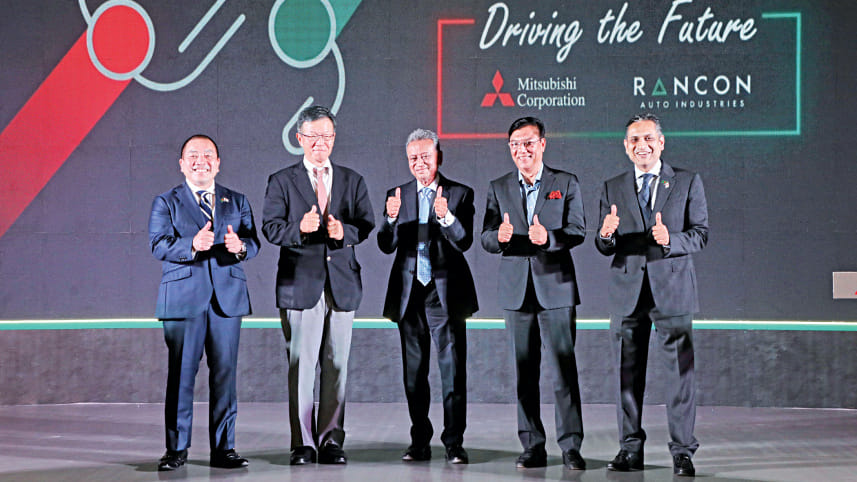
Rancon Auto Industries Ltd (RAIL) has entered a strategic partnership with Japan’s Mitsubishi Corporation to manufacture vehicles in Bangladesh for sale in domestic and regional markets.
Under the agreement, Mitsubishi will take a 25 percent equity stake in Rancon Auto, which began local production of the Mitsubishi Xpander in June last year.
 For all latest news, follow The Daily Star's Google News channel.
 Announcing the joint venture at an event at Sheraton Dhaka yesterday, Rancon Holdings Group Managing Director Romo Rouf Chowdhury said the partnership would mark a major step forward for the country’s automotive sector.
Finance Minister Amir Khosru Mahmud Chowdhury, State Minister for Civil Aviation M Rashiduzzaman Millat and Japanese Ambassador to Bangladesh Saida Shinichi were present at the event.
Rancon Holdings Group Managing Director Chowdhury said, “The landmark strategic alliance -- the first of its kind in the country’s automotive sector -- underscores the strength of Bangladesh-Japan trade relations.”
He added that the strategic investment is expected to enhance access to affordable and convenient vehicle financing, expand after-sales services, ensure spare parts availability, and strengthen distribution networks across the country.
“It will also facilitate the transfer of technology and knowledge to develop a highly skilled local workforce, while contributing to government revenue through VAT and taxes,” said Chowdhury, adding the company’s automobile arm has gradually built its manufacturing base since starting operations in 2017.
Rancon Auto, which focuses on multi-brand vehicle manufacturing and assembly, began with the local assembly of the Mitsubishi Outlander. It later expanded its portfolio to include the Fuso BM117, Mercedes OF1623, Proton X70, as well as trucks and pickups from JAC and GMC.
The company upgraded its factory in 2023 with a modern paint facility. The following year, it launched the locally painted and assembled Mitsubishi Xpander, which quickly gained traction, with monthly sales exceeding 100 units, making it the highest-selling brand-new vehicle in Bangladesh.
Despite this growth, Chowdhury said the country’s automobile market remains largely underdeveloped.
With one of the lowest per capita vehicle ownership rates in the region and a population of around 200 million, he said Bangladesh offers strong long-term demand potential as the middle class expands.
Against this backdrop, Rancon initiated discussions with Mitsubishi Corporation to leverage its manufacturing and distribution expertise. The talks culminated in the joint venture, under which Mitsubishi Corporation acquired a 25 percent stake in Rancon Auto Industries through direct foreign investment.
“This is a proud moment for us,” Chowdhury said, adding that the partnership reflects growing international confidence in Bangladesh’s industrial prospects.
He said it could be the first instance of direct foreign investment in four-wheel vehicle manufacturing in the country.
Chowdhury expressed hope that the move would encourage other global players to invest, helping build a stronger automotive manufacturing ecosystem capable of generating employment and eventually developing into an export hub.
He also pointed to regional examples such as Indonesia, Thailand, Malaysia, Vietnam, India and Pakistan, which have developed established automotive industries with export capacity.
Japanese Ambassador to Bangladesh Saida Shinichi described the joint venture between Mitsubishi and Rancon as a “significant milestone”, crediting engineers, technicians and government officials for their roles in bringing the project to fruition.
He said Mitsubishi had begun training Rancon engineers in 2024, followed by the launch of Xpander assembly in June last year, calling it evidence of strong collaboration between the two sides.
The envoy also highlighted Bangladesh’s efforts to improve the investment climate, including its first Economic Partnership Agreement (EPA) with Japan, signed in February, and initiatives such as the “Investment Gateway”.
He said the Mitsubishi Xpander is the only locally assembled Japanese-brand vehicle in Bangladesh, calling it the country’s first “made-in-Bangladesh” Japanese car.
He added that local assembly could support wider industrial development, including technology transfer, job creation and growth in upstream industries such as parts manufacturing.
Hiroyuki Egami, senior vice-president and division COO of Mitsubishi Corporation, reaffirmed the company’s commitment to bringing its global automotive expertise to the partnership.
In his speech, Finance Minister Amir Khosru Mahmud Chowdhury described the Mitsubishi-Rancon joint venture as a “refreshing change” for an automobile sector long dependent on imported vehicles.
“Bangladesh has traditionally depended on cars imported from Japan, Europe and the United States, a pattern that had become a way of life,” he said, adding that local assembly with a global brand like Mitsubishi marks a significant turning point.
He said Rancon’s experience in the automobile market makes it a suitable partner and expressed confidence that the collaboration would grow “from strength to strength”.
The minister highlighted the venture’s wider economic impact, pointing to its potential to raise value addition, create jobs and support industrial development, particularly in light engineering.
He added that the government is planning a dedicated zone for light engineering industries to support such initiatives.
At the programme, State Minister for Civil Aviation M Rashiduzzaman Millat announced that direct flights between Dhaka and Tokyo would resume next month, restoring a key air link between Bangladesh and Japan after a prolonged suspension.
He said the resumption would strengthen connectivity, facilitate trade and business, and deepen people-to-people ties between the two countries.
“You will be happy to know that we are starting flights to Tokyo from next month,” he said, adding that the move was expected to boost bilateral engagement on multiple fronts.
Comments