


No overcapacity, forced labour in apparel sector

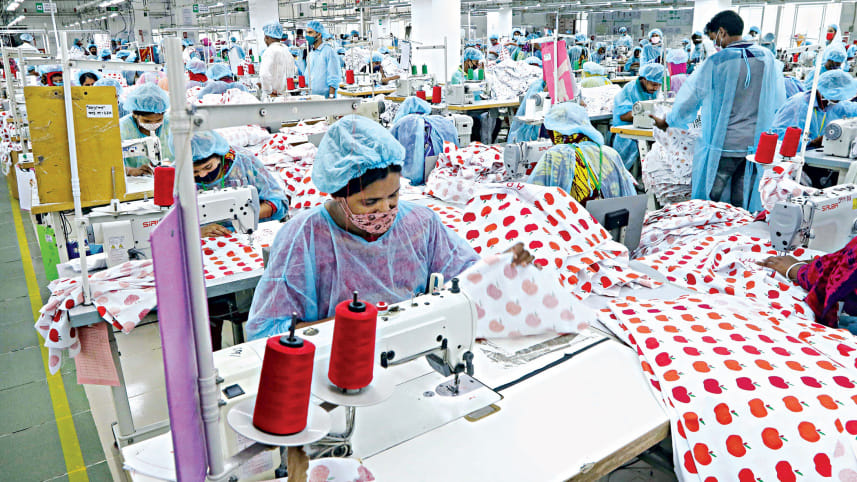
Bangladesh’s garment industry does not have overproduction capacity that could harm the American manufacturing sector and is free from forced labour, as exporters comply with internationally recognised labour laws, according to the Bangladesh Garment Manufacturers and Exporters Association (BGMEA).
The association made the remarks in a position paper submitted to the commerce ministry as the government prepares to attend a hearing of an investigation launched by the United States Trade Representative (USTR) on April 29.
 For all latest news, follow The Daily Star's Google News channel.
 The probe covers alleged overproduction capacity and forced labour in 60 countries, including Bangladesh.
Responding to the USTR’s “structural excess capacity” or “overproduction” concerns, the BGMEA said the terms do not have a universally accepted definition or measurable benchmark.
It argued that in a market-driven economy, production levels constantly adjust to shifts in demand, input costs and supply chain conditions. Determining “excess capacity” without clear parameters or methodology is a major challenge.
The association added that Bangladesh’s apparel sector has not expanded suddenly or in a way that would indicate structural excess capacity. The industry’s growth should be viewed over the long-term.
Over the past decade, the sector has followed a steady growth path, it said, driven by global demand and changing sourcing strategies rather than policy-induced expansion.
After more than four decades of development, Bangladesh exported garment products worth $39.3 billion in fiscal year 2024-25, accounting for nearly 7 percent of the global apparel market. It is now the world’s second-largest garment exporter after China.
In 2025, Bangladesh accounted for 10.73 percent of US apparel imports by volume and 10.53 percent by value, according to the American Apparel and Footwear Association (AAFA).
The BGMEA said the dominance of the sector in national exports shows structural constraints in economic diversification and reliance on a single industry, rather than excessive industrial capacity.
It added that the concentration of resources in apparel should be seen as part of a development pathway, not as evidence of overcapacity.
From a US perspective, the association said Bangladesh primarily exports labour-intensive, low to mid-priced apparel that is not produced in the US in significant volumes. In domestic production, the US focuses on advanced manufacturing and heavy industries rather than basic clothing items such as T-shirts and casual wear.
As a result, such imports do not adversely impact US manufacturing, but instead support consumers by providing affordable clothing, particularly for low and middle-income households, it added.
The BGMEA said Bangladesh’s role in the global apparel value chain complements the US economy.
It also said the government provides policy support, including cash incentives, to offset structural disadvantages such as inadequate infrastructure, longer lead times and limited backward linkage industries.
These factors add an additional seven to ten days of transit time and increase logistics costs, conditions that are not faced by competitors such as China, India and Vietnam.
On allegations of forced labour, the BGMEA said Bangladesh maintains a firm and unequivocal position that there is no forced labour in its export-oriented garment sector.
It said the industry operates under a strong legal and institutional framework that ensures compliance with national labour laws and internationally recognised standards.
Citing the official US Customs and Border Protection (CBP) dashboard, the BGMEA said 55 Withhold Release Orders (WROs) are currently active across all industries.
A WRO is a command by US Customs to stop, and hold imported goods at the border if they are suspected of being made with forced labour. A thorough review of the database confirms that there is no instance of any WRO issued against Bangladesh.
Comments