


ICDs raise charges, a day after fuel price hike

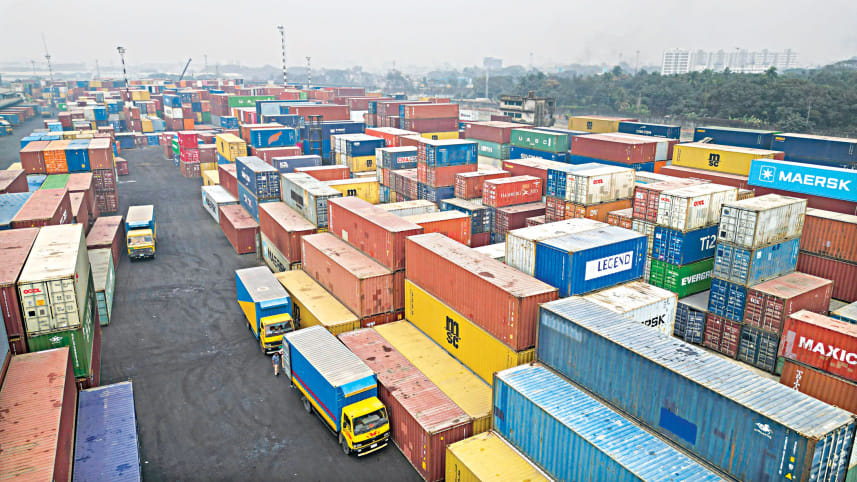
The recent fuel price hike is rippling through Bangladesh’s trade logistics chain, pushing up costs for importers, exporters and freight operators at the same time.
On Sunday night, owners of 21 private inland container depots (ICDs) announced an 8.5 percent increase in container handling charges with immediate effect.

The operators say the increase was obvious after a 15 percent rise in diesel prices. Exporters, however, say it will erode their competitiveness at a time when export growth has been falling for eight consecutive months.
Apparel exporters have criticised the move and called for a government review.
However, the Bangladesh Inland Container Depots Association (Bicda) defended the move, saying operators had to adjust costs to keep services running smoothly.
“Following the diesel price hike, cost adjustments became unavoidable to maintain smooth operations,” said Md Ruhul Amin Sikder, secretary general of Bicda.
The latest adjustment comes just months after ICD charges were raised by 20 percent, while the Chittagong Port Authority increased tariffs by more than 41 percent.
Private ICDs handle 20-23 percent of import-laden containers and around 93 percent of export-bound containers moving through Chattogram port.
The revised ICD rates cover six service categories, including container transport, lift-on/lift-off charges, export stuffing, container weight charges and import delivery, according to a circular issued by Bicda.
The association said ICD operations consume more than 70,000 litres of diesel a day, making cost adjustments unavoidable.
At present, ICDs charge an average of Tk 2,046 to transport an empty container between the port and depots. Export stuffing costs about Tk 7,424 for a 20-foot container and Tk 9,900 for a 40-foot container. Rates vary across depots as they are negotiated individually with clients.
Industry stakeholders, however, have raised concerns about the wider impact on trade costs.
“With the latest ICD hike, the cost of import and export business will rise sharply,” said Khairul Alam Suzan, former vice-president of the Bangladesh Freight Forwarders Association (BAFFA), pointing to earlier increases in charges and tariffs in December last year.
Shipping agents have echoed similar concerns, warning that the higher costs could weigh on external trade performance.
The Bangladesh Garment Manufacturers and Exporters Association (BGMEA) has criticised the decision as unilateral, calling for a government-led committee to assess the actual cost impact before any tariff adjustments are made.
SM Abu Tayyab, director of the BGMEA, said the combined pressure of higher port tariffs, ICD charges and rising freight costs would hit the already struggling readymade garment sector hard.
Bangladesh’s merchandise exports, heavily dependent on apparel, have recorded eight consecutive months of decline as of March. Exports fell by more than 18 percent year-on-year, dropping to $3.48 billion last month from $4.25 billion a year earlier.
The dual increase in logistics and handling costs is likely to squeeze profit margins further, particularly in low-margin sectors.
“With exports already on a softer trend, this will push exporters further onto the back foot,” said Riad Mahmud, managing director of industrial manufacturing company National Polymer Group.
 For all latest news, follow The Daily Star's Google News channel.
 He said truck fares rose by 6 percent to 7 percent within hours of the fuel hike announcement and are likely to settle 18 percent to 20 percent higher.
“These are cumulative pressures,” he said. “Transport costs are rising, and ICD handling charges are also going up. All of this directly increases export costs.”
He added that exporters are especially exposed because most orders are agreed in advance. “We cannot revise prices after contracts are signed. The additional costs must be absorbed by exporters.”
Salauddin Sikder, general manager (export) at RFL, said the impact is particularly severe for exporters of non-traditional goods such as plastics, doors and luggage, where shipments are smaller and fixed costs per document are higher.
He said the total cost per container has risen from around Tk 14,000 to about Tk 23,000, an increase of nearly 70 percent to 80 percent.
“Exporters are facing a double burden. Raw material prices have surged due to global geopolitical tensions, while local charges have also increased, leaving little room to absorb costs,” said Sikder.
“If our prices rise disproportionately compared with competitors like China or Vietnam, we risk losing orders,” he added.
Meanwhile, businesses are bracing for further changes as the Department of Shipping is due to meet stakeholders in Dhaka tomorrow to discuss cost adjustments for lighter vessels.
Shafiq Ahmed, convener of the Bangladesh Water Transport Coordination Cell, said a lighter vessel currently consumes around 3,500 litres of diesel on a round trip between Chattogram and Dhaka. Freight for transporting cement clinker stands at Tk 550 per tonne.
Comments