


25 lakh tonnes of mangoes, and barely 0.1% make it abroad

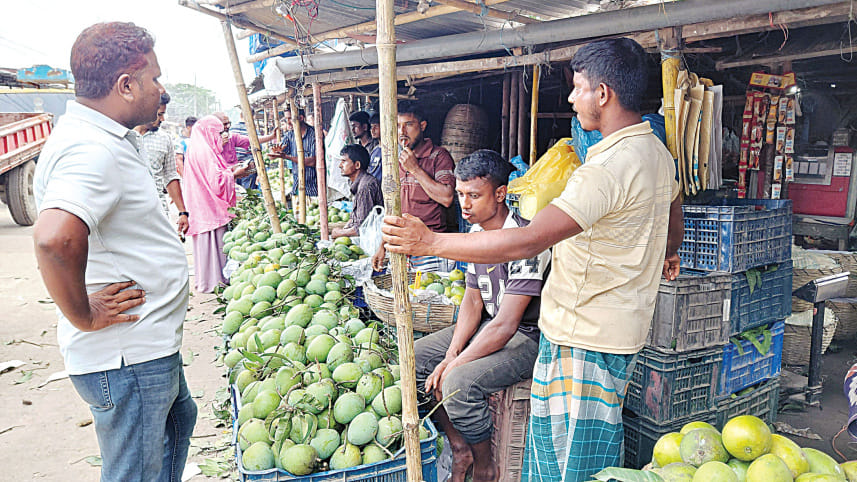
Despite being one of the largest mango producers in the world, with an annual surplus of 5 to 7 lakh tonnes, Bangladesh is failing to turn it into an export strength.
The country produces 24-25 lakh tonnes of mangoes annually for a domestic market worth Tk 13,000-14,000 crore, with domestic demand standing at around 18-20 lakh tonnes. Yet, its annual export has reached barely 0.1 percent of total production even in its best year.

Mango exports stayed flat at around 230 to 310 tonnes a year from fiscal year 2016-17 through FY2020, before growing more than tenfold to a peak of 3,100 tonnes in FY2023, according to Department of Agricultural Extension (DAE) data.
The growth, however, has been volatile, with exports falling to 1,321 tonnes in FY2024 before recovering to 2,194 tonnes in FY2025. In the current season, exports stand at 1,408 tonnes so far. Harvesting typically runs from mid-May through August, with peak availability stretching into July.
Officials and experts note that with stable production, supply is not the problem for mango exports. Fruit bound for export must clear a higher bar than domestic sale, including international standards for appearance, pest-freedom and food safety.
For the low mango exports, they point to a shortage of internationally compliant packhouses, inadequate cold-chain infrastructure, no standardised grading or packaging system, limited adoption of Good Agricultural Practices (GAP), pest and disease blemishes, and too few entrepreneurs pursuing export markets.
Dr Md Sorof Uddin, chief scientific officer at the Regional Horticulture Research Centre in Chapainawabganj, the country’s only dedicated mango research facility, said exports can multiply within a few years if the aforementioned issues can be addressed.
According to the centre, also known as the Mango Research Station, Bangladesh grows an estimated 800 to 850 mango varieties, more than 100 of them commercially, across Rajshahi, Chapainawabganj, Naogaon, Rangpur, Dinajpur, Thakurgaon, Lalmonirhat, Kushtia, Jashore, Satkhira, Meherpur and Natore.
Dr Sorof attributed rising output to modern orchard management, grafted saplings, balanced fertiliser use, improved irrigation and science-based cultivation. “Many farmers are now replacing paddy and jute with commercial mango orchards. Mangoes are now produced not only in the plains but also extensively in the country’s hilly regions.”
Stating that production has crossed 25 lakh tonnes this year, he said the larger harvest pushed supply up and prices down slightly from last year, though growers are still profitable on volume. “Premium-quality mangoes continue to command higher prices in the market. Farmers who have adopted modern cultivation methods and produced high-quality fruit are receiving satisfactory returns.”
DAE Director General Abdur Rahim said quality mangoes are now grown in nearly every household nationwide, but scaling exports will require wider GAP implementation and greater entrepreneurial participation.
“Bangladeshi mangoes are among the world’s finest in taste and colour,” he said. “What we need now is production that fully complies with international standards.”
To close the gap, the DAE is running its Exportable Mango Production Project across 46 upazilas in 15 districts.
Mango exports stayed flat at around 230 to 310 tonnes a year from fiscal year 2016-17 through FY2020, before growing more than tenfold to a peak of 3,100 tonnes in FY2023
The initiative covers GAP implementation, PRA, GIS-based orchard mapping, farmer training, modern machinery distribution, and export-profile development for priority varieties, said Project Director Mohammad Arifur Rahman.
He said Bangladesh has the potential to become a leading global exporter with planned orchard management, climate-resilient varieties, better post-harvest preservation, upgraded packaging and stronger export infrastructure.
Bangladesh now exports mangoes to 27 countries, including Germany, Sweden, Saudi Arabia, Qatar, Ireland, the United Kingdom and Italy, said the DAE official.
Several popular and commercially important varieties already carry Geographical Indication (GI) status: Haribhanga from Rangpur; Langra, Khirsapat (Himsagar), Fazli and Ashwina from Chapainawabganj; Himsagar from Meherpur; and Nak Fazli from Naogaon.
Other significant varieties include Amrapali, Gopalbhog, Mallika, Katimon and BARI Mango-4.
THE MANGO CAPITAL AND NEW WAVES
 For all latest news, follow The Daily Star's Google News channel.
 According to the Mango Research Station, most of the mangoes produced in Bangladesh are consumed in the domestic market. Over 4.5 lakh tonnes of them comes from Chapainawabganj, widely known as the mango capital of Bangladesh. The district cultivates mangoes across roughly 37,000 hectares.
In its famous Kansat Bazaar – the largest mango market in the country and the second largest in Asia, where mangoes worth millions – are traded every day during peak season, officials said.
The market trades Gopalbhog, Khirsapat, Langra, Fazli, Amrapali, Ashwina and Gourmati varieties.
In recent years, thanks to the popularity of online trading, it has seen a new wave of entrepreneurs constantly taking orders over the phone, photographing their produce, and arranging deliveries to Dhaka and other parts of the country. This has led to a growth in internal exports even when shipment to other countries failed to pick up momentum.
One such entrepreneur is Zulfikar Ali. Noting that both production and sales have increased this season, he said, “Besides selling at Kansat market, I also sell mangoes online, allowing me to reach customers
across the country.”
Modern cultivation methods are also being adopted rapidly. Zahurul Islam, who has grown mangoes commercially for a decade on 12 bighas of land, said he earns more than Tk 700,000 annually from the crop.
“I adopted modern cultivation methods this season, although there were a few shortcomings. Next year I hope to produce even better-quality mangoes,” he said.


Comments