


Largest budget in the works

The BNP-led government, which swept into power with a two-thirds majority in February, is set to unveil the country’s largest budget yet, hinging on an ambitious revenue target and a bold plan to draw on foreign assistance.
Tomorrow, Finance Minister Amir Khosru Mahmud Chowdhury will deliver his first budget, whose theme will be “Economic democratisation and decentralisation, Bangladesh in the trillion-dollar economic march”. The budget will cross the Tk 9 lakh crore mark for the first time in history.
 For all latest news, follow The Daily Star's Google News channel.
 Although the finance minister has not mentioned specific figures in budget discussions, he has said the upcoming budget will be quite large to support economic recovery.
Broadly, three main objectives will be set: reviving the economy, implementation of the government’s electoral pledges and turning towards a high growth trajectory to expand employment.
For three consecutive years, GDP growth has been on a downward trend.
In the last fiscal year, growth fell below 4 percent, the first time since the global coronavirus pandemic in fiscal 2019–20.
Development partners have forecast that growth will remain below 4 percent this fiscal year as well. Meanwhile, since 2023, inflation has stayed above 9 percent.
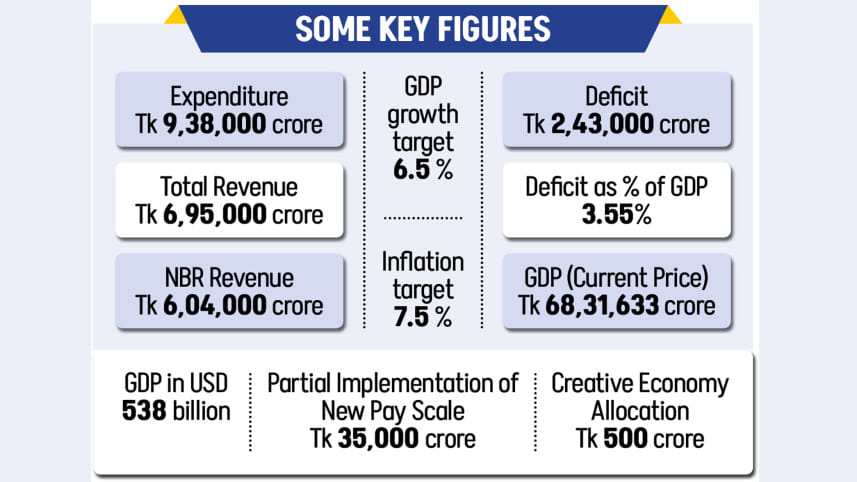
In the upcoming fiscal year, the GDP growth target is expected to be 6.5 percent growth and the inflation target 7.5 percent.
To achieve this, the revenue target will be set at Tk 695,000 crore, 90 percent of which will have to be borne by the National Board of Revenue.
Last fiscal year, the NBR collected Tk 369,528 crore. Based on current trends, officials estimate that the NBR revenue may reach Tk 400,000 crore this year.
That means next year’s collection will have to increase by Tk 200,000 crore to hit the target.
Meeting this revenue target will be the biggest challenge for the finance minister in managing large expenditure expectations.
Beyond revenue collection, deficit financing will rely on about $11 billion in foreign assistance, including roughly $3 billion in budget support. This target is being set without any loan from the International Monetary Fund.
In the first 10 months of the fiscal year, $4 billion in foreign assistance has been utilised. By June, including budget support, $7 billion is expected to be used.
Therefore, removing obstacles to project implementation funded by foreign aid and securing budget support through reforms will be another major challenge in the upcoming budget.
The budget deficit is expected to be set at Tk 243,000 crore, or 3.55 percent of GDP, which is below the globally accepted level of 5 percent of GDP.
Under the previous Awami League-led government, budget deficits were proposed between 4 and 5 percent, though during COVID it exceeded 6 percent in one year.
In the interim period, due to stagnation and indecision in development spending, this fiscal year’s original budget set the deficit at 3.6 percent of GDP.
While revenue collection will fall short, not all of the government’s planned expenditure will be spent either, said a finance ministry official. As a result, the actual deficit at the end of the fiscal year may come down to around 3 percent.
In the upcoming fiscal year, the government is setting an expenditure target of Tk 938,000 crore, which is 19 percent higher than this fiscal year’s revised budget.
The government aims to boost public investment in line with its electoral pledges.
Already, a Tk 300,000 crore annual development programme has been approved, which is 50 percent higher than this fiscal year.
However, challenges remain regarding implementation capacity.
Meanwhile, out of the Tk 638,000 crore operating budget, about Tk 450,000 crore may be allocated for interest payments, partial implementation of the new pay scale and subsidies.
From the next fiscal year, partial implementation of the Pay Commission’s recommendations will begin.
According to the government’s plan, this will be completed over three fiscal years, with 50 percent of the basic pay becoming effective in the upcoming fiscal year.
As a result, an additional Tk 35,000 crore will be allocated for salaries, allowances and pension benefits of government officials and employees. The total allocation in this sector will stand at Tk 166,000 crore.
Allocations for subsidies and incentives may amount to Tk 126,125 crore and for interest payments Tk 142,000 crore.
Last fiscal year, Tk 122,000 crore was allocated for interest payments, but the actual expenditure reached Tk 134,430 crore. It may reach Tk 140,000 crore this fiscal year.
“To manage the situation, there is no alternative to increasing domestic resource mobilisation,” said Mustafizur Rahman, distinguished fellow at the Centre for Policy Dialogue.
At the same time, in the case of new loans, greater emphasis must be placed on project selection, expenditure control, timely implementation and skilful negotiation of loan conditions.
“Otherwise, the pressure of debt repayment may intensify in the coming years,” he said.
In its election manifesto, the government highlighted the education and health sectors.
Accordingly, in the upcoming fiscal year, more than Tk 100,000 crore will be allocated to three ministries and divisions related to education, and more than Tk 60,000 crore will be allocated to two divisions related to the health ministry.
However, implementation remains a bigger challenge than allocation in these two sectors. How this challenge will be addressed will become clear during budget execution.
In this budget, Khosru will announce a new initiative called the Creative Economy.
As part of this, Tk 500 crore will be allocated in this year’s budget, of which the government will provide Tk 200 crore and the Bangladesh Bank will contribute Tk 300 crore from its CSR fund.
In his budget speech, Khosru will highlight the potential of the creative economy and present its framework.
Broadly, the creative economy encompasses film, dance, music, drama, publishing, advertising, architecture, fine arts, crafts, design, software, video games, and similar industries.
Comments